tutorial · 2026-02-24
How to Play a Music Track for a Fantasy Scene in Unreal Engine 5
Use the bard pack's 40 included songs and theme tracks to score a tavern, a campfire or a quest cutscene, triggered on scene entry and faded under your vocal lines.
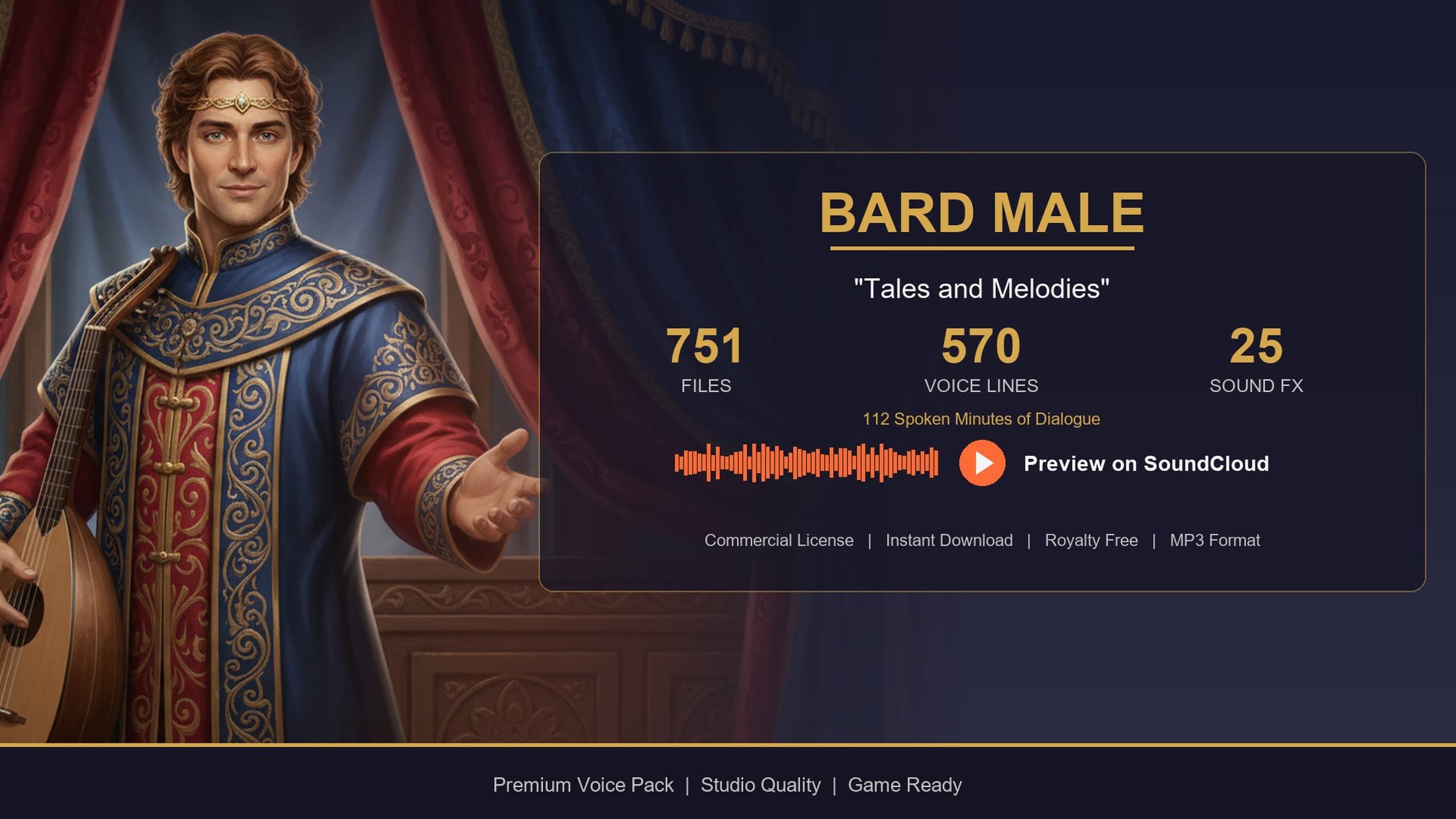
What the included songs are for
Most of the value people see in a bard voice pack is the spoken dialogue, but the Bard Dialogue Pack also ships 40 songs and theme tracks, and those are easy to overlook. They are not background filler. They are short, self-contained pieces of fantasy music meant to colour a moment: a tavern in full swing, a quiet campfire on the road, the swell behind a quest-giver's monologue, or the fanfare of a festival square.
If you have been searching for how to play a music track for a fantasy scene in Unreal Engine 5, the songs in this pack give you ready-made material so you do not have to compose or license anything separately. They live in the same content folder as the spoken lines. After you migrate the pack, look under the Audio folder, where the music sits alongside the Dialogue and VoiceFX clips. Every track is a USoundWave in PCM form, the same asset type as the dialogue, so anything you already know about playing a SoundWave applies directly.
One detail shapes how you use them: the audio is one-shot, with no loop points authored into the assets. A song plays from start to finish and stops. That is fine for a stinger, a cutscene cue or a one-off performance, and it changes how you handle anything that needs to run continuously, which the final section covers.
Triggering a theme on scene entry
The most common job is starting a track the moment the player arrives somewhere. The cleanest way to do that is a trigger volume around the area you want scored, wired to play the chosen song on overlap.
1. Drop a 'Box Trigger' (or 'Box Collision' component on a placed Actor) around the tavern, campfire or set-piece you want to score.
2. In the Actor's Event Graph, add an 'On Component Begin Overlap' node and branch so it only responds to your player pawn or character.
3. Reference the song you want from the pack's Audio folder. Because the pack drives audio through soft references, the tidy pattern is to expose a 'Sound Base' variable on the Actor, set it to the track in the editor, and call 'Load Synchronous' if you are holding it as a soft object pointer.
4. Play it with 'Play Sound 2D' for non-diegetic scoring that follows the player, or 'Spawn Sound at Location' (or an 'Audio Component' on a placed Actor) if the music should appear to come from a physical source such as a bard performing on a stage.
5. Store the returned 'Audio Component' reference so you can stop or fade the track later, for example on an 'On Component End Overlap' when the player leaves.
Routing the music through a dedicated 'Sound Class' and 'Sound Mix' at this stage pays off immediately: it gives you one master handle for music volume that is separate from dialogue and effects, which is exactly what you need for the next step.
Crossfading vocal lines over music
A bard scene is rarely just music. You will usually want the bard's spoken lines or sung verses to sit clearly on top of a softer instrumental bed. The bard's dialogue lives in the same pack, queried from the DT_Dialogue DataTable, so you can pull a line and play it over a track that is already running.
The technique is ducking: drop the music a few decibels while a line plays, then bring it back up. Put your music on its own 'Sound Class' and create a 'Sound Mix' that lowers that class's volume. When you start a dialogue line, push the mix with 'Push Sound Mix Modifier'; when the line finishes, pop it with 'Pop Sound Mix Modifier'. The 'Fade In Time' and 'Fade Out Time' on the mix give you a smooth dip rather than an abrupt drop, so the music breathes under the voice instead of cutting.
Because the dialogue clips are also one-shot SoundWaves, you know exactly when a line ends, which makes it straightforward to time the music coming back up. Bind an event to the dialogue Audio Component finishing, or use the line's known duration, and pop the mix there. The result is a scored conversation where the theme carries the mood and the spoken performance stays intelligible.
One-shot versus looped considerations
Because the songs are one-shot with no loop points, you have to decide per scene whether a track should play once or run for as long as the player stays. For a stinger, a fanfare, or a song the bard performs once during a cutscene, one-shot is exactly right: trigger it, let it finish, done.
For ambience that needs to persist, such as a tavern you can linger in, you have two honest options. The first is to play the track and set the Audio Component to loop, accepting that without authored loop points the seam at the wrap-around will be audible to a careful listener. The second, cleaner approach is to bind to the 'On Audio Finished' event on the Audio Component and restart the same track, optionally choosing a different song from the pool of 40 each time so the area does not feel repetitive. Cycling through several of the included themes keeps a hub area fresh across a long session.
Whichever you choose, keep the soft-reference habit: the SoundWaves are referenced as soft object pointers, so nothing is loaded until you resolve a track at play time, and a folder of 40 songs costs almost nothing at rest. Your concrete next step is to migrate the Bard Dialogue Pack into your project, open the Audio folder, drag one theme into a trigger volume around your tavern, and you will have a fantasy scene scored in a couple of minutes.
FAQ
How do I play a music track for a fantasy scene in Unreal Engine 5?
Reference a song from the Bard Dialogue Pack's Audio folder, then play it from a trigger volume on scene entry: use 'Play Sound 2D' for scoring that follows the player or 'Spawn Sound at Location' for a diegetic source. The pack ships 40 ready-made fantasy songs and theme tracks as USoundWave assets, so you do not need to compose or license music separately.
Are the bard pack's songs loopable?
The audio is one-shot with no loop points authored into the assets, so a track plays from start to finish and stops. For persistent ambience you can either set the Audio Component to loop and accept a small seam at the wrap-around, or bind to the 'On Audio Finished' event and restart, optionally rotating through different tracks from the pool of 40.
How do I keep dialogue audible over the music?
Use ducking. Put the music on its own Sound Class, create a Sound Mix that lowers that class's volume, and push the mix with 'Push Sound Mix Modifier' while a line plays, then pop it when the line finishes. Setting the mix's fade-in and fade-out times gives a smooth dip so the theme drops under the voice rather than cutting abruptly.
Where are the songs in the project?
After you migrate the pack, the music sits in the Audio folder alongside the Dialogue and VoiceFX clips. Each track is a USoundWave in PCM form, referenced via a soft object pointer, so nothing loads into memory until you resolve and play a specific track at runtime.
Bard Dialogue Pack
Quest-givers, tavern tales and travelling-minstrel banter — 112 minutes of professionally delivered bard dialogue for medieval and fantasy worlds. Plug the cues straight into your dialogue system.