comparison · 2026-04-21
Cheap Ground Mist in UE5: Niagara Drifting Fog vs Volumetric Fog
When localised plant-level mist needs to hug the ground, a CPU Niagara emitter often beats reaching for volumetric fog.
The real problem: localised mist, not whole-scene fog
You want a thin layer of mist drifting around the base of a few plants in a swamp, a glen, or a morning garden. You reach for volumetric fog because that is the headline UE5 atmosphere feature, and suddenly you are tuning a global fog volume, fighting light shafts that wash out your whole level, and watching your frame budget evaporate for an effect that should occupy a couple of square metres. That is the classic ue5 ground fog mist niagara vs volumetric fog performance trade-off, and the honest answer is that volumetric fog is frequently the wrong tool for plant-level mist.
Volumetric fog in UE5 is a scene-wide, camera-frustum volume that interacts with every shadow-casting light. It is superb for god rays, valley haze and atmospheric depth across a whole vista. But it is a global system: it does not naturally give you a tight pool of fog clinging to one toadstool while the rest of the clearing stays clear. To localise it you start layering Local Fog Volumes or height-fog tricks, and the authoring cost climbs quickly for a small, art-directed pool of mist.
A particle mist emitter inverts that. Instead of asking the renderer to fog the world and then carving out where you do not want it, you place the fog exactly where it belongs and nowhere else. Ambient Garden VFX takes that approach for its Mist family: low-lying, slowly-drifting ground fog that hugs the base of each plant, authored as CPU Niagara so you can drop it precisely where the art needs it.
How a CPU Niagara mist emitter hugs the ground
The Mist family in Ambient Garden VFX is one of three ambient effect families in the pack, applied across the full Fantasy Flower roster of 51 stylised flower and plant meshes. Every system is a content-only NiagaraSystem asset that simulates on the CPU and renders through the standard deferred path, so there is nothing to compile and no plugin to install. You drag the system into the level and it plays.
Because the effect is built from particles rather than a screen-space volume, the mist is genuinely local. The emitter spawns low and drifts slowly outward across the ground around the plant base, which is exactly the swamp or pre-dawn garden read you are usually after. You are not fogging the camera frustum, so distant geometry, your skybox and your sun shafts are untouched. What you place is what you get.
The pack ships its systems with a clear naming convention so you can find the right one fast. Mist systems live in the Mist subfolder of the pack's Niagara content and follow the NS_<flower>_<family> pattern, for example NS_blood_lotus_bloomingmotes for the motes family or the matching mist variant per flower. The Content Browser entries are prefixed by family, so you can filter the whole Mist set in one search rather than hunting per-asset.
There is no parameter tuning required for a default look. The systems render correctly at any world location, whether you sit them on the ground, lift them into mid-air, or parent them to a moving actor. That last point matters for set dressing: a mist system attached to a drifting platform or a slow-walking creature travels with it, something a static volumetric fog volume cannot do without extra setup.
When to use particle mist vs exponential height fog vs volumetric
These three techniques are not competitors so much as different scales of the same idea, and a good UE5 scene usually layers them. The trick is matching the tool to the footprint of the effect you want.
Reach for Exponential Height Fog when you want a cheap, global wash of atmosphere that fills low ground across the whole level and recedes with height. It is the baseline atmosphere layer and costs almost nothing. Reach for Volumetric Fog when you specifically need fog that scatters light, catches shadows and produces god rays through a forest canopy or a window, and you are happy for it to read across the whole frustum. Reach for a particle mist emitter when the effect is localised and art-directed: a pool of drifting fog around specific plants, props or a patch of swamp, where you want full control over exactly where the fog sits.
It is worth noting how Ambient Garden VFX itself is lit in its demos, because it shows the intended layering. The demo levels use a Movable Directional light with SkyAtmosphere, a SkyLight, Exponential Height Fog and a VolumetricCloud, with fully dynamic lightmaps and no baking. In other words the pack does not replace your atmosphere stack; the Niagara mist sits on top of a normal ExpFog-and-sky setup and adds the localised ground layer that those global systems cannot place precisely.
On the question of cost, be honest with yourself about scope. The pack documents that its systems are CPU emitters and that its demo maps cap placement at roughly 15 flowers per map to stay performant. We do not publish particle counts or frame numbers for the Mist systems, and you should not assume one: profile your own scene. The general principle still holds, though, that a handful of tightly-bounded local emitters gives you far more predictable, localised cost than asking the renderer to volumetrically fog an entire frustum.
Layering mist with other ambient and dark effects
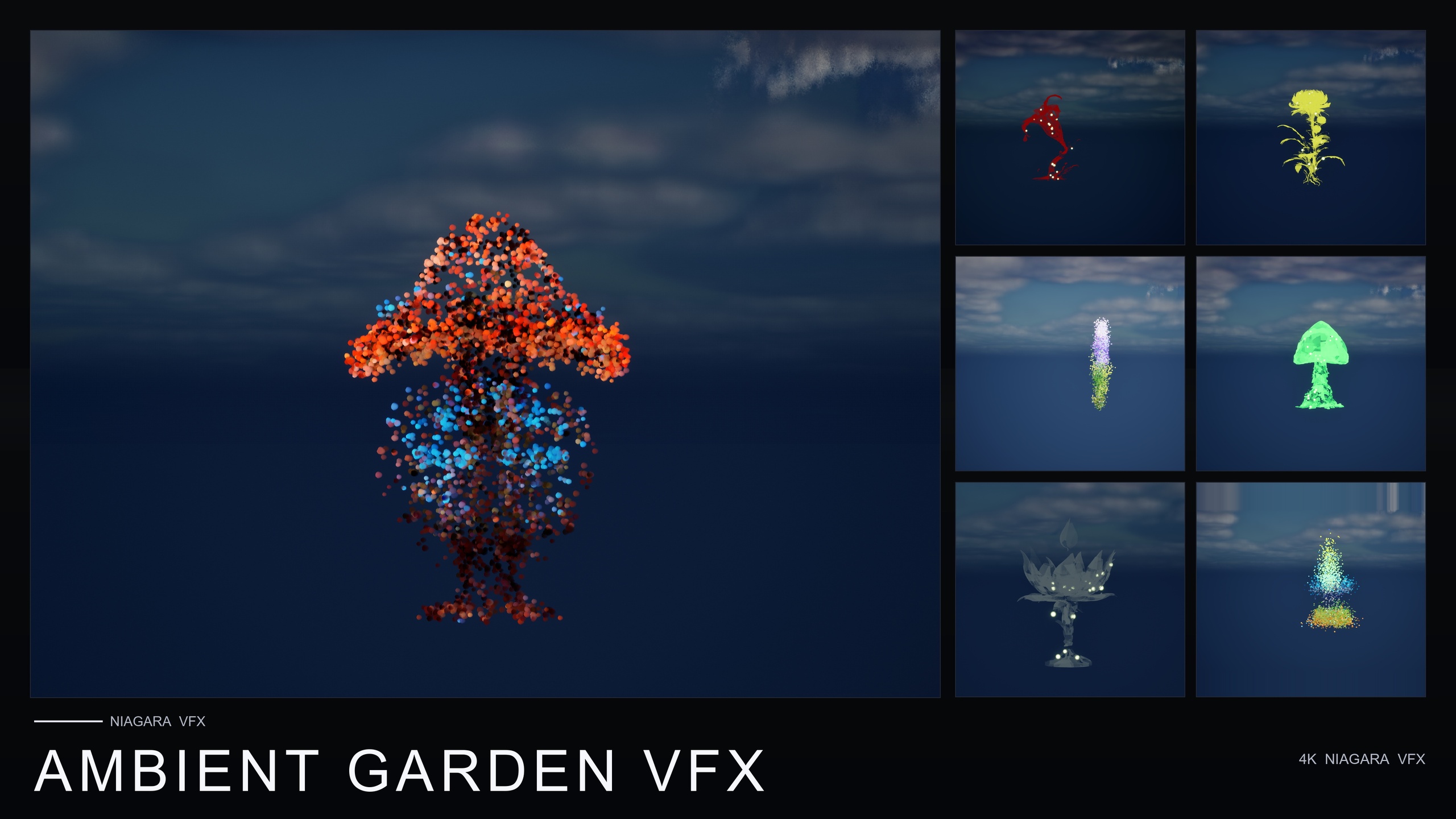
Ground mist rarely travels alone. Ambient Garden VFX is built as the broadest atmospheric set in the line precisely so you can stack reads on the same scene: the Mist family for the ground layer, BloomingMotes for soft floating pollen and light motes orbiting each flower, and FireflySwarm for warm flickering firefly trails for twilight and night. Because each is a separate NiagaraSystem, you can place a mist system and a motes system on the same flower and dial the mood from misty-morning to enchanted-dusk by choosing which families you drop in.
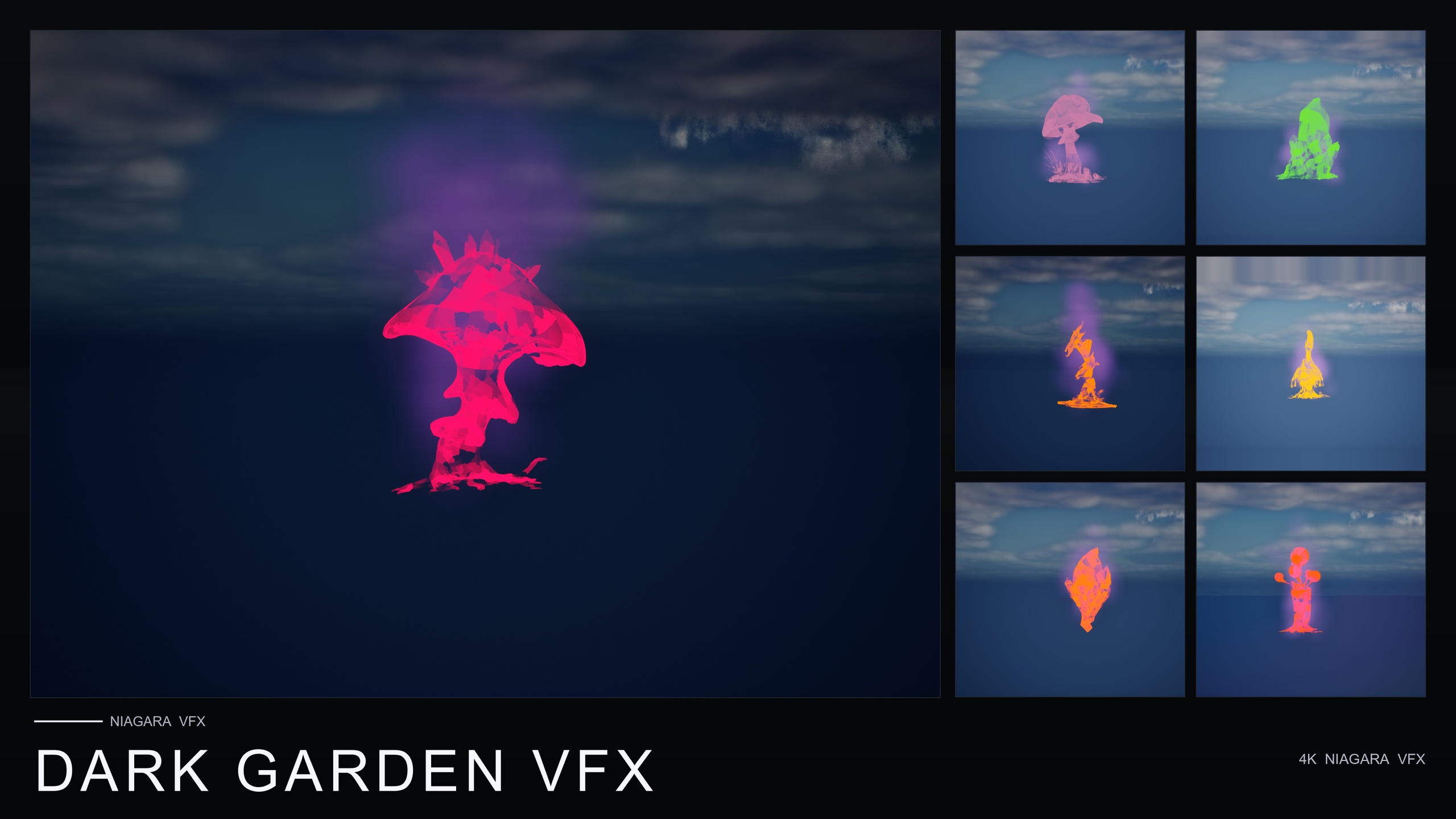
If your scene turns sinister, Dark Garden VFX is the villain counterpart. Its single BlackMist family wraps the same 51 meshes in slow-creeping, ground-hugging dark smoke for curse, corruption, necromancy and plague reads, and it is cross-pack compatible, so you can drop BlackMist over flowers that came from any other Fantasy Flower pack to corrupt a previously-clean garden for a plot beat. Where Ambient Garden's Mist reads as gentle morning fog, BlackMist reads as creeping blight on the same ground plane.
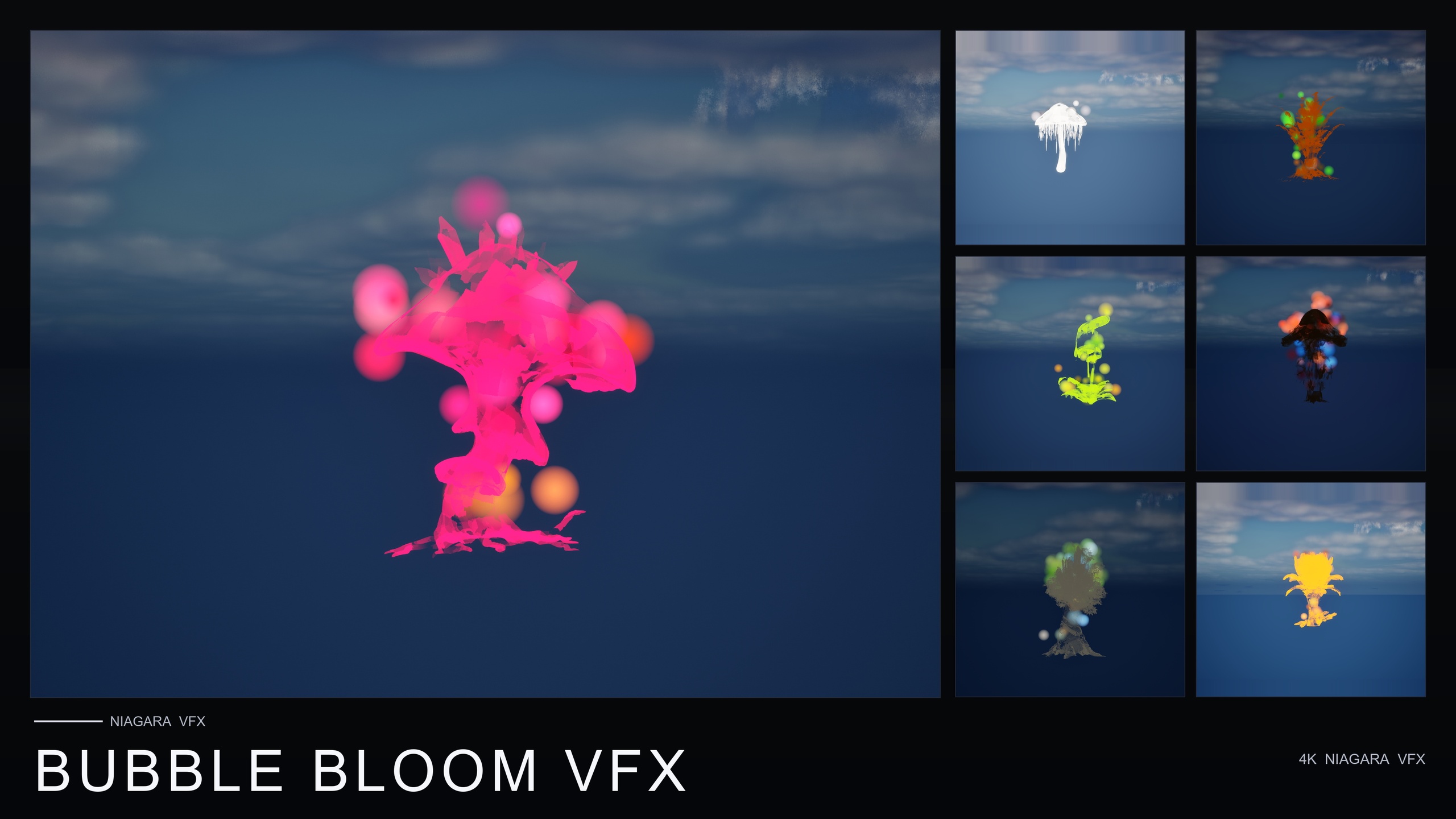
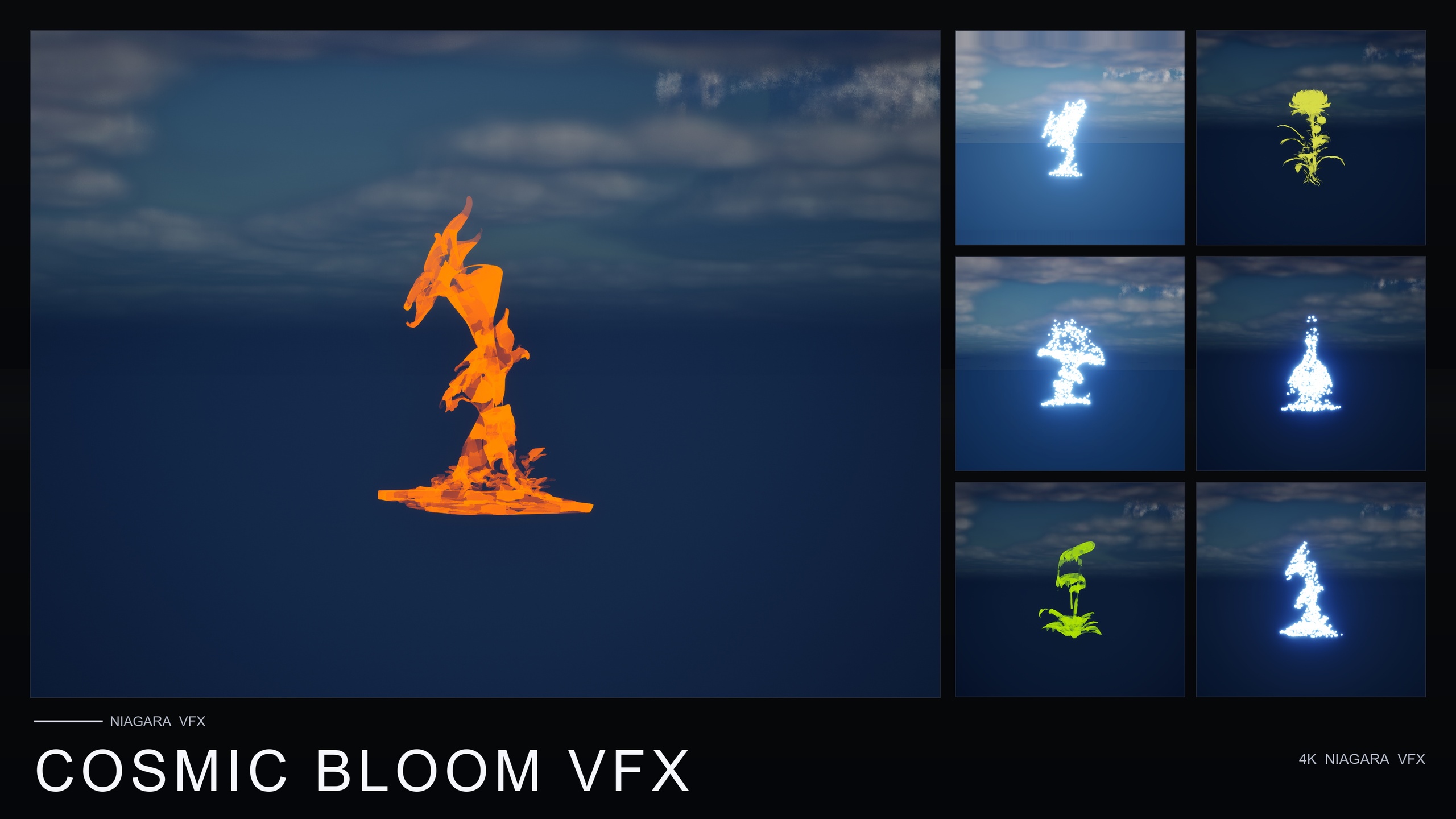
For lighter or more fantastical scenes, two siblings extend the same drop-in, content-only model. Bubble Bloom VFX rises translucent, rainbow-tinted soap-film bubbles from each flower base with built-in size, rotation and alpha variance, suiting whimsical fairy-magic and alchemy scenes. Cosmic Bloom VFX adds two celestial families, Constellation tracing each flower's silhouette in connected star points and LumenLight orbiting it with soft warm-white light puffs, for astral and divine-glow moments. All of these share the same 51-mesh roster, CPU sim target and zero-dependency install, so they layer cleanly with your mist.
Dropping it in: a quick workflow
1. Add Ambient Garden VFX to your project. It is content-only with no plugin dependencies, so there is no compile step and no engine modification; the assets simply appear in the Content Browser.
2. Open the AmbientGardenVFX Niagara folder, which is split into BloomingMotes, FireflySwarm and Mist subfolders, and select the Mist subfolder for ground fog.
3. Drag the NS_<flower>_<family> mist system for the plant you want into the level, or attach it to an actor. It plays automatically with no parameter tuning, and renders correctly whether placed on the ground, in mid-air, or parented to a moving actor.
4. Preview the intended look by opening the included demo map for the family, L_Demo_AmbientGardenVFX_Mist, which lays the flowers out under the pack's dynamic Movable Directional, SkyAtmosphere, SkyLight, ExpFog and VolumetricCloud lighting setup.
5. Layer as needed: keep your Exponential Height Fog for the global wash, reserve Volumetric Fog for genuine light-scattering god rays, and let the Niagara mist own the localised ground layer around your plants.
Ground mist: Niagara particle emitter vs Exponential Height Fog vs Volumetric Fog
| Technique | Footprint | Best for | Localised control | Light scattering / god rays |
|---|---|---|---|---|
| Niagara particle mist (Ambient Garden VFX Mist family) | Local, where you place it | Art-directed ground fog around specific plants, props, swamp patches; can parent to moving actors | High: exactly where the system sits | No (particle sprites, not a scattering volume) |
| Exponential Height Fog | Global, height-based | Cheap whole-level atmosphere wash that fills low ground and recedes with height | Low: it is scene-wide by design | Limited (volumetric component aside) |
| Volumetric Fog | Global, camera frustum | Light-scattering haze, god rays and shadowed atmosphere across the whole view | Low without extra local-volume setup | Yes: interacts with shadow-casting lights |
Guidance for localised plant-level mist in UE5. No FPS or particle-count figures are claimed; profile your own scene.
FAQ
For ue5 ground fog mist niagara vs volumetric fog performance, which should I use?
For a localised pool of mist around specific plants or a patch of swamp, a CPU Niagara particle emitter such as the Mist family in Ambient Garden VFX gives you tight, art-directed control with cost that scales with how much you place. Volumetric fog is a global, frustum-wide system better suited to light-scattering god rays and whole-scene haze. They are complementary, not interchangeable, and a typical scene layers both. Always profile your own scene rather than assuming a frame number.
Does the Mist effect require volumetric fog to be enabled?
No. The Mist family is built from CPU Niagara particles rendered through the standard deferred path, so it does not depend on volumetric fog. The pack's demo levels do use Exponential Height Fog and a VolumetricCloud as part of a normal sky and atmosphere setup, but the mist itself is a self-contained NiagaraSystem you can drop into any lit scene.
Will the mist fog up my whole level like volumetric fog can?
No. Because it is a particle effect placed where you put it, the mist stays local to the plant base and drifts outward slowly across the ground. Your skybox, distant geometry and existing atmosphere are untouched, which is the main reason to choose particle mist over a global fog volume for plant-level effects.
Can I attach the mist to a moving object?
Yes. The systems render correctly at any world location and can be parented to a moving actor, so the mist travels with a drifting platform or a slow-moving creature. A static volumetric fog volume cannot follow an actor without additional setup.
What engine versions and platforms does Ambient Garden VFX support?
The pack is documented as compile-clean on UE 5.4 and opens cleanly on later versions, with the product listing stating UE 5.4 to 5.7 and the source listing stating UE 5.4 and up. Listed platforms are Windows, Mac and Linux. It is content-only with no plugin dependencies, so there is no compile or engine modification step.
Ambient Garden VFX
Bring outdoor scenes alive with 150 ambient Niagara effects — drifting pollen, fireflies, floating spores and mist — across 51 meshes and 131 material instances. CPU-simulated for Windows, Mac and Linux.