article · 2026-04-19
LumenLight Particles vs Lumen Global Illumination: What's the Difference?
Two unrelated things in UE5 carry the word 'Lumen' — one is Epic's lighting system, the other is a Niagara glow effect. Here's how to keep them straight.
Two unrelated things named 'Lumen' in UE5
If you have searched around the UE5 lumen light particles vs lumen GI question and come away confused, you are not misreading anything — the name really is overloaded. There are two completely different things in the Unreal world that share the word 'Lumen', and they have nothing to do with each other beyond the marketing-friendly Latin for light.
The first is Lumen, Epic's real-time global illumination and reflections system that shipped with UE5. It is an engine feature you switch on in your project settings, and it changes how bounced light, indirect shadows and reflections are computed across your whole scene. The second is LumenLight, the name of a Niagara effect family inside the Cosmic Bloom VFX pack — a set of particle systems, not a lighting renderer.
The confusion is understandable because both are 'about light' and both make scenes look glowier. But one is a global rendering pipeline and the other is a content asset you drag into a level. Getting clear on which one a tutorial or product is talking about saves a lot of wasted setting-hunting. This article draws the line cleanly.
What Lumen global illumination actually is
Lumen GI is Epic's dynamic global illumination solution built into UE5. It calculates how light bounces around your environment in real time, so a red wall tints the floor next to it, a sunlit doorway spills soft light into a dark room, and reflections update as objects move. You enable it through the engine's lighting settings on the project or post-process volume; you do not import it as an asset.
Because Lumen is fully dynamic, it removes the old workflow of baking static lightmaps and waiting on long light builds. That is a property of the engine's renderer, and it applies to your entire scene regardless of which meshes or effects you place in it. If someone tells you to 'turn on Lumen' or 'configure Lumen quality', they are talking about this engine system in your settings — there is nothing to drag into the viewport.
Crucially, Lumen GI is not something a content pack ships or requires you to configure in any particular way. A drop-in VFX pack can look great in a Lumen-lit scene, but that is a description of the surrounding lighting, not a dependency. Keep that separation in mind whenever a product mentions a 'Lumen-lit' look.
What the LumenLight particle family actually is
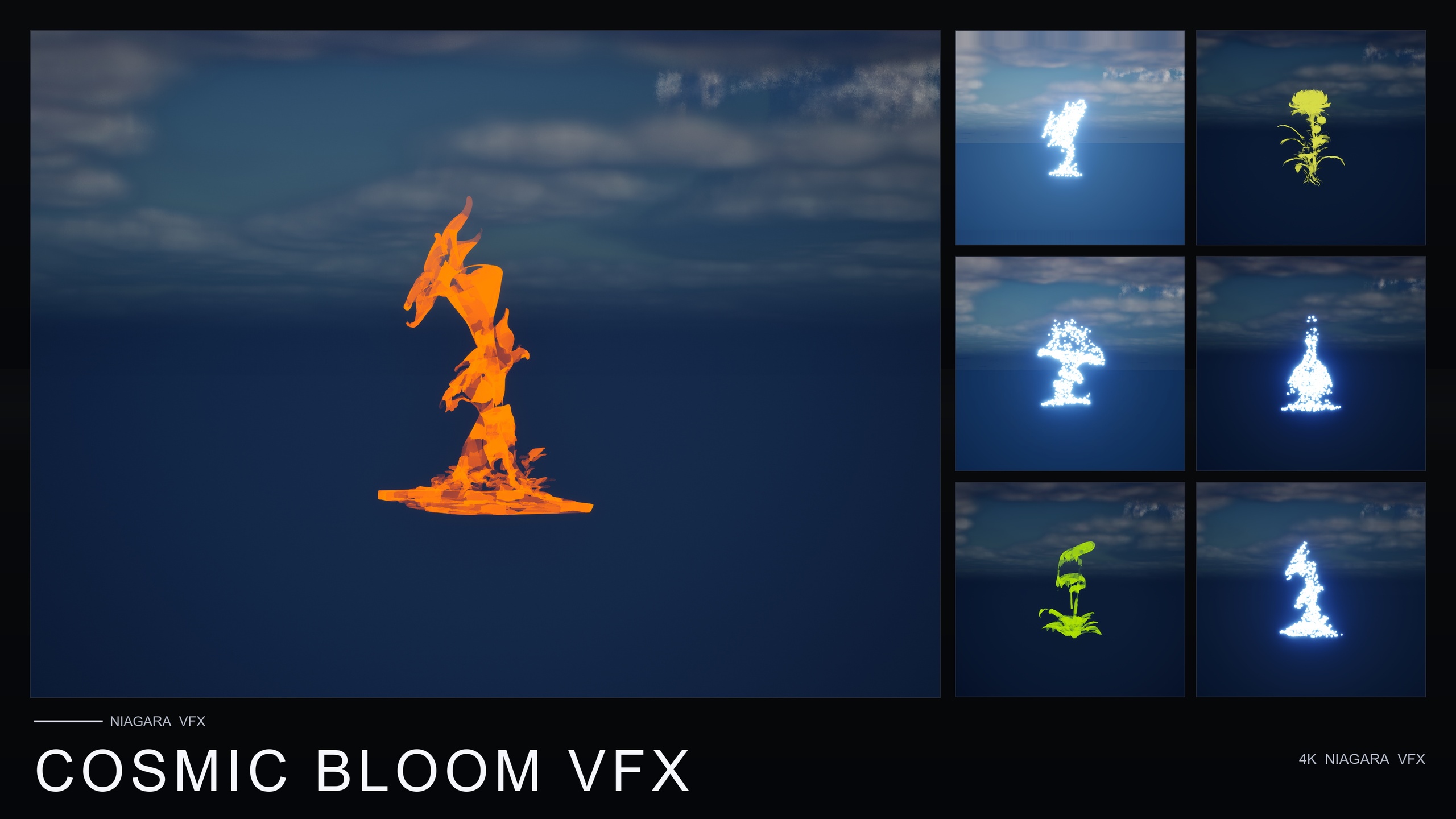
LumenLight is one of the two Niagara effect families inside Cosmic Bloom VFX, a content-only pack from MythicLemon. The LumenLight family is made of soft warm-white volumetric light puffs that orbit each flower in a slow, calming dance — the effect reads as bio-luminescence, a divine glow, or astral resonance depending on the scene you drop it into. It is a particle effect, full stop. It has nothing to do with the global illumination system.
The pack wraps every one of its 51 stylised flower meshes in two complementary families, producing 100 ready-to-use NiagaraSystems in total. The other family is Constellation, which traces each flower's silhouette with bright star-point particles connected by subtle line segments, with a slow twinkle and gentle parallax. Constellation gives you the silhouette read; LumenLight gives you the soft halo. They are designed to be layered on the same flower.
Technically, LumenLight is a CPU Niagara effect on a deferred render path, and the pack ships no C++, no Blueprints and no plugin dependencies. The flower materials and demos use dynamic lightmaps, so there is no light build to wait on. In other words, despite the name, LumenLight is firmly in the 'content you place' category, not the 'engine system you configure' category.
Where the naming overlap genuinely earns its keep is the look: a pack marketed as 'Lumen-lit' is pointing at the soft volumetric LumenLight glow, not promising a specific Lumen GI configuration. The two simply pair well — warm particle puffs reading beautifully against a dynamically lit scene.
How the particle glow interacts with your lighting
Because LumenLight is a Niagara effect rather than a lighting feature, it behaves like any other particle system in your scene. You enable Lumen GI (or not) in your project settings independently, and you drag a LumenLight NiagaraSystem into the level separately. Neither switches the other on. That independence is the whole point of telling them apart.
To use the effect, add the pack and browse the CosmicBloomVFX/Niagara folder, which is split into Constellation and LumenLight. Drag a LumenLight system onto a flower or actor to get the soft warm halo, and optionally layer a Constellation system on the same bloom for the star-traced silhouette. No parameter tuning is required — the twinkle randomisation is baked per particle for organic motion.
1. Add Cosmic Bloom VFX to your project and open the CosmicBloomVFX/Niagara folder in the Content Browser.
2. Open the LumenLight subfolder and drag the system for your chosen flower onto the flower mesh or actor in the viewport.
3. To layer the silhouette read, drag the matching Constellation system onto the same bloom — the two families are built to sit together.
4. Preview the result in the included per-family demo maps, where flowers are laid out under dynamic sky lighting so you can see the glow in context before placing your own.
Whether your scene uses Lumen GI or a more traditional dynamic setup, the LumenLight puffs render the same way: as warm volumetric particles that sit on top of whatever lighting you have chosen. Decide your global illumination strategy as an engine concern, then place the particle glow as a dressing pass — they are two separate decisions that happen to share a word.
Lumen GI versus the LumenLight effect family
| Aspect | Lumen (global illumination) | LumenLight (Niagara family) |
|---|---|---|
| What it is | Epic's real-time GI and reflections system | A Niagara particle effect family in Cosmic Bloom VFX |
| Where it lives | Engine / project lighting settings | CosmicBloomVFX/Niagara/LumenLight content folder |
| How you use it | Enable and tune it in settings | Drag a NiagaraSystem into the level |
| What it produces | Bounced indirect light and reflections across the scene | Soft warm-white volumetric light puffs orbiting a flower |
| Dependency | Built into UE5 | Content-only; no C++, Blueprints or plugins |
One is an engine renderer you configure; the other is a Niagara content asset you place.
FAQ
Is UE5 lumen light particles vs lumen GI actually the same thing?
No. Lumen GI is Epic's built-in global illumination and reflections system that you enable in your project settings. LumenLight is the name of a Niagara particle family in the Cosmic Bloom VFX pack that produces soft warm-white volumetric light puffs. They share a word and nothing else.
Does the LumenLight effect family require Lumen global illumination to be turned on?
No. LumenLight is a content-only CPU Niagara effect with no plugin dependencies. It renders as particles on top of whatever lighting your scene uses. A 'Lumen-lit' description refers to the soft volumetric glow of the effect, not a required Lumen GI configuration.
What does the LumenLight family look like in a scene?
Soft warm-white volumetric light puffs that orbit each flower in a slow, calming dance. Depending on context it reads as bio-luminescence, a divine glow, or astral resonance. It pairs with the Constellation family, which traces each flower's silhouette with connected star-point particles.
How many effects come in Cosmic Bloom VFX?
The pack wraps 51 stylised flower meshes in two families — Constellation and LumenLight — for 100 ready-to-use NiagaraSystems in total. It is content-only with no C++, Blueprints or plugin dependencies, and the systems sit in folders split by family.
Do I need to bake lighting to use the effect?
No. The pack's flowers and demos use dynamic lightmaps, so there is no light build to wait on. You drag a LumenLight NiagaraSystem onto a flower or actor and it plays, independent of whatever global illumination setup your scene runs.
Cosmic Bloom VFX
100 ready-to-use Niagara systems — constellations, drifting starlight and Lumen-lit blooms — across 51 stylised flower meshes and 131 material instances. CPU-simulated for Windows, Mac and Linux, with two demo levels included. Content-only: no C++, no Blueprints, no plugin dependencies.