article · 2026-05-02
Five Ancient Scripts for Game Worlds: Cuneiform, Hieroglyphics, Mayan, Ogham, Phoenician
A working reference to the five real writing systems in the Niagara Ancient Scripts Pack, and how to set-dress each one without breaking the fiction.
Why ancient writing is the cheapest worldbuilding you can ship
When a player rounds a corner and sees marks carved into a wall, they read the room before they read the marks. A line of wedge-pressed clay says Mesopotamia; a column of birds and eyes says Egypt; a stack of strokes biting across a stone edge says Iron Age Ireland. The writing system itself is doing the storytelling, and it does it faster than any voice line or codex entry can.
That is exactly why a reference to ancient writing systems for games is worth keeping at hand. You do not need to be a palaeographer to use these scripts well, but you do need to know what each one signals, where it belongs historically, and what it must never sit next to. Mix the wrong scripts in the wrong room and an attentive player feels the seam even if they cannot name it.
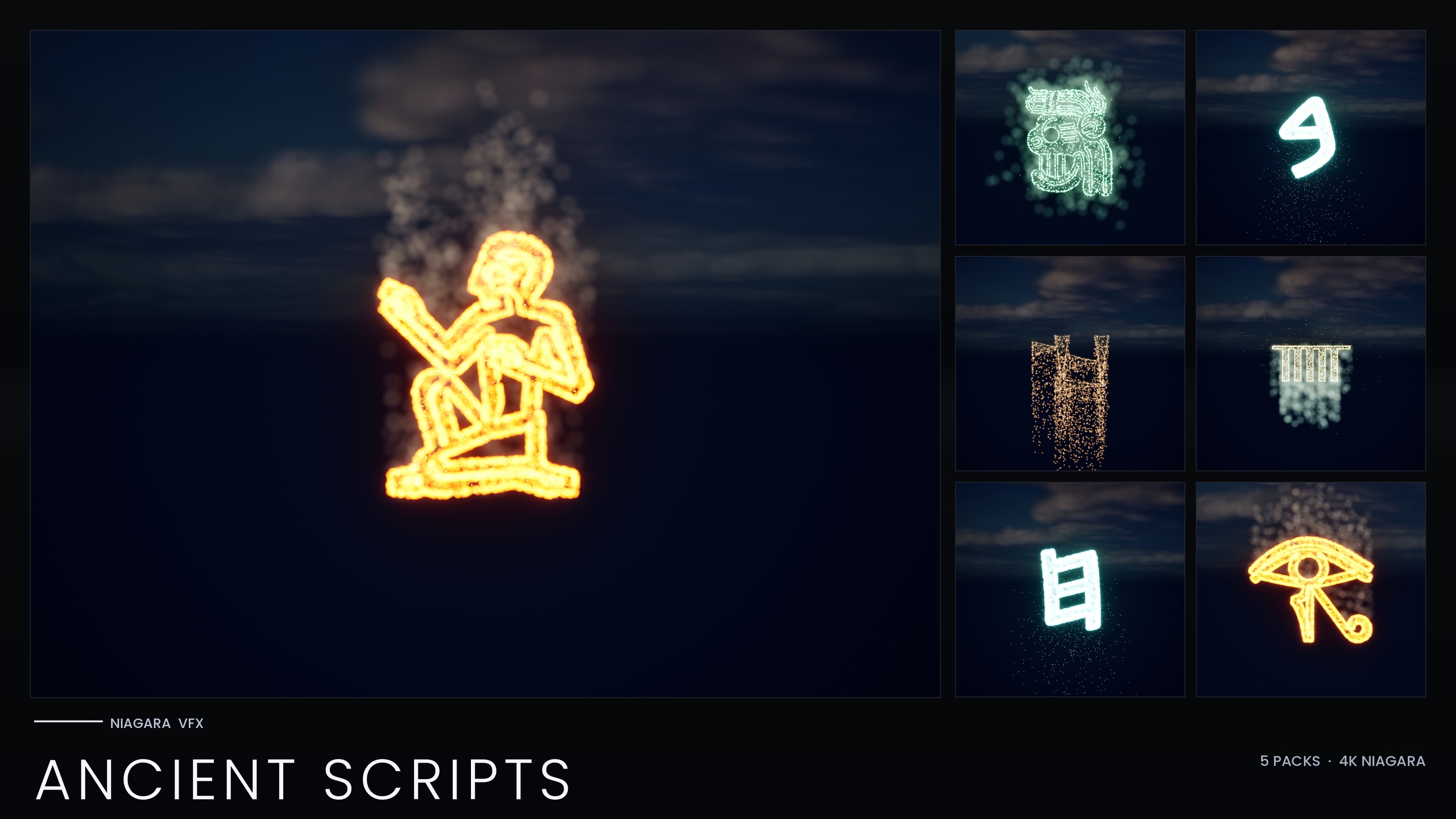
This article walks through the five real scripts in the Niagara Ancient Scripts Pack: Egyptian Hieroglyphics, Cuneiform, Mayan, Ogham and Phoenician. The pack ships every glyph of each script twice over, once as an independently spawnable Niagara System and once as a matching static mesh, so you can compose actual inscriptions rather than loop a single stock asset. We will cover what each script is, how it reads on screen, how to dress a scene around it, and how to combine scripts in one world without breaking the fiction.
What is in the pack, in concrete terms
The Ancient Scripts Pack is a content pack, not a code plugin. It contains 114 Niagara Systems and 114 matching static meshes drawn from five source fonts, one per script. Every glyph exists in both forms: drag the NS_ Niagara System into a level to get an animated, glowing inscription, or place the matching static mesh to carve the glyph physically into a wall and light it with an emissive.
Each script shares a single unified Niagara backbone, and the pack includes a Niagara Parameter Collection so an entire script can be recoloured or re-timed from one asset edit. Swap a tomb's amber burn for a curse-blue glow once, and every glyph in that script follows. The effects are CPU-simulated and use Unreal's default materials only, which means zero custom materials, zero material instances and zero textures, keeping the footprint small.
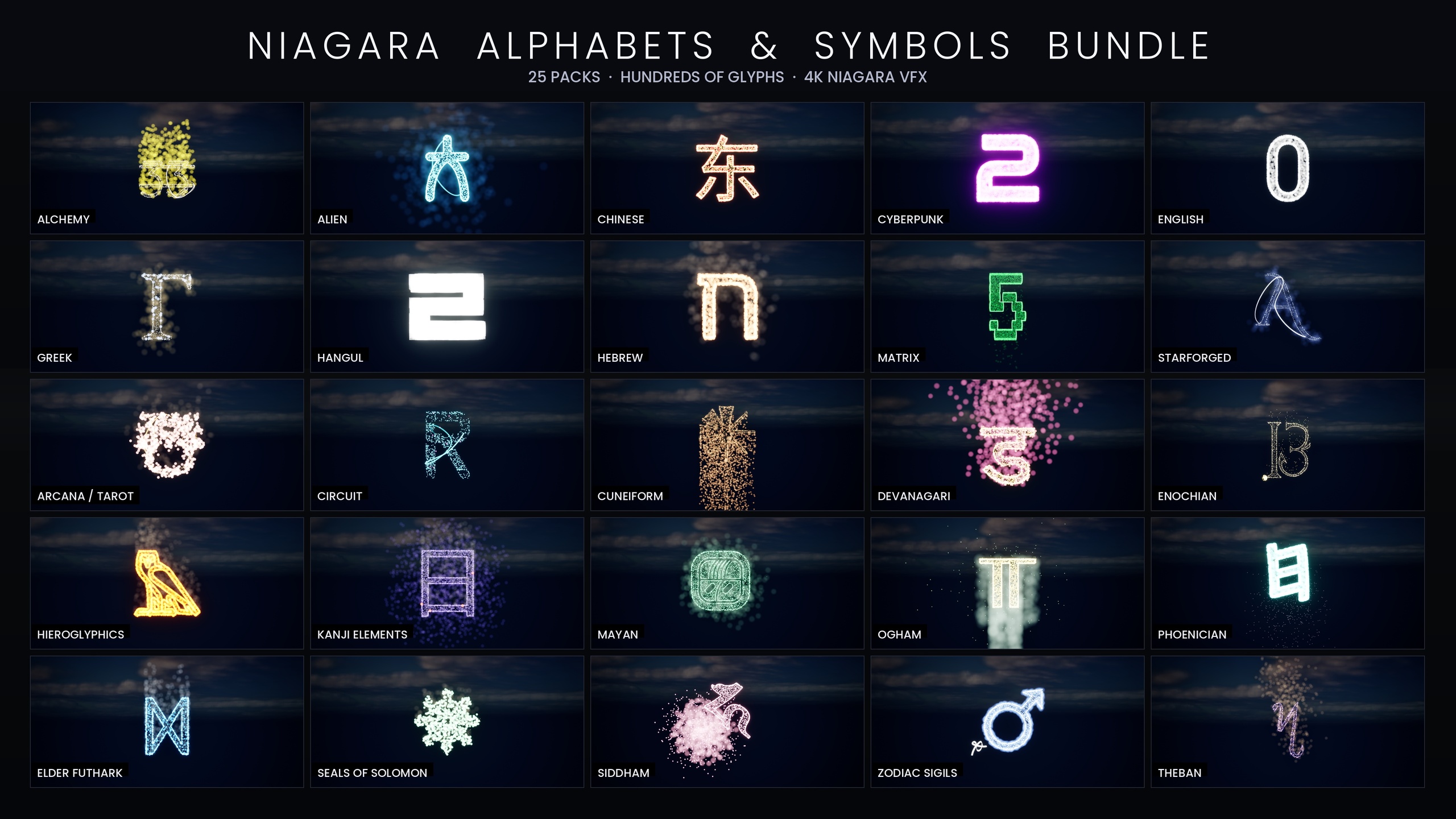
To keep particle load manageable during preview, the demo content is split across five maps, one per script. Open the map for the culture you are building and you will see that script's glyphs laid out and lit. The exact per-script split is roughly Cuneiform 24, Hieroglyphics 19, Mayan 26, Ogham 24 and Phoenician 22 glyphs, drawn from the catalogue; treat those as approximate rather than a precise sum, since the documented standalone total for the pack is 114 systems. The pack itself is a thematic subset of the larger Alphabet and Symbols bundle.
The five scripts and where each one belongs
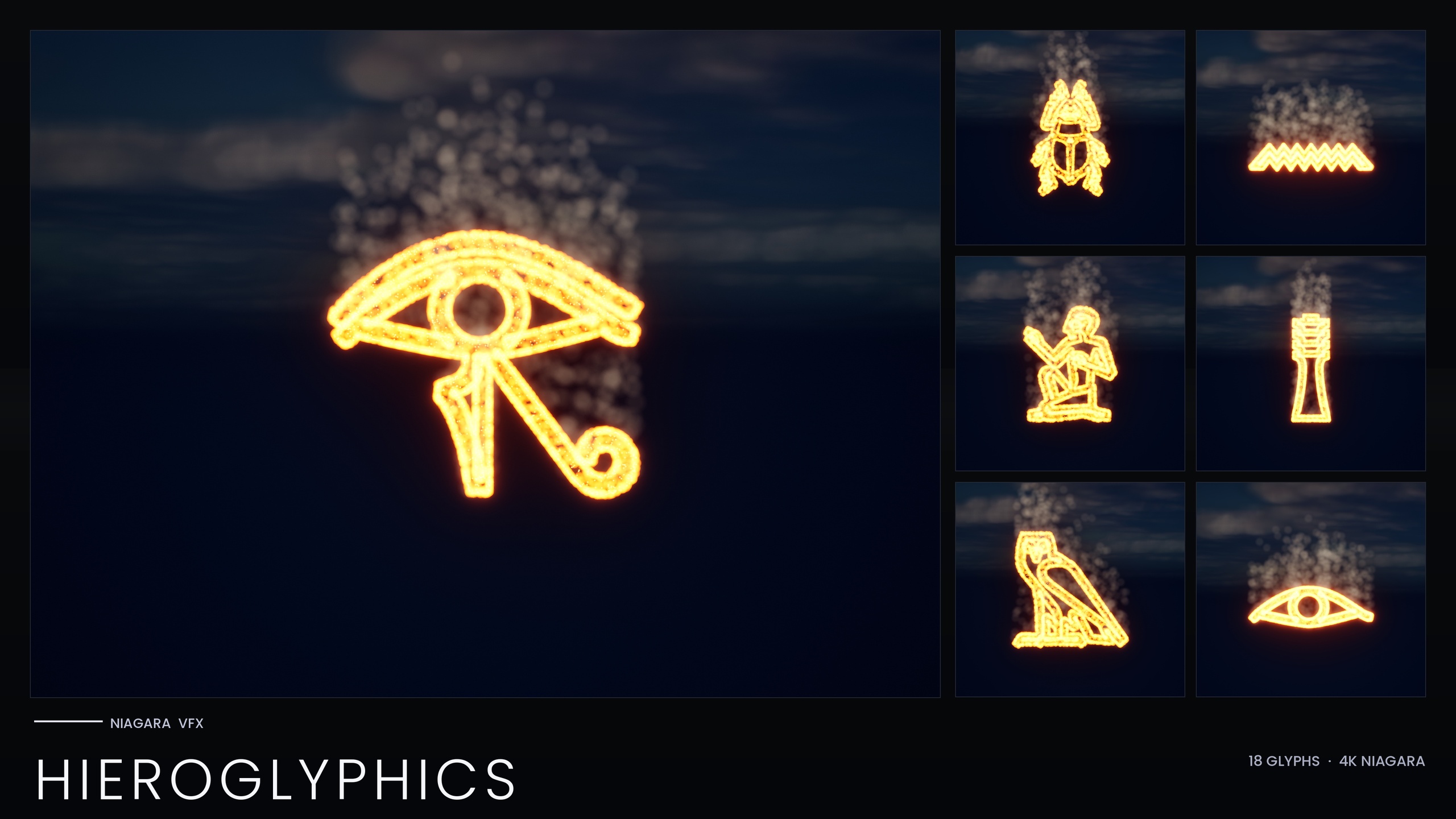
Egyptian Hieroglyphics is the monumental script: pictographic, formal, carved into temple walls and tombs and arranged in vertical columns or framed cartouches. On screen it reads instantly as ancient Egypt, which is both its strength and its trap. Use it for sarcophagus reveals, pyramid-passage inscriptions and pharaoh cartouches, and resist the urge to use it anywhere that is not unmistakably Nile-valley.
Cuneiform is the wedge script of Mesopotamia, pressed into wet clay by the Sumerians and Akkadians rather than carved. It is the oldest writing system here and the most abstract to a modern eye, all angular impressions rather than recognisable pictures. It belongs on clay tablets, royal proclamations and incantation reveals in a Tigris-Euphrates setting, and it is the right choice when you want writing that feels primordial rather than decorative.
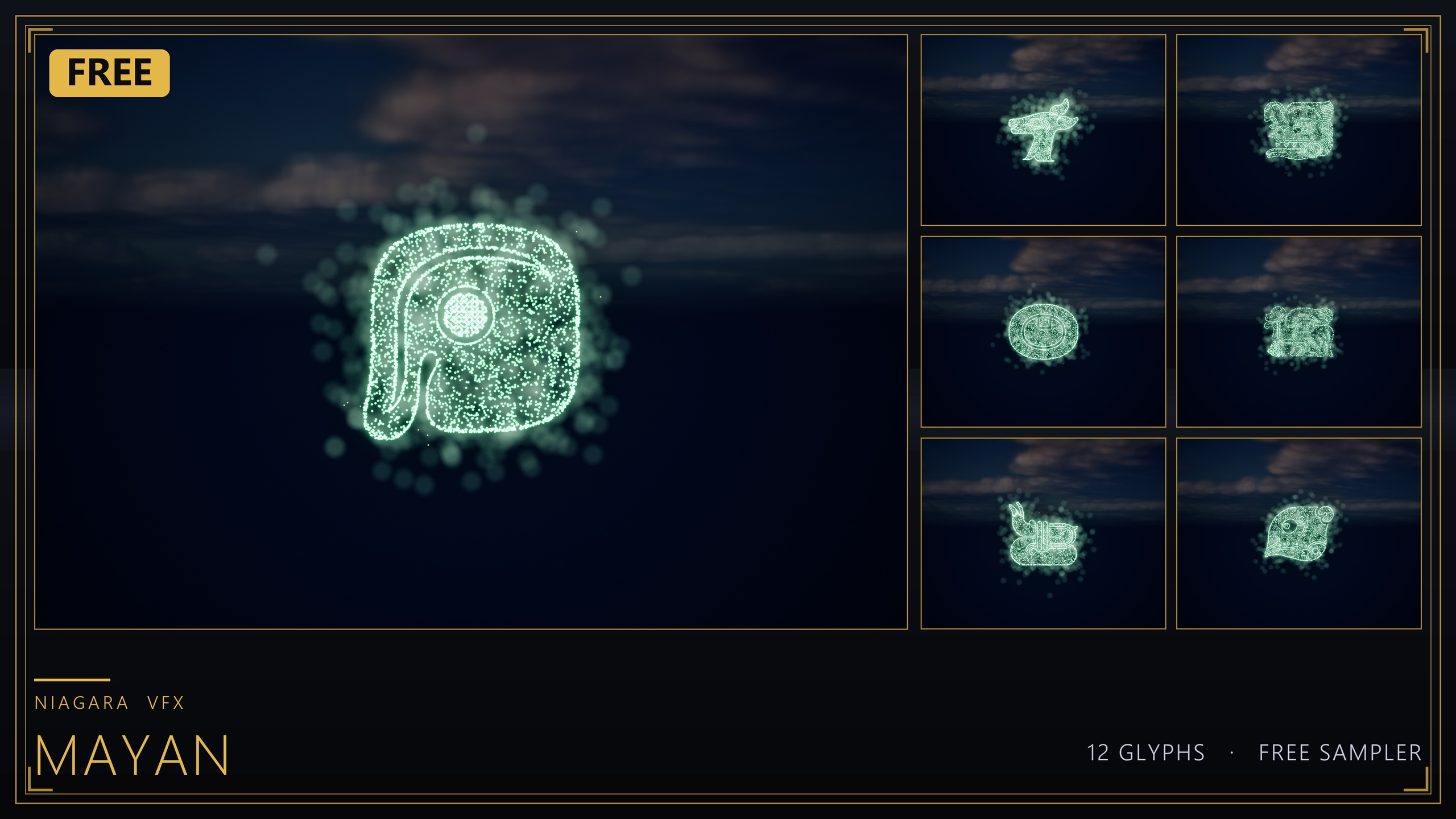
Mayan is the Mesoamerican logo-syllabic script: dense, rounded, block-like glyphs that pack into rectangular cells. It signals jungle-canopy temples, codex pages and ballcourt friezes, a world apart from the Old World scripts. Reserve it for Mesoamerican ritual and discovery scenes.
Ogham is the odd one out and the most useful for that reason. It is an early Irish script made of straight strokes cut across or beside a central stem line, traditionally read up the edge of a standing stone. It reads as Celtic, druidic and cold-climate, and it is perfect for mark-stones, ritual circles and anything that needs to feel like the far edge of the known world rather than a sun-baked empire.
Phoenician is the quiet hinge of the whole set: a Mediterranean proto-alphabet, the trader's script that seeded later alphabets. It is spare and linear where the others are pictorial or monumental, and it belongs on merchant scrolls, trade manifests and harbour-town set-dressing. If your world has shipping lanes and ledgers, Phoenician is the script that makes commerce feel old.
Visual identity per script: how each one reads on screen
Because every script in the pack runs on the same Niagara backbone and draws its look from a Parameter Collection, you control identity mainly through colour, timing and placement rather than through bespoke per-glyph art. That is a feature: it keeps the five scripts visually coherent as a family while letting you pull each one in a distinct direction.
Lean into the cultural colour associations players already carry. Warm amber and ember tones suit Egyptian and Mayan stonework and torch-lit interiors; cold blues and greens read as cursed, magical or druidic and suit Ogham mark-stones and any haunted inscription. Cuneiform sits well in dim, earthy clay tones that suggest a tablet rather than a glowing rune. Phoenician, being the mundane working script, often reads best with the most restrained, ink-like treatment.
Whichever direction you choose, the glow in these systems comes from HDR colour values driving Unreal's bloom, so keep bloom enabled in your post-process volume or the inscriptions will look flat. When in doubt, keep the HDR intensity modest so bloom tints the glyph rather than blowing it out to white.
Set-dressing ideas per culture
For Egypt, carve a cartouche into a tomb wall using the static meshes and leave it dark until the player's torch comes close, then spawn the matching Niagara Systems to make the glyphs ignite in sequence as a reveal. The same trick drives sarcophagus reveals and pyramid-passage cinematics, and a mummy-curse beat lands well when the hex appears to manifest as living, moving text.
For Mesopotamia, the clay tablet is your hero prop. Place static-mesh cuneiform on a tablet surface, then trigger the Niagara version for an incantation or a royal proclamation that lights up as it is read aloud. Cuneiform reveals feel right when they emerge slowly, as if pressed back into the clay.
For the Maya, dress pyramid friezes, ballcourt walls and codex pages with the static meshes, and use the spawnable systems for ritual-glyph activations and lost-city discovery moments where a symbol assembles itself out of particles. The same approach turns a jungle-expedition lore drop into a set-piece.
For the Celts, an Ogham mark-stone or a druidic ritual circle gives you a strong silhouette before a single glyph lights. Run the strokes up the stone's edge as the tradition demands, and reserve the glowing Niagara reveal for the moment of ritual. For the Phoenicians, lean domestic and commercial: merchant scrolls, trade manifests and harbour set-dressing, where the writing is incidental texture rather than a magical reveal. Across all five, the pack's static meshes carve real inscriptions and the Niagara Systems handle anything that needs to move, glow or react.
Combining scripts in one world believably
The temptation in a fantasy world is to throw every ancient script onto the same dungeon wall because they all look old. Players who notice will read it as a costume box rather than a history, so the safer instinct is one script per culture and one culture per room. Let the writing system mark territory the way architecture and music do.
When you do want more than one script visible at once, give the mixing a diegetic reason. A trade-route waystation, a harbour customs house or a comparative-archaeology museum exhibit can plausibly carry Phoenician manifests beside Egyptian or Mesopotamian goods, because trade is exactly what put those scripts in contact historically. Phoenician is the natural bridge here precisely because it was the merchant alphabet of the Mediterranean.
A scholar's study, a wizard's library or a dig-site catalogue room is another honest place to gather scripts, because the in-world premise is that someone collected them. In those scenes, vary the treatment per script rather than glowing everything identically: let the museum's working notes sit in restrained Phoenician while the cursed artefact behind glass burns in blue Ogham. The contrast does the storytelling.
Mechanically, mixing is easy. Because each script reads its style from its own slice of the Niagara Parameter Collection, you can tune several scripts side by side in one map without them bleeding into each other. The pack deliberately splits its own demo content across five maps to keep per-map particle load manageable, so when you assemble a multi-script scene, spawn a sensible number of systems at once rather than lighting every glyph in the room simultaneously.
Working with the pack: a practical first pass
1. Add the content pack to your project, then open the demo map for the script you want, for example the Egyptian map, to see those glyphs lit and arranged.
2. To compose an inscription, drag the individual 'NS_' Niagara Systems for the glyphs you need into the level, or spawn them from Blueprint with the 'Spawn System at Location' node attached to the prop they belong to.
3. To style the whole script at once, open the pack's Niagara Parameter Collection and edit the colour and timing parameters; every glyph in that script follows the change, so you can shift a tomb from amber to curse-blue in a single edit.
4. For carved inscriptions, place the matching 'SM_Glyph_' static meshes into walls, tablets or stones and light them with an emissive material, then layer the Niagara Systems on top only where you want movement or a reveal.
5. Confirm bloom is enabled in your post-process volume so the HDR-driven glow renders, and keep the HDR intensity modest so the glyphs tint rather than wash out.
If you only need one culture, two of these scripts are available as smaller standalone products that share the same workflow. The Niagara Hieroglyphics Pack is the focused Egyptian entry point, an 18-glyph set built from three emitters per glyph, an ember core, a red-orange glow halo and a slow smoke column, all driven by a single 'NPC_HieroglyphicsStyle' Parameter Collection. The Niagara Mayan Glyphs sampler is free and gives you 12 of the 26 Maya glyphs under the standard Fab licence, with a direct upgrade path into this pack. And if you need far more than five scripts, the Ancient Scripts Pack is a subset of the full Niagara Alphabet and Symbols Bundle, which spans 687 systems across 25 themed sets including runes, sci-fi, occult and more.
The five scripts at a glance
| Script | Culture / era | Reads on screen as | Best set-dressing |
|---|---|---|---|
| Egyptian Hieroglyphics | Ancient Egypt, monumental | Pictographic, formal, carved | Tombs, sarcophagi, cartouches |
| Cuneiform | Sumerian / Akkadian Mesopotamia | Abstract wedge impressions | Clay tablets, royal proclamations |
| Mayan | Mesoamerican, logo-syllabic | Dense rounded glyph blocks | Pyramid friezes, codices, ballcourts |
| Ogham | Early Irish, stroke-marks | Strokes up a stone edge, Celtic | Mark-stones, druidic ritual circles |
| Phoenician | Mediterranean proto-alphabet | Spare, linear, trader's script | Merchant scrolls, trade manifests |
Per-script glyph counts are from the source catalogue and are approximate; the documented standalone pack total is 114 systems. Each glyph ships as both a Niagara System and a static mesh.
FAQ
What is the best reference to ancient writing systems for games?
For a practical, build-ready reference to ancient writing systems for games, work from the five real scripts in the Niagara Ancient Scripts Pack: Egyptian Hieroglyphics, Cuneiform, Mayan, Ogham and Phoenician. Each one signals a specific culture and era on screen, and the pack ships every glyph as both a spawnable Niagara System and a carve-able static mesh so you can compose authentic inscriptions rather than reuse a single stock loop.
Are these scripts historically accurate writing systems?
Each script is built from a real source font for that writing system: Egyptian hieroglyphics, Mesopotamian cuneiform, Mesoamerican Maya glyphs, early Irish Ogham and the Phoenician proto-alphabet. They give you authentic glyph shapes for set-dressing. They are a visual reference for worldbuilding, not a translation tool, so use them to evoke a culture rather than to encode literal sentences.
Can I recolour a whole script at once?
Yes. Each script shares one Niagara backbone and reads its style from the pack's Niagara Parameter Collection, so editing that collection recolours and re-times every glyph in the script from a single asset. For example you can switch a tomb's amber burn to a curse-blue glow in one edit. Per-glyph overrides are still possible where you need one symbol to stand out.
Do I need to set up custom materials or textures?
No. The pack is CPU-simulated and uses Unreal's default materials only, with zero custom materials, material instances or textures. The glow comes from HDR colour values driving Unreal's bloom, so the main requirement is to keep bloom enabled in your post-process volume.
Is there a free or smaller way to try this style first?
Yes. The Niagara Mayan Glyphs sampler is free under the standard Fab licence and gives you 12 of the 26 Maya glyphs with the same workflow. The Niagara Hieroglyphics Pack is a focused 18-glyph Egyptian standalone. Both share their workflow with the Ancient Scripts Pack, which itself is a subset of the full Alphabet and Symbols Bundle.
Niagara Ancient Scripts Pack
114 Niagara glyph systems across five ancient scripts — Cuneiform, Hieroglyphics, Mayan, Ogham and Phoenician — for rituals, spells and mystical UI. CPU-simulated with a Parameter Collection and demo map.
Related on Fab
Related reading