01
Five ways to start a building
Presets (House, L-Shape, Gable Cottage, 3-Storey Block, Setback Tower, Castle, Log Cabin, Round Tower), a true-to-scale 2D Sketch canvas, a floor-plan image, a plain-English description, or your own modular meshes via Kit Mode. They all converge on the same editable building file.
02
Multi-volume composition & character
Compose castles, round towers, gatehouses and wings from several volumes — not just single boxes. Add stacked-log or timber wall styles, crenellation and cornice detail bands, arcs and round towers, and a subtle stylize deformation for a less machine-made look.
03
Kit Mode — tile your own meshes
Tile your log, brick, stone or sci-fi modular meshes (your own kit, marketplace packs, or Quixel/Megascans) onto walls, floors, ceilings and interior walls, with correct placement and pivots. Tile repeats at natural size with integer fill; Stretch scales one instance. Roof and trim stay procedural so they always close cleanly.
04
Optional AI input, bring-your-own-key
Draft from Text and Draft from Image read your sentence or floor plan into an editable building — using your own Anthropic, OpenAI or Google key, or a fully local Ollama model. The AI only produces editable parameters; the geometry is still built by the deterministic engine, and no AI-generated meshes are shipped. Every other workflow needs no AI at all.
05
Game-ready, deterministic output
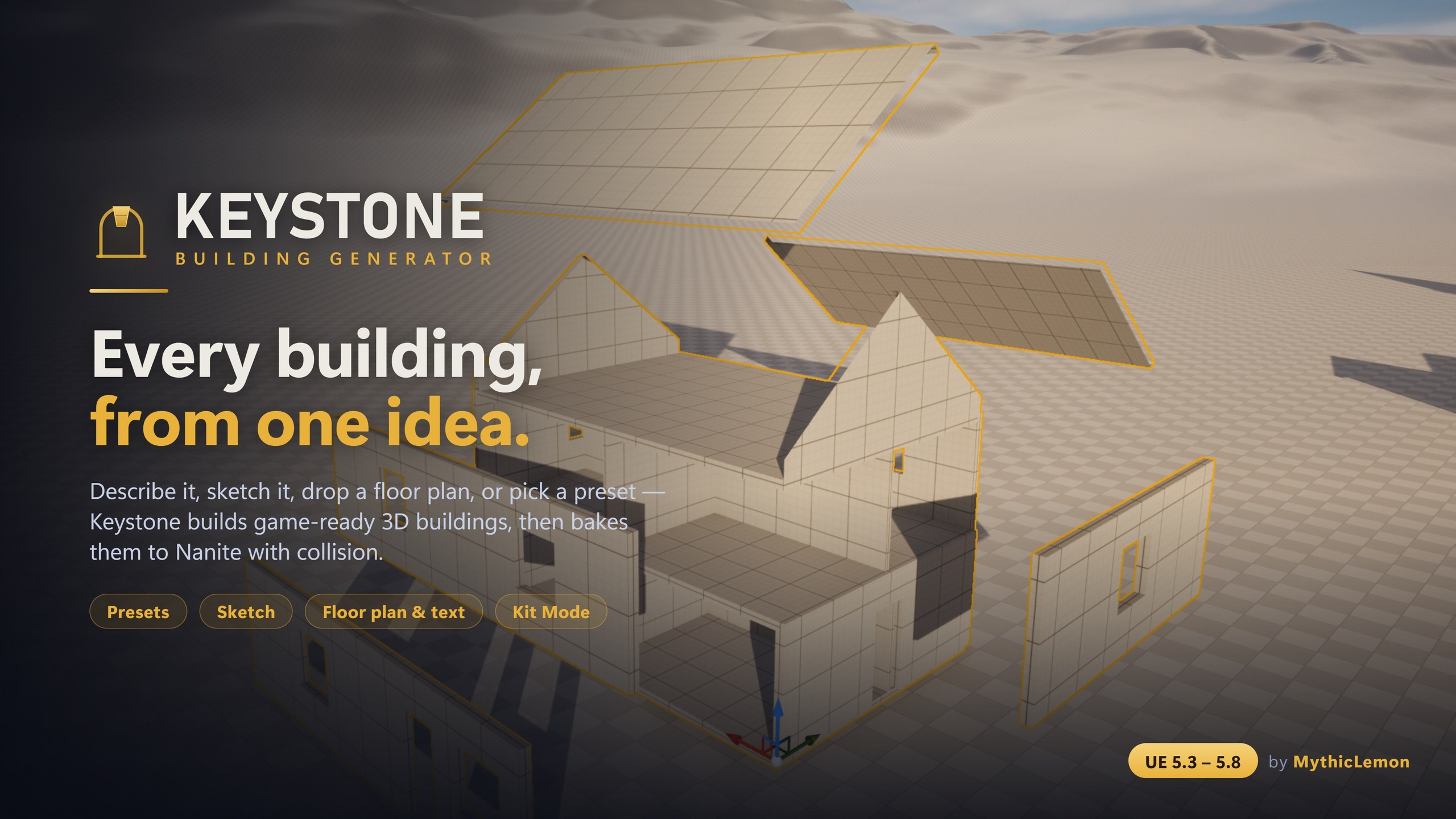
Bakes to standard Unreal StaticMeshes with collision and optional Nanite (both on by default), broken into separable pieces you can edit, swap or detach. The same building file always produces the same building, and baked output has no runtime dependency on Keystone.