tutorial · 2026-01-26
Voicing a Bard Quest-Giver NPC in Unreal Engine 5
Wire a charismatic bard to an interaction event, pull quest-pitch lines from a DataTable, and sequence them into a fully voiced quest hand-off.
Why a bard makes the ideal quest-giver
Most quest-givers fail for the same reason: they read like a quest log with a face attached. The player walks up, a wall of objective text appears, and nobody believes a word of it. If you are searching for how to build an Unreal Engine quest giver NPC with dialogue and a real voice, the fix is not more text — it is a character who can actually deliver the pitch out loud, with the timing and colour of a performer.
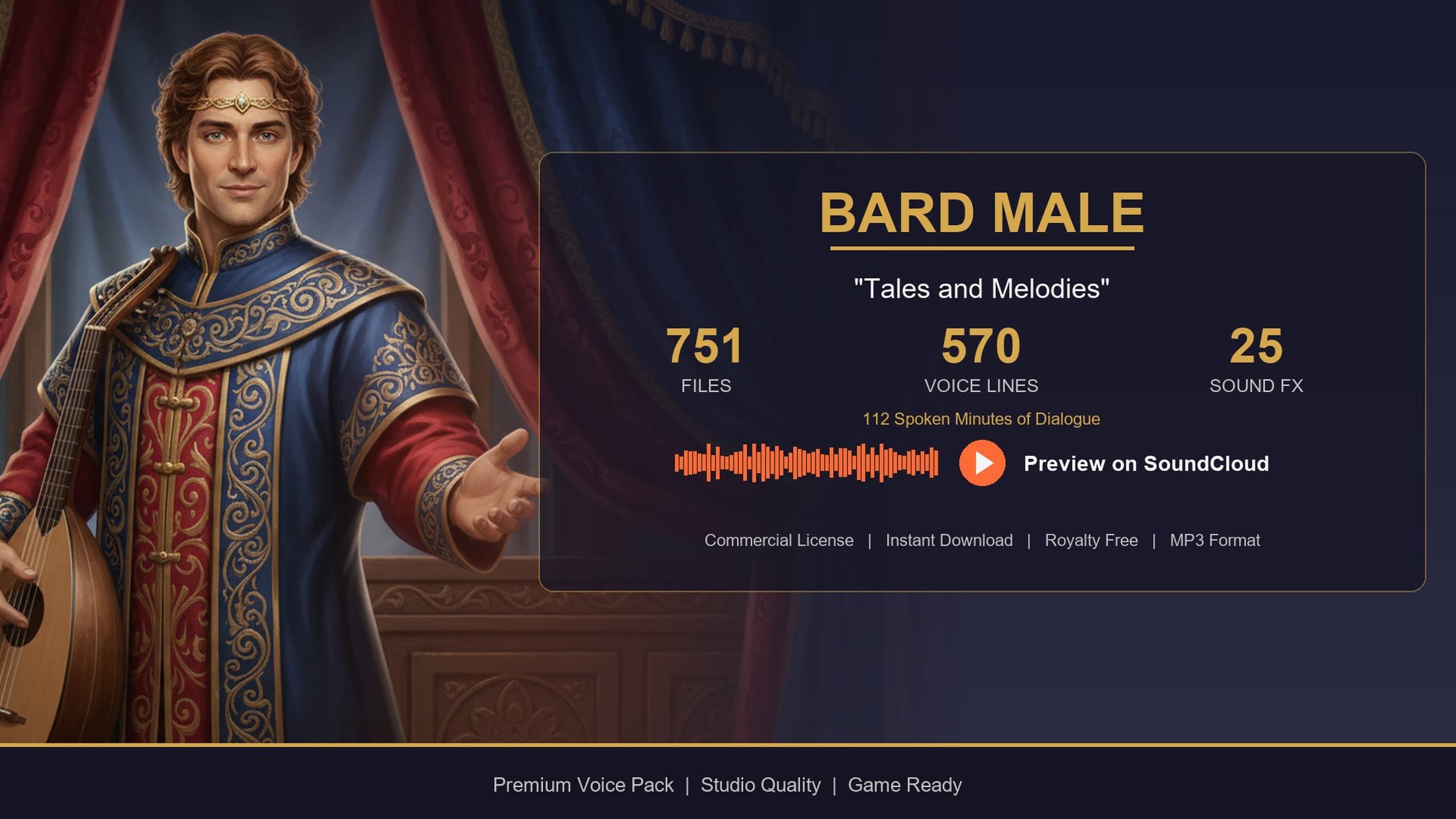
A bard is built for exactly this job. Bards are narrators by trade: they explain the world, set up a stake, and hook a listener into what happens next — the same shape as a quest hand-off. That is why this tutorial uses the Bard Dialogue Pack as its voice source. It ships 570 voice lines and roughly 112 minutes of audio in a theatrical, story-rich male-bard performance, with lines tagged by gameplay context so you can pull the right ones for the right moment.
Crucially, the pack does not just hand you WAV files. It carries the same DataTable-driven dialogue layer as the rest of the Lore Pack collection, so every line is queryable by category and length — you can ask the data for first-person, quest-giving lines and get them back ready to play, which is what the rest of this guide does.
Migrate the pack and find the pieces you need
Download the pack from Fab and bring the bard content folder into your project. The fastest route is to right-click the folder in the Content Browser of the source project and choose 'Migrate', pointing it at your game's Content directory; the folder is self-contained, so it will not drag the rest of a collection along with it.
Once it lands, you will see the standard asset-type-first layout: Audio, AudioCues, DataTables, DialogueVoices, Structs and Textures. Two assets matter most for a quest-giver. The first is 'DT_Dialogue', the DataTable that holds every line, its written text, and a soft reference to the audio. The second is the 'DV_' DialogueVoice asset, which you can assign as the speaker if you drive lines through Unreal's built-in dialogue system rather than playing sounds directly.
The pack also includes the other four DataTables from the collection schema — 'DT_CharacterProfile', 'DT_Equipment', 'DT_Quests' and 'DT_WrittenContent' — plus 85 written-content lore items for backstory and readable in-world documents. For the voiced hand-off itself, though, 'DT_Dialogue' is the table you will query.
Hook the dialogue to an interaction event
A quest-giver only speaks when the player engages it, so the first job is the trigger. Place your bard actor in the level and give it a way to detect intent to interact. The two common patterns are a collision volume that fires on overlap and a line-trace 'use' prompt that fires when the player presses an interact key while looking at the NPC; either is fine, and the rest of this tutorial is identical from the trigger onward.
1. On your bard actor, add the detection you prefer — for an overlap approach, add a 'Sphere Collision' component sized to a conversational radius and bind its 'On Component Begin Overlap' event; for a 'use' approach, expose a custom event such as 'Interact' that your player controller calls on the looked-at actor.
2. In that event, gate against re-triggering. Add a boolean variable 'bIsSpeaking' and, at the top of the handler, branch on it: if the bard is already talking, return early so a second overlap or key-press cannot start a second line over the top of the first.
3. If the bard is free, set 'bIsSpeaking' to true and call a custom event named 'GiveQuest', which is where the line selection and playback live. Keeping selection in its own event keeps the trigger clean and lets you reuse 'GiveQuest' from a cutscene or a debug key later.
Pull story-category lines from DT_Dialogue
Every row in 'DT_Dialogue' follows the collection schema: Name (the row key), DialogueName, ResponseText, CharacterName, EmotionalTone, ContextTags, NPCType, and VoiceAudio. The two fields you will lean on are 'ContextTags', a hierarchical tag string in the form category/subcategory/size, and 'VoiceAudio', which is a TSoftObjectPtr<USoundWave> so the clip is not loaded into memory until you actually ask for it.
For a quest hand-off you want the story category, because that is where the pack keeps its first-person, narrative quest-giving lines — bards skew narrative, and the story tag is where that strength lives. Filter to it like this.
1. Reference your migrated 'DT_Dialogue' asset. In Blueprint, add a variable of type 'Data Table' and set its default to the bard's table; in C++, load it once with LoadObject<UDataTable> and cache the pointer.
2. Get all the row names with 'Get Data Table Row Names', then 'ForEach' over them calling 'Get Data Table Row' to read each row out as the dialogue row struct.
3. For each row, test whether its 'ContextTags' string contains the substring 'story'. A simple 'Contains' check is enough because the tags are plain strings; keep every matching row in a local array of candidates.
4. From the candidate array, pick one with a random index so the bard does not greet every player with the identical opener. Hold onto that chosen row — its 'ResponseText' is your subtitle and its 'VoiceAudio' is the clip to play.
For performance, do not re-scan the whole table on every interaction. Cache the DataTable reference and, ideally, pre-filter the story rows once at initialisation so 'GiveQuest' only has to pick from an already-narrowed list.
Sequence LG and XL lines into a quest pitch
A real quest pitch is rarely a single sentence. It is a short build: a hook, the explanation of the task, and a closing call to action. The pack supports this directly through the size suffix on each tag. The LG and XL length tiers are the longer lines — explanations and full narratives — which is exactly what a quest pitch is made of, while the shorter tiers suit barks and one-liners.
To stage a multi-beat hand-off, select more than one story row and order them by size before playing. Pull an LG or XL story line as the core of the pitch, and optionally bracket it with a shorter greeting beforehand. Because you already have the candidate rows in hand, you can sort them by reading the size suffix from 'ContextTags' (the segment after the last slash) and assembling a small ordered queue.
Then play them in turn rather than all at once. The clean pattern is a recursive event: 'PlayNextLine' takes the queue, pops the front row, calls 'LoadSynchronous' on its 'VoiceAudio' to resolve the soft pointer into a USoundWave, plays it, and waits for completion before calling itself again on the remaining queue. When the queue is empty, set 'bIsSpeaking' back to false so the bard can be engaged again. For playing the audio you can use 'Play Sound 2D' for a narrator feel or 'Play Sound at Location' / a spatialised audio component if you want the voice anchored to the bard in the world.
Waiting for completion is the part people skip, and it is what separates a believable performance from clips trampling each other. Bind to the audio component's 'On Audio Finished' event so each beat lands before the next begins.
Subtitles and letting the player barge in
Voice without subtitles is an accessibility gap and a comprehension gap, and it is trivially avoidable here because every row already carries its text. As you play each line in 'PlayNextLine', push that row's 'ResponseText' to a subtitle widget, and clear it on the line's finished event. Because the text and the audio come from the same row, they can never drift out of sync the way a separately authored caption can.
Barge-in — letting the player skip ahead or walk away mid-pitch — is the other thing that makes a quest-giver feel responsive rather than scripted. Keep a reference to the currently playing audio component when you start a line. If the player presses the interact key again or leaves the conversational radius, stop that component, flush the remaining queue, clear the subtitle, and reset 'bIsSpeaking'. The same 'bIsSpeaking' guard you added at the trigger now does double duty as the lock that barge-in releases.
With those two touches the loop is complete: the player approaches, the bard hooks them with a story line, delivers an LG or XL quest pitch in sequence with synced subtitles, and yields gracefully the moment the player wants to move on. From here the obvious next step is breadth — give the same treatment to the merchants, rogues and townsfolk the bard shares a hub with, reusing the identical query code because the whole collection shares one row schema.
Which length tier for which moment
| Tier | Rough length | Best used for |
|---|---|---|
| SM | A few words | Greeting barks and acknowledgements |
| MD | One to two sentences | A quick hook or a short reply |
| LG | Two to four sentences | Explaining the quest objective |
| XL | A paragraph or more | A full narrative quest pitch or lore beat |
The size suffix on a line's ContextTags signals how long it is. Pick the tier that matches the beat you are staging.
FAQ
How do I build an Unreal Engine quest giver NPC with dialogue and a real voice?
Hook an interaction event (overlap or interact key) on your NPC actor to a custom 'GiveQuest' event, query the pack's 'DT_Dialogue' for rows whose ContextTags contain 'story', pick LG or XL lines for the pitch, LoadSynchronous each row's VoiceAudio and play it in sequence while showing its ResponseText as a subtitle. The Bard Dialogue Pack supplies both the voice lines and that ready-made DataTable layer.
Why filter by the story category specifically?
Bards skew narrative, and the pack keeps its first-person, quest-giving lines under the story category. Filtering ContextTags to 'story' returns the lines written to set up a task and hook a listener, which is the natural raw material for a quest hand-off.
How is the audio referenced, and does it stay loaded in memory?
Each DT_Dialogue row references its clip via the VoiceAudio column, which is a TSoftObjectPtr<USoundWave>. Nothing is loaded until you call LoadSynchronous on it at play time, so the table itself is cheap to hold and you only pay for the clips you actually voice.
Can I reuse this same code for other NPCs?
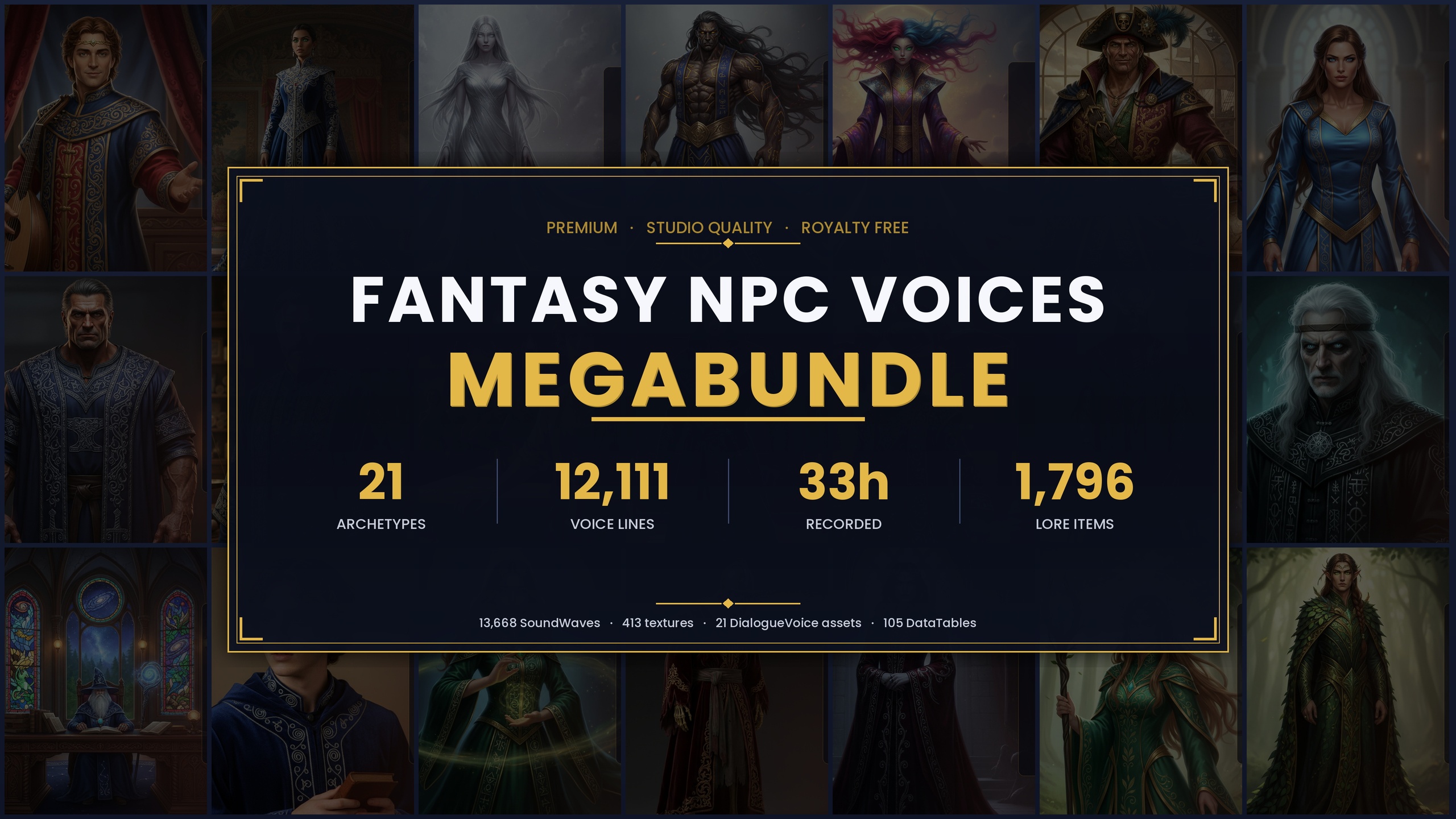
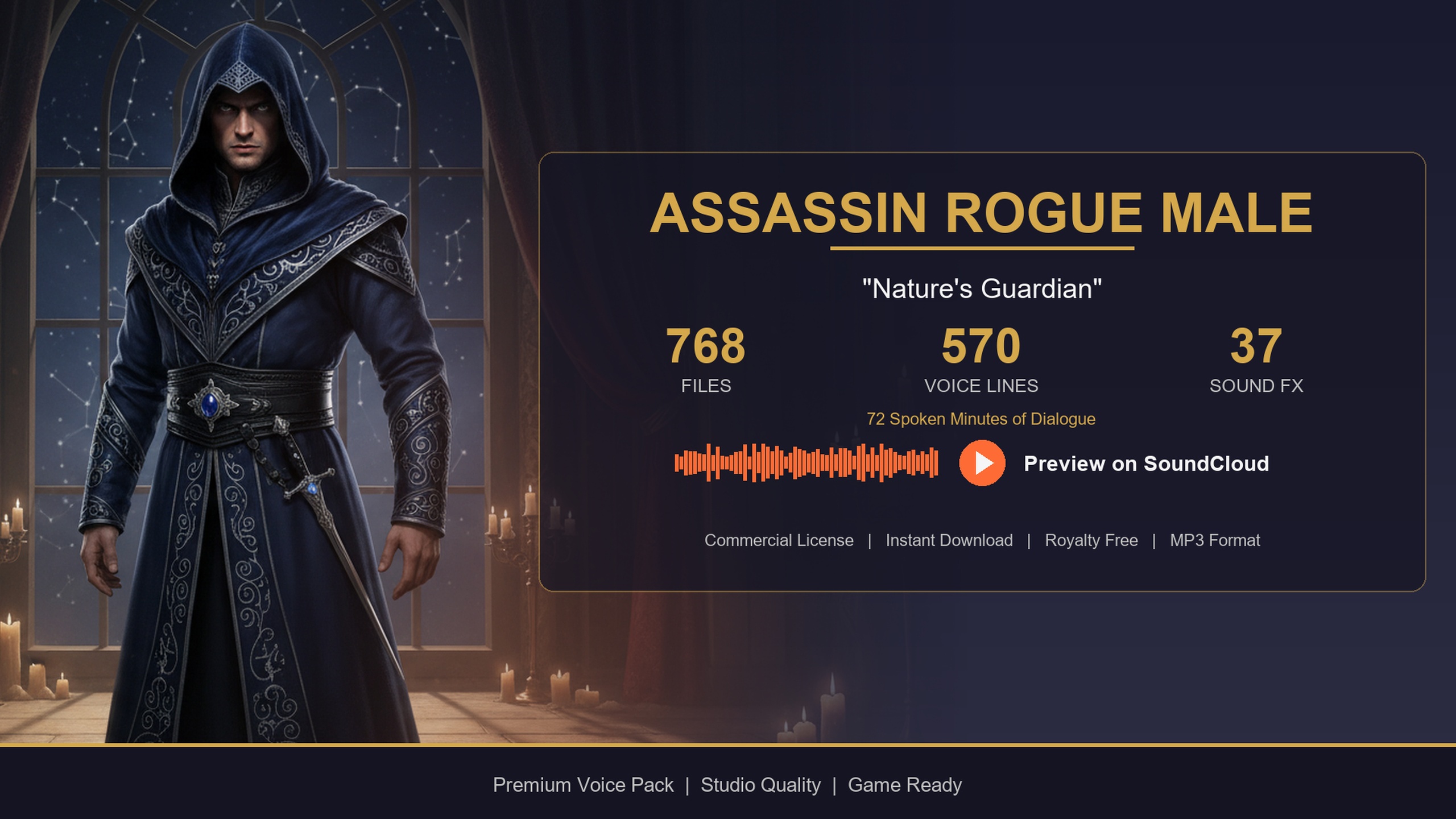
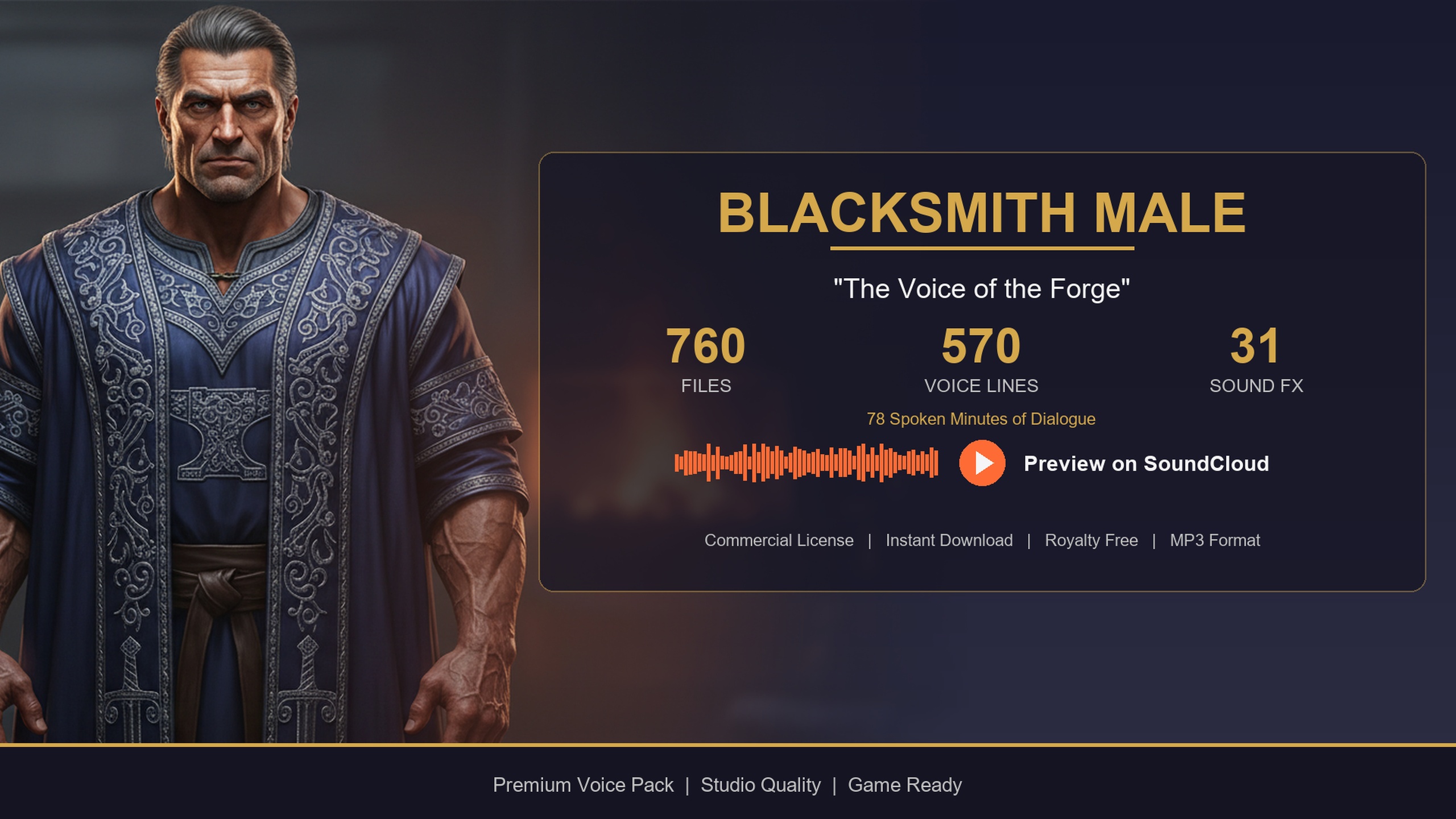
Yes. The bard shares its row schema with the rest of the Lore Pack collection, so the exact same query-and-play path works for the free Assassin pack, the Blacksmith pack, or any of the 21 archetypes in the Fantasy NPC Voices megabundle. Write the helper once and point it at a different character's DT_Dialogue.
What engine versions and platforms does the pack support?
The Fab listing states Unreal Engine 5.3 to 5.7, on Windows and Mac. The audio ships as PCM USoundWave assets that Unreal compresses per target platform at cook time.
Bard Dialogue Pack
Quest-givers, tavern tales and travelling-minstrel banter — 112 minutes of professionally delivered bard dialogue for medieval and fantasy worlds. Plug the cues straight into your dialogue system.
Related on Fab
Related reading