article · 2026-02-18
Divine vs Mortal: RPG God NPC Voice Design for a Fantasy Pantheon
How to make a deity read as divine, keep your common-folk NPCs grounded, and drive both from one dialogue data layer.
The problem: your god sounds like everyone else
You have a shrine, an altar reveal, or a war-god boss who is meant to speak from on high, but in-engine the line plays back like any other barked greeting and the moment falls flat. RPG god NPC voice design for a fantasy pantheon is less about a single 'epic' clip and more about a consistent set of contrasts: how the deity sounds, how it is mixed, and how it is framed against the mortal NPCs the player has been hearing for hours.
The good news is that you do not need a separate, bespoke audio system for the divine tier. With the Deity Dialogue Pack the god lines ship in the same DataTable-driven dialogue layer as every common-folk archetype, so you can lean on placement, mixing and writing tier to sell 'divine' rather than re-engineering your pipeline. This guide walks through what makes a voice read as a god, how to contrast it with mortals, and how to keep both running on one code path.
What makes a voice read as divine
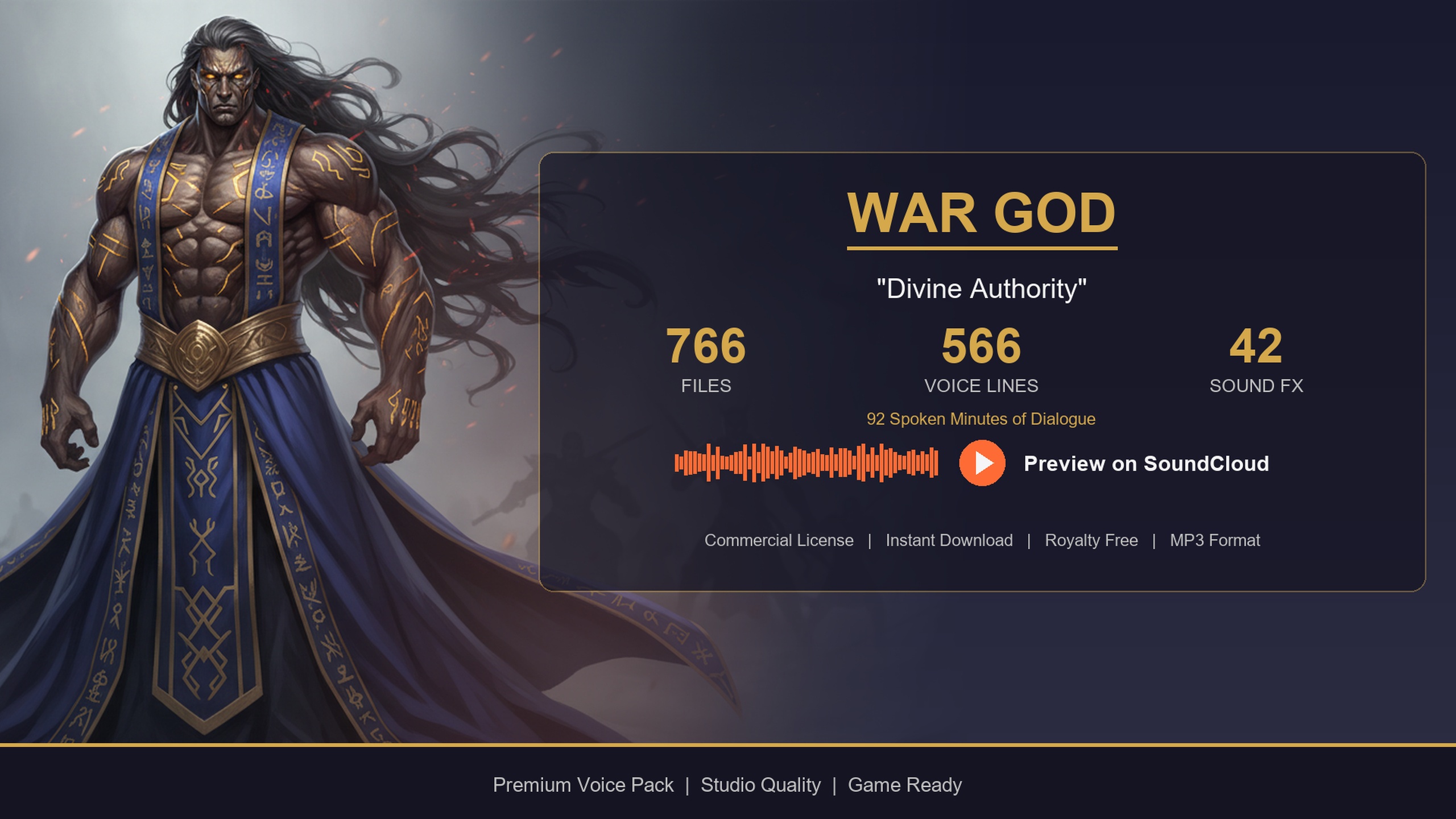
The Deity Dialogue Pack is built around a thunderous, commanding war-god performance: challenges, proclamations and martial exultation, plus cinematic divine narration suited to higher-power characters and oracles. That performance does a lot of the work, but how you play it back decides whether the player hears a deity or just a loud man.
The single biggest lever is diegesis. For a true 'voice of god' moment, the pack's own guidance is to use Play Sound 2D and skip attenuation entirely, so the line is non-diegetic and seems to exist everywhere rather than emanating from a point in space. A mortal blacksmith two metres away should fall off with distance and occlusion; a god addressing the player should not. That contrast alone reads as supernatural before the player has parsed a single word.
Writing tier reinforces it. The collection tags every line by size, and for proclamations and prophecy you want the longer LG and XL lines rather than the short barks you would give a shopkeeper. A deity speaks in measured, weighty sentences; brevity is for mortals who have somewhere else to be. Reserve the SM and MD lengths for the people of the world and let the god take the floor.
Finally, frame the line. A booming proclamation triggered at a shrine, ritual or boss arena lands harder than the same clip fired mid-traversal. Pair the audio with the moment the camera or gameplay already wants to elevate, and the performance and the staging compound.
Contrasting deity audio with common-folk NPCs
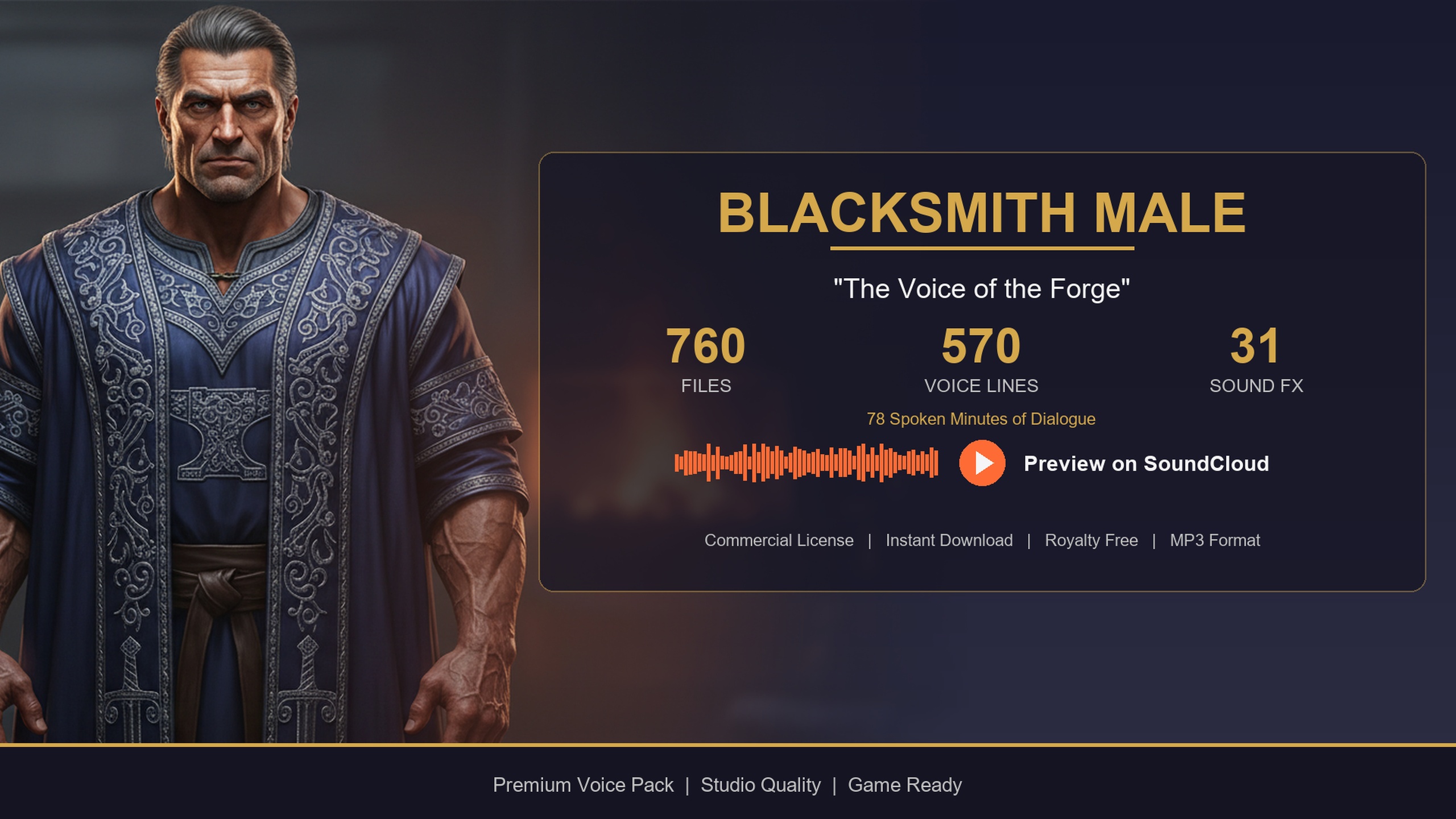
Divinity is relative. The deity only reads as 'other' because the player has spent hours with grounded mortals, so the mortal tier is part of the design, not a separate concern. The Blacksmith Dialogue Pack is the natural foil here: a gravelly, forge-warm baritone delivering shop greetings, crafting flavour and commerce banter. It is deliberately attenuated, deliberately short, and deliberately tied to a place, a stall, a forge, a counter.
Set them up as opposites along three axes. On space, the smith is 3D and attenuated while the god is 2D and omnipresent. On length, the smith leans on SM and MD greeting and farewell barks while the god uses LG and XL pronouncements. On framing, the smith fires on shop-open and shop-close overlap events while the god fires on shrines, rituals and boss reveals. Same playback system, opposite settings.
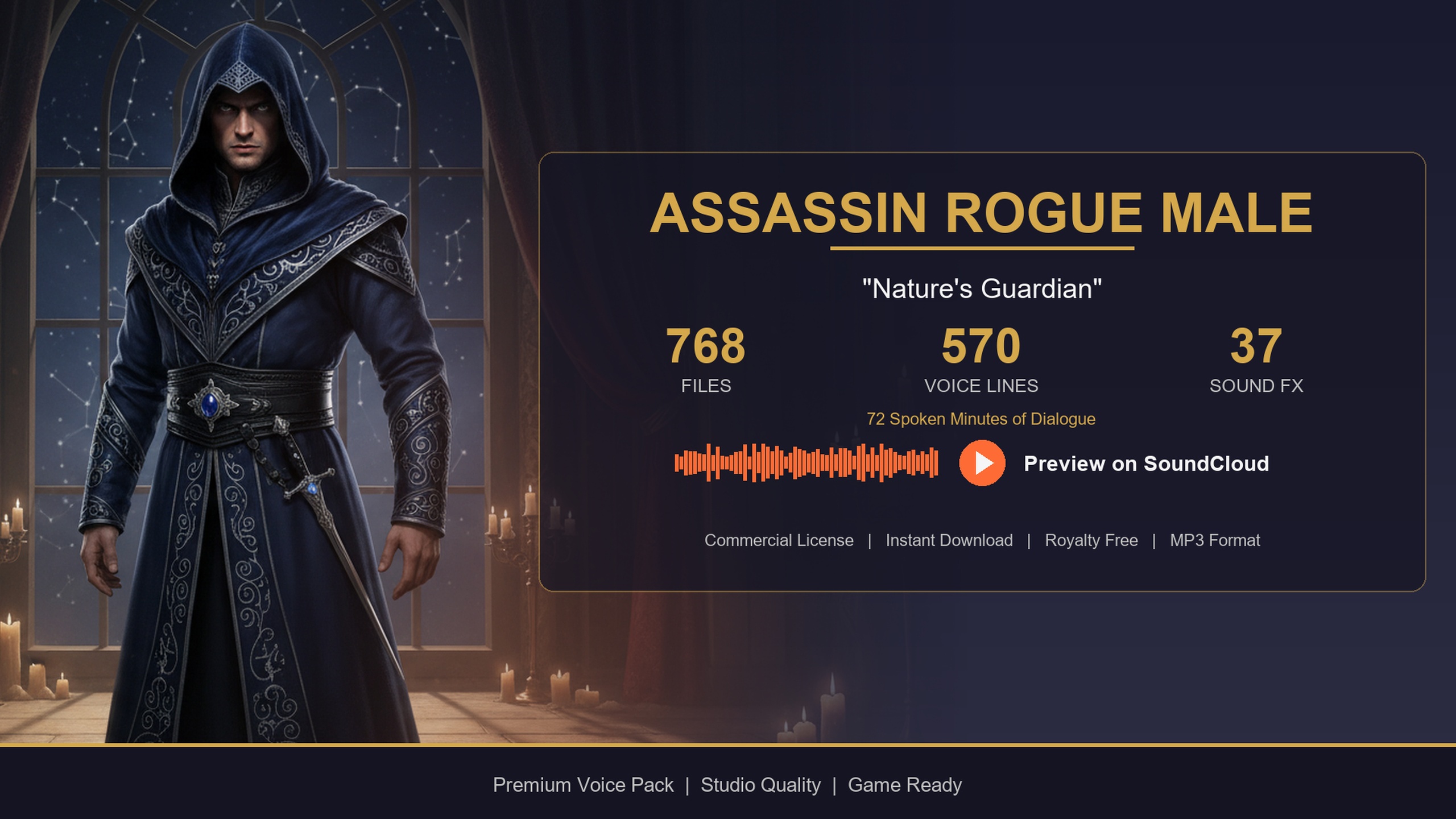
A dark archetype gives you a third point of reference. The free Assassin Dialogue Lore Pack supplies a rogue voiced across combat, social, story, taunt, death and idle categories, with the same four length tiers (SM, MD, LG, XL) and the same context tagging. It is a low, close, human counterpoint, useful for proving that your divine framing is doing the lifting, since the assassin and the deity run through identical query code yet feel nothing alike.
Per-pack figures are close but not identical, which is fine: the deity tier carries roughly 92 minutes of audio across 566 lines and 15 categories, the blacksmith around 78 minutes across 570 lines, and the assassin around 72 minutes across 570 lines. Treat these as the public per-pack figures and don't over-index on the exact counts; what matters is that the divine tier is comparable in scale to your mortal tiers, not a thin afterthought.
Using the same data layer for both
The reason a two-tier pantheon is cheap to build is that every archetype in this collection shares the same schema. Each pack ships five DataTables, DT_Dialogue, DT_CharacterProfile, DT_Equipment, DT_Quests and DT_WrittenContent, and the DT_Dialogue row layout is identical across packs, with the VoiceAudio column typed as a soft object pointer to a USoundWave so nothing loads until first play. Write one query helper and it serves gods and mortals alike.
1. Reference the relevant DT_Dialogue DataTable for the character you are voicing, the deity table for the god, the blacksmith table for the smith.
2. Get all row names, then keep only the rows whose ContextTags contains the situation you want, for example 'story' or 'taunt' for a war-god proclamation, or 'social' for a shop greeting.
3. Pick a random row from the filtered set so repeated triggers do not replay the same line.
4. Call LoadSynchronous on the row's VoiceAudio soft pointer to pull the USoundWave into memory.
5. For the deity, use Play Sound 2D with no attenuation for a non-diegetic 'voice of god'; for the blacksmith, use Play Sound 3D at the NPC so it attenuates in the world.
Because the row structs are shared, the only thing that changes between a god and a mortal is which table you point at and whether you play 2D or 3D. In a hot loop, cache the DataTable reference and pre-filter rows by category at initialisation rather than scanning every trigger. If you prefer Unreal's native dialogue system, assign each pack's DialogueVoice (DV_) asset as the speaker and route audio through that instead.
DT_WrittenContent is the quiet bonus. The deity tier carries 85 written-lore items styled as commandments, scriptures and prophecies, which you can surface as readable shrine inscriptions or pickup documents. The blacksmith's 85 items are smithing notes and recipes; the assassin's 85 are journals and contract letters. Same column layout, wildly different in-world tone, populated from one document-reader widget.
Goddess and Deity for a two-god pantheon
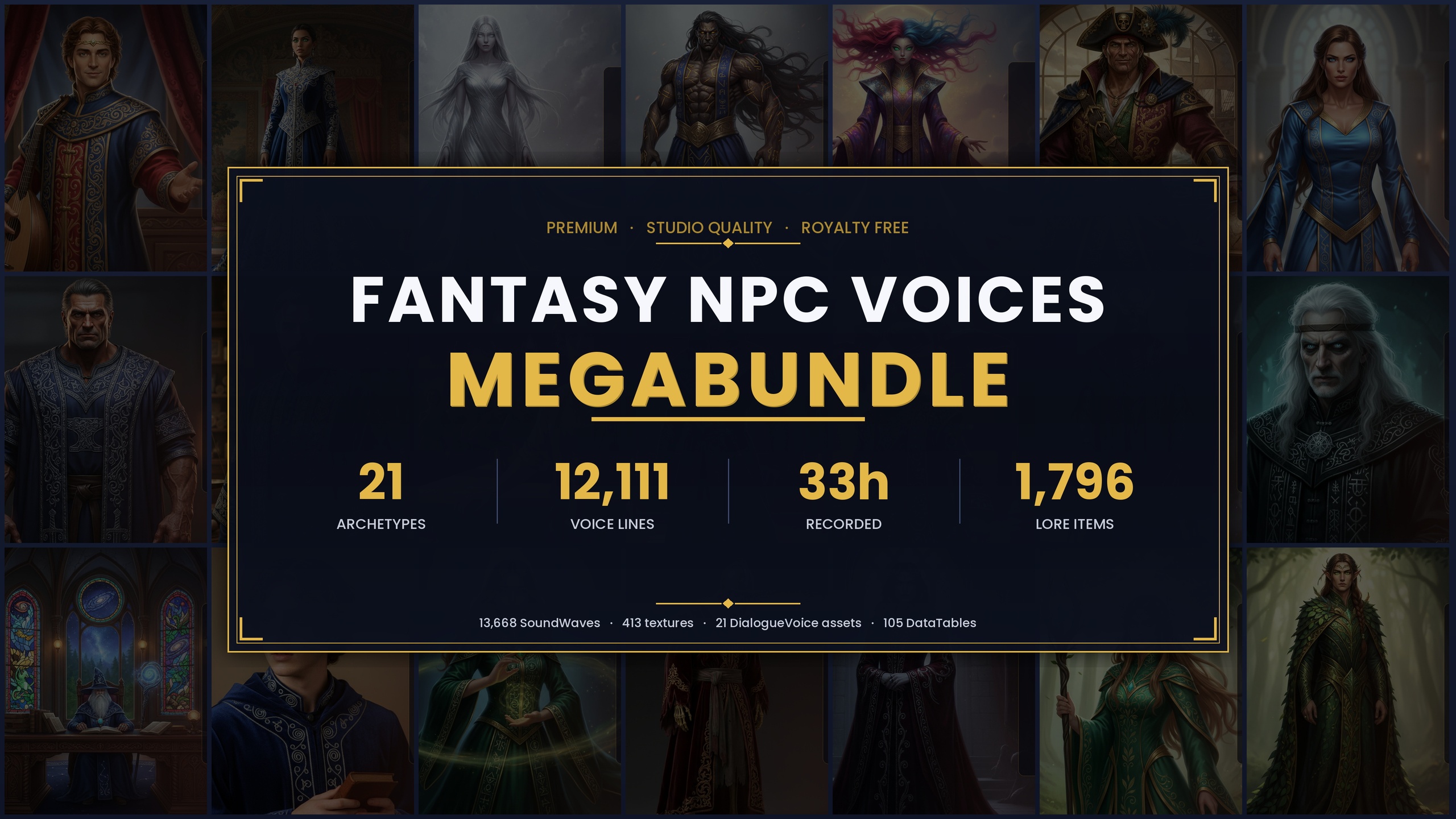
If one war-god is not a pantheon, the Divine tier gives you a pair. The Deity (Male) archetype is one of the 21 characters inside the Fantasy NPC Voices Complete megabundle, sitting in its Divine tier alongside a Goddess (Female). Buying the megabundle puts both divine voices, plus every mortal archetype you might want to contrast them against, under a single content root, and each character folder is self-contained so you can right-click Migrate just the two gods if that is all you need.
Design the pair as complements rather than duplicates. Give the war-god Deity the martial, challenging lines and the boss-arena proclamations, and reserve the Goddess for oracular guidance, blessings or prophecy, but keep both non-diegetic and both on the longer length tiers so they read as a matched divine tier against your attenuated mortals. The shared schema means a single 'speak as a god' helper, parameterised by which DataTable to read, drives both.
If you are only building one deity right now, start with the standalone Deity Dialogue Pack and add the rest of the cast later; if you already know you want a full pantheon plus the common-folk to set it against, the megabundle is the cheaper route per archetype. Either way the integration code you write today does not change when you scale up, because every archetype speaks through the same data layer.
Divine vs mortal: playback design at a glance
| Trait | Deity Dialogue Pack (divine) | Blacksmith Dialogue Pack (mortal) | Assassin Dialogue Lore Pack (mortal) |
|---|---|---|---|
| Voice character | Thunderous, commanding war-god | Gravelly, forge-warm baritone | Low, close rogue/assassin |
| Spatialisation | 2D, no attenuation (voice of god) | 3D, attenuated at the NPC | 3D, attenuated at the NPC |
| Preferred length tiers | LG / XL proclamations | SM / MD greetings and barks | SM / MD barks, LG/XL for story |
| Typical trigger | Shrine, ritual, boss reveal | Shop-open / shop-close overlap | Combat, spotted, taunt, death |
| Voice lines (User Guide) | 566 | 570 | 570 |
| Audio runtime (User Guide) | ~92 min | ~78 min | ~72 min |
| Written-lore items | 85 | 85 | 85 |
| Price | $9.99 | $14.99 | Free |
Same DataTable schema and query helper for every row; only the table, length tier and playback mode change. Per-pack line/minute figures are the authoritative User Guide values.
FAQ
How do I approach RPG god NPC voice design for a fantasy pantheon without a custom audio system?
Lean on contrast rather than bespoke tech. The Deity Dialogue Pack ships in the same DataTable-driven dialogue layer as the mortal archetypes, so you sell 'divine' through playback (non-diegetic 2D audio with no attenuation), writing tier (longer LG/XL proclamations) and framing (shrines, rituals, boss reveals) while mortal NPCs stay 3D, attenuated and short. Same system, opposite settings.
What actually makes the deity voice read as divine in-engine?
Three things in combination: a thunderous, commanding war-god performance; non-diegetic playback via Play Sound 2D with attenuation skipped so the voice seems to be everywhere; and longer, weightier lines reserved for proclamations and prophecy. Triggering the line at a moment the camera or gameplay already elevates, such as a shrine or boss arena, compounds the effect.
Can one query helper drive both gods and common-folk NPCs?
Yes. Every archetype in the collection shares the same five DataTables and an identical DT_Dialogue row schema, with VoiceAudio as a TSoftObjectPtr<USoundWave>. You reference the relevant DT_Dialogue, get all rows, filter by ContextTags, pick a random row, LoadSynchronous the VoiceAudio and play it. Only the table you point at and the 2D-versus-3D playback choice change between a deity and a mortal.
How do I build a two-god pantheon with a Goddess as well as a Deity?
The Deity (Male) is one of the 21 archetypes in the Fantasy NPC Voices Complete megabundle, in its Divine tier alongside a Goddess (Female). The megabundle gives you both divine voices plus the mortal cast to contrast them against under one content root, and each character folder migrates independently. Keep both gods non-diegetic and on the longer length tiers, and assign the Deity the martial lines while the Goddess handles oracular guidance.
Which pack should I buy first?
If you only need a single war-god right now, start with the standalone Deity Dialogue Pack at $9.99 and add archetypes later. If you already want a full pantheon plus the common-folk NPCs to set it against, the Fantasy NPC Voices Complete megabundle is cheaper per archetype. The integration code is identical either way, so scaling up does not mean rewriting anything.
Deity Dialogue Pack
Booming pronouncements and divine narration — 92 minutes of deity dialogue for gods, oracles and otherworldly beings. Cinematic voice cues to give your RPG's higher powers a real presence.
Related on Fab
Related reading