
article · 2026-02-23
21 Fantasy RPG NPC Archetypes Every Cast Needs (and the Voices That Cover Them)
A working developer's tour of the full Fantasy NPC Voices roster, grouped by role, with what each character actually covers in dialogue.
Why archetype coverage is the real problem
If you are building an RPG, the hard part of voicing your world is rarely a single character. It is the spread. A believable cast needs a noble paladin who sounds nothing like the gravel-voiced smith two streets over, a god whose pronouncements carry weight a tavern bard never could, and a sneering goblin who undercuts both. Recording that range is where voice budgets disappear, and it is exactly the gap a roster is built to close.
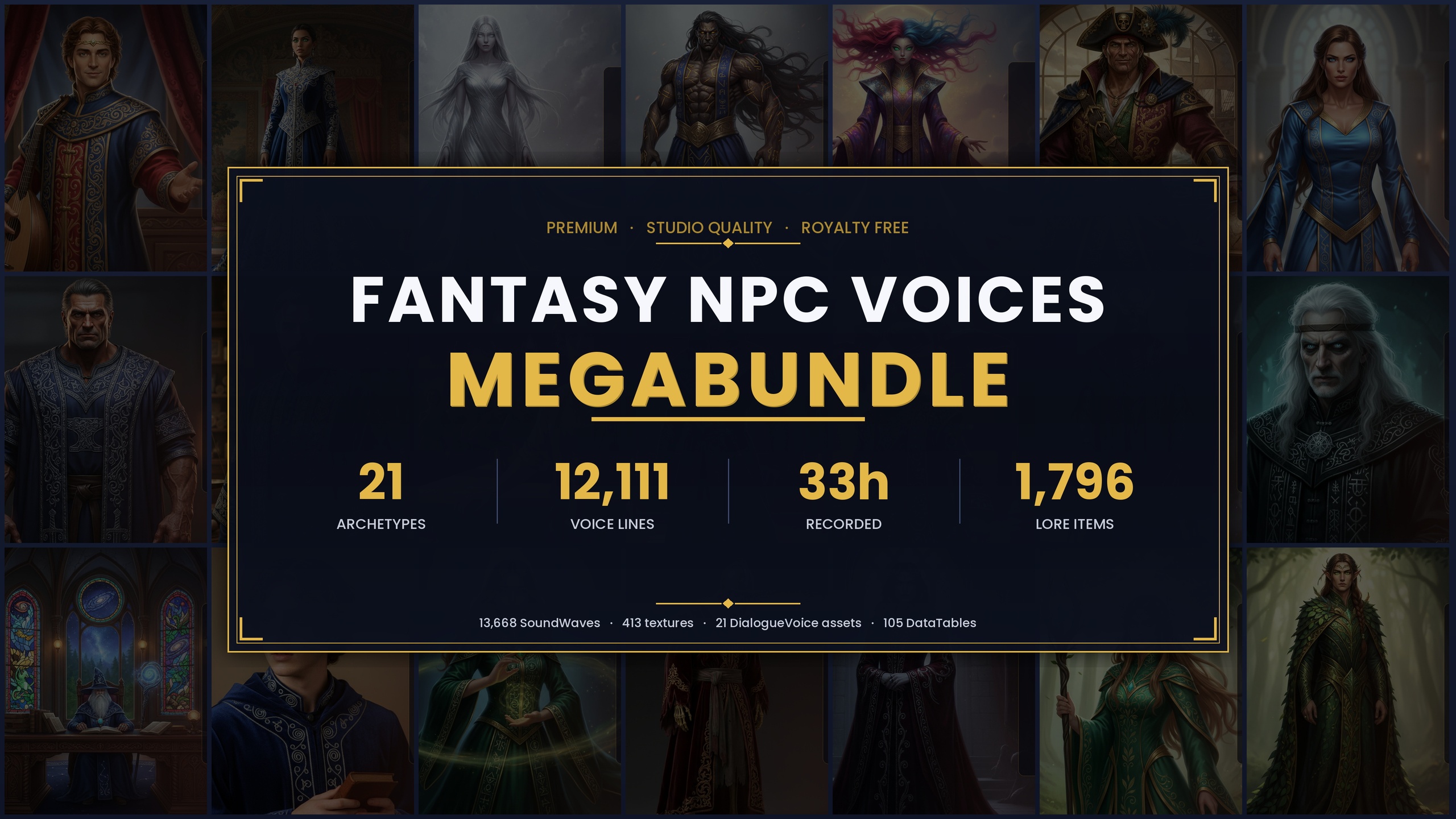
This is a practical guide to fantasy RPG NPC archetypes and the voices that cover them. It walks the full 21-archetype roster in Fantasy NPC Voices, grouped by the role each character plays in a party, a town or a dungeon, and tells you what each one actually delivers in dialogue. The pack consolidates the whole Lore Pack collection into one UE5.3 project, so every archetype below ships under a single content root and can be cherry-picked by right-click 'Migrate'.
Crucially, every character speaks the same data shape. All 21 share five byte-identical row schemas, so once you write one query helper against 'DT_Dialogue' you reuse it for every NPC in the cast. That uniformity is what turns a list of voices into a usable system, and it is worth keeping in mind as you read the roster.
Heroic and noble: the characters players root for
The heroic tier covers the voices a player is meant to trust. In this group sit the paladin, the wood elf, the bard and the young wizard. These are your questing companions, your honourable knights, your wide-eyed apprentices and your idealistic guides, the characters who hand out the noble framing of a story.
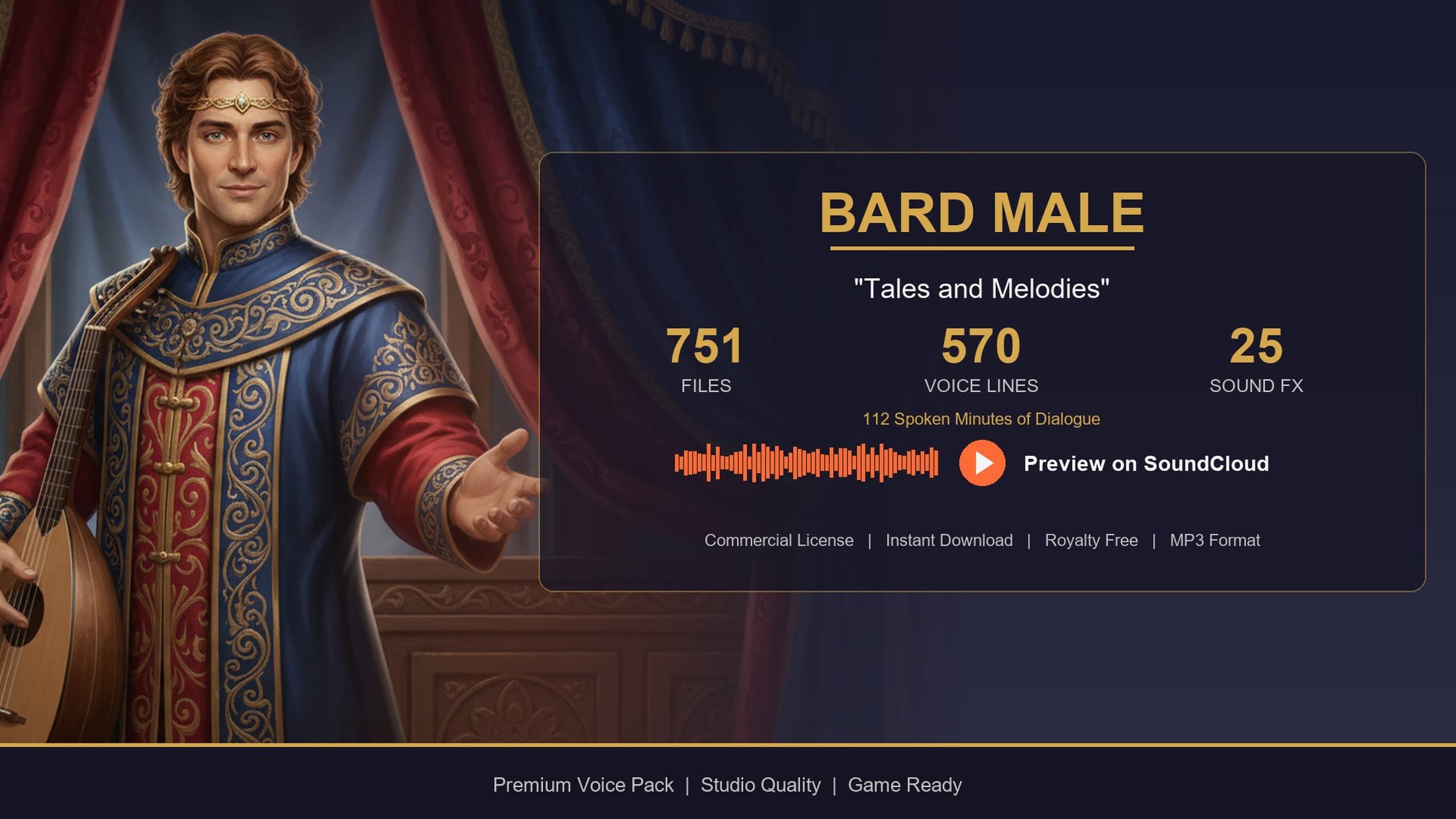
The bard is the archetype that does the most narrative heavy lifting here. It is a charismatic, theatrical male-bard performance built for quest-giving, tavern tales and travelling-minstrel banter, and it skews deliberately story-heavy. Lines run long enough to carry campaign intros, cutscene narration and lore delivery, which is why the bard leans on the longer length tiers rather than quick combat barks. If your hub town needs a single voice to tell the world's stories, this is the one to reach for.
The young wizard and the wood elf give you the lighter, more earnest end of the heroic register: apprentices learning their craft, scouts and guides with a cleaner, less weathered tone than the arcane veterans below. Together with the paladin's measured nobility, this tier handles almost every 'the player is supposed to like this person' moment a fantasy cast throws up.
Arcane and mystical: the keepers of secrets
The arcane tier is where the world's knowledge and its weirdness live: the old wizard, the sorceress, the witch and the trickster god. These voices carry exposition, prophecy and the faint sense that the speaker knows more than they are letting on, which makes them ideal for tutorial mentors, hedge-of-the-map hermits and morally slippery quest-givers.
The old wizard is the single largest character in the entire pack, with 777 dialogue lines to its name. That depth matters in practice. A mentor archetype is one you return to repeatedly across a campaign, so it benefits from the widest pool of context-tagged lines for greetings, advice, warnings and reactions. When you need an NPC who can carry a long-running relationship without obviously repeating itself, the old wizard has the most material to draw from.
The sorceress and witch sit alongside it as the feminine arcane voices, ranging from refined spellcaster to something more unsettling, while the trickster god adds a mischievous, capricious edge that bridges into the divine tier without ever sounding fully benevolent. Treat this group as your reservoir of secrets: the characters who explain the world and complicate it in the same breath.
Divine: voices that come from above
Two characters occupy the divine tier: the deity and the goddess. These are not town NPCs. They are the booming, otherworldly voices reserved for altars, shrines, divine interventions and end-game reveals, and they are deliberately pitched to contrast with every mortal speaker around them.
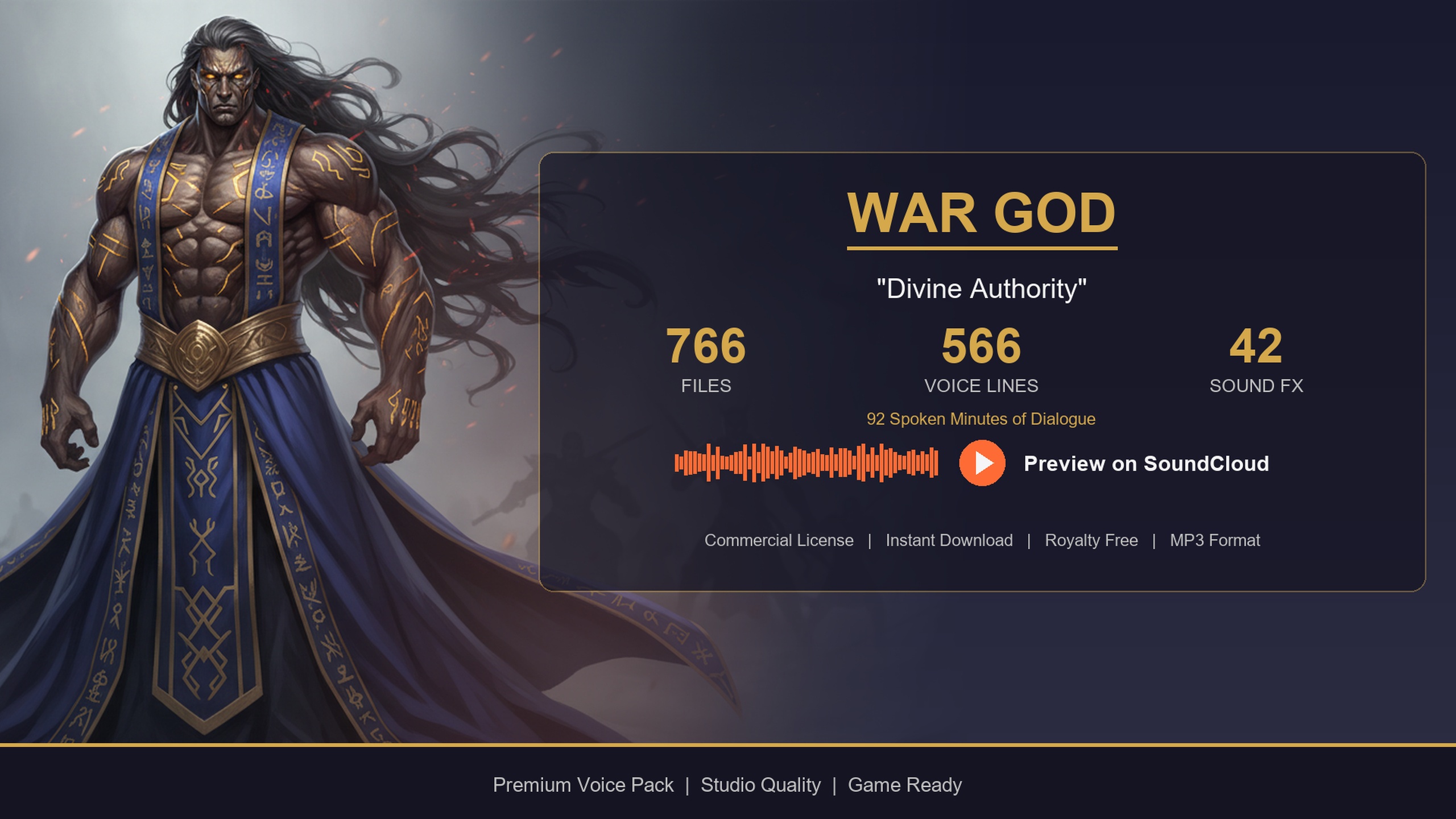
The deity is delivered as a thunderous war-god performance built for proclamations, challenges and martial exultation, with cinematic narration suited to prologues and boss arenas. The practical trick with a god is delivery: for a non-diegetic 'voice from on high' you play the line as a 2D sound and skip attenuation entirely, so it fills the player's headspace rather than emanating from a point in the world. Reserve the longer length tiers for prophecy and proclamation, where the weight of the voice does the work.
The goddess gives you the second divine register, letting you split mortal and immortal speakers cleanly so the player feels the shift the moment a god speaks. If your game has shrines, oracles or a pantheon, this tier is what makes those moments land as something other than another conversation.
Dark and villainous: the cast's antagonists
The villain tier is one of the deepest by role count, which fits how often a fantasy game needs someone to threaten the player. It covers the necromancer, the lich, the vampire lord, the undead soldier and the assassin, spanning everything from a calculating mastermind to the disposable enemies that fill a dungeon.
The split here is deliberate. The necromancer, lich and vampire lord are your named antagonists, the recurring villains who taunt, monologue and gloat across a campaign, so lean on their story and taunt context tags for the set-piece confrontations. The undead soldier and the assassin work as the rank-and-file menace: combat barks, ambush lines and the short reactive chatter that procedurally spawned enemies need in volume.
Because every villain shares the same dialogue schema as every hero, mixing them in a single encounter is trivial. A lich commanding a wave of undead soldiers is three characters pulled from the same data structure, queried through one code path, with no per-character special-casing on your side.
Common folk: the world between the quests
The last tier is the one that makes a world feel inhabited rather than staged: the innkeeper, the merchant, the blacksmith, the pirate and the goblin. These are the shopkeepers, the wharf-side rogues and the lowlife enemies that fill the space between your set-piece encounters, and a fantasy game lives or dies on having enough of them.
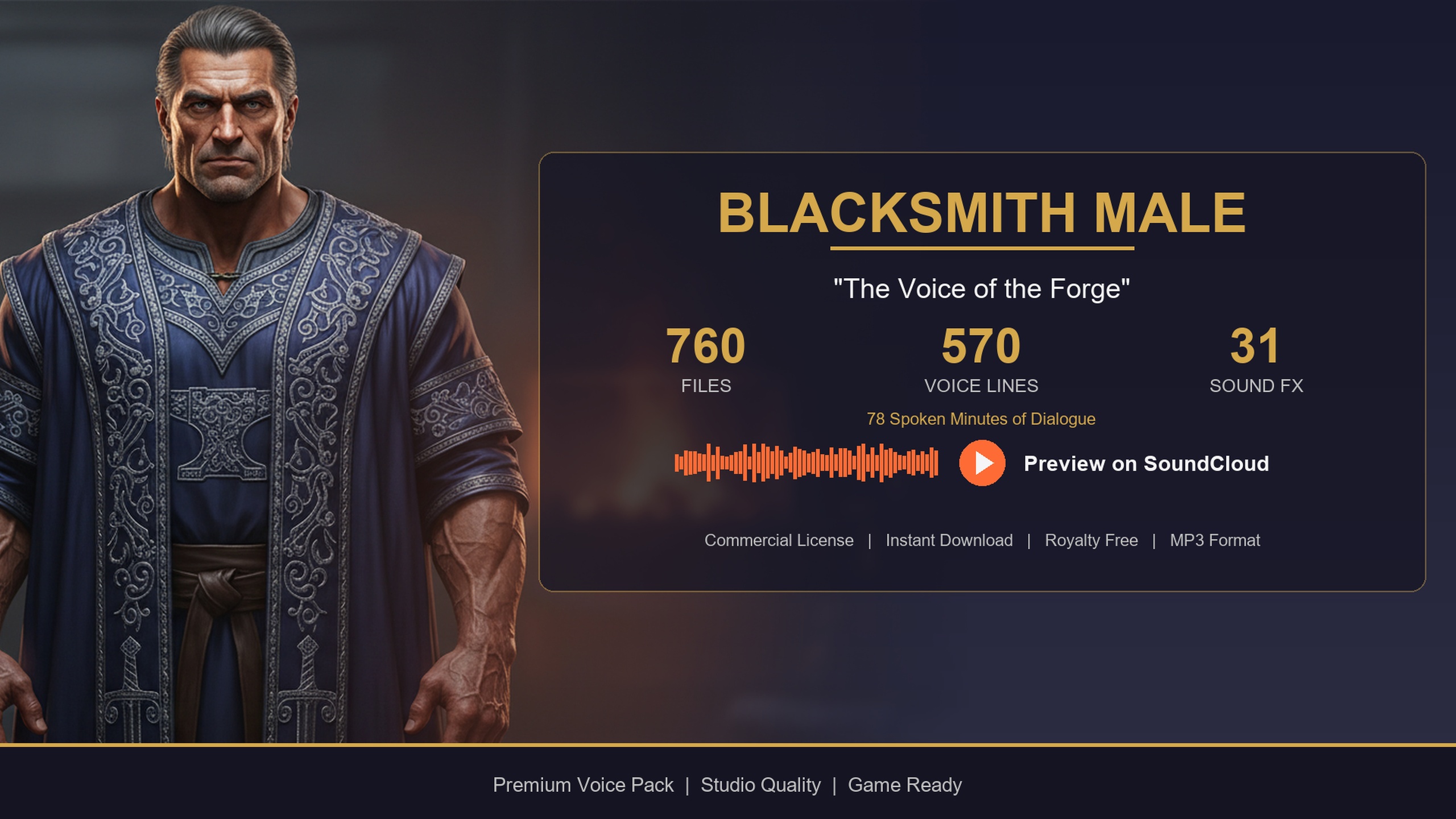
The blacksmith is the workhorse of this tier, a gravel-throated, forge-warm baritone built for shop greetings, crafting flavour and forge banter. In practice you wire its greeting lines to a shop-open or overlap event and its farewells to shop-close, then pull from its written-content rows to populate readable smithing recipes and craft notes. The innkeeper and merchant give you the same commerce-and-hospitality shape for taverns and general stores, while the pirate and goblin supply the grubbier voices: dockside threats, cowardly squabbling and the comic-menace barks that low-tier enemies trade in.
This tier is also where the pack's variety pays off most. Roguelikes and dungeon crawlers that procedurally spawn NPCs need many distinct common-folk voices so the world does not sound like one actor reading every part, and having goblin, pirate, merchant, innkeeper and blacksmith in a single drop covers most of that surface area on day one.
What each character actually covers
A roster is only as useful as the dialogue behind each name, and this is where the pack's structure shows. Every character carries context-aware lines tagged by category, subcategory and size, spanning combat, social, story, discovery, emotion, self, response and environmental or atmospheric chatter, plus dedicated voice-FX lines and per-character music themes for scene scoring. In other words, a single archetype is not a handful of greetings; it is a full behavioural spread you can query by situation.
Across the whole bundle that adds up to 13,668 SoundWave audio assets: 12,111 dialogue lines, 793 voice-FX lines and 764 music or theme tracks, with one matching audio cue per SoundWave. There are 12,904 voiced clips in total once dialogue and voice FX are counted together, and roughly 33 hours of recorded dialogue and voice FX combined. On the data side, 105 DataTables back the cast (five per character), alongside 1,796 written-lore items in the 'DT_WrittenContent' rows for in-world books, letters and journals, and 413 image textures for portraits, environments, items and scenes.
The mechanism for using any of it is the same regardless of archetype. You query 'DT_Dialogue' for a character, filter rows whose 'ContextTags' contains the situation you want, pick one at random, then 'LoadSynchronous' the 'VoiceAudio' soft pointer and play it as a 2D or 3D sound, optionally displaying the row's 'ResponseText'. Because the 'VoiceAudio' references are soft object pointers, nothing loads until first play, so shipping all 21 characters does not mean loading all 21 up front.
If you do not need the full cast, the same characters are available as standalone single-archetype packs. The Bard, Blacksmith and Deity dialogue packs are the same voices and the same DataTable layout as their slots inside the megabundle, which makes them a sensible way to add one archetype to an existing project, or to audition a voice before committing to the whole roster.
Picking the right voices for your game
If you are voicing an entire cast from scratch, the complete pack is the obvious starting point: 21 archetypes covering every tier above, one shared schema, and the freedom to migrate the whole content root or cherry-pick individual character folders. It is built for the day-one problem of giving a full RPG a voice without a recording budget, and for procedurally spawned NPCs that need genuine variety.
If you only need one or two roles filled, the single-character packs are the cheaper path. Reach for the Bard when a town needs a story-telling quest-giver, the Blacksmith when a shop or forge needs a grounded common-folk voice, and the Deity when a shrine or boss reveal needs a voice that comes from above. Each drops into the same query helper you would write for the megabundle, so moving from one pack to the full collection later costs you nothing in code.
Whichever route you take, the payoff is the same uniformity. One dialogue schema, one filter-and-play helper, and a cast whose archetypes already span the heroic, arcane, divine, villainous and common-folk roles a fantasy RPG is built from.
The roster's archetypes by role
| Tier | Archetypes | Best for |
|---|---|---|
| Heroic / noble | Paladin, Wood Elf, Bard, Young Wizard | Companions, quest-givers, honourable knights, narration |
| Arcane / mystical | Old Wizard, Sorceress, Witch, Trickster God | Mentors, exposition, prophecy, morally slippery quest-givers |
| Divine | Deity, Goddess | Altars, shrines, divine interventions, boss reveals |
| Dark / villainous | Necromancer, Lich, Vampire Lord, Undead Soldier, Assassin | Named antagonists, taunts, plus rank-and-file enemy barks |
| Common folk | Innkeeper, Merchant, Blacksmith, Pirate, Goblin | Shopkeepers, town flavour, dockside rogues, low-tier enemies |
The pack ships 21 fully-voiced archetypes; this map groups the cast by the role each one plays. Use it as a casting guide for which voice fills which slot in your game.
Standalone single-character packs
| Pack | Tier | Voice lines | Audio runtime | Price |
|---|---|---|---|---|
| Bard Dialogue Pack | Heroic / noble | 570 | ~112 minutes | $3.99 |
| Blacksmith Dialogue Pack | Common folk | 570 | ~78 minutes | $14.99 |
| Deity Dialogue Pack | Divine | 566 | ~92 minutes | $9.99 |
| Fantasy NPC Voices (Complete) | All 21 archetypes | 12,111 | ~33 hours voiced | $99.99 |
The same voices and DataTable layout as their slots in the megabundle. Per-pack figures are from each pack's User Guide.
FAQ
What fantasy RPG NPC archetypes does the pack cover, and which voices cover them?
It covers 21 archetypes across five roles: heroic/noble (paladin, wood elf, bard, young wizard), arcane/mystical (old wizard, sorceress, witch, trickster god), divine (deity, goddess), dark/villainous (necromancer, lich, vampire lord, undead soldier, assassin) and common-folk (innkeeper, merchant, blacksmith, pirate, goblin), among others. Each archetype is a self-contained, fully-voiced character with its own context-tagged dialogue.
Which character has the most dialogue?
The Old Wizard is the largest single character at 777 dialogue lines, which makes it well-suited to a recurring mentor relationship that needs a wide pool of greetings, advice and reactions without obviously repeating itself.
What does each character cover beyond plain dialogue?
Every character carries lines tagged across combat, social, story, discovery, emotion, self, response and environmental/atmospheric context, plus dedicated voice-FX lines and per-character music themes. Each also ships five DataTables, including written-lore rows for in-world books, letters and journals.
Can I buy just one archetype instead of the whole roster?
Yes. The Bard, Blacksmith and Deity dialogue packs (among others) are sold standalone, using the same voices and the same DataTable layout as their slots in the complete pack. You can start with one character and move to the full collection later without changing any of your dialogue code.
How are the lines played at runtime?
All 21 characters share five identical row schemas, so you write one helper: query the character's DT_Dialogue, filter rows whose ContextTags match your situation, pick one at random, LoadSynchronous the VoiceAudio soft pointer and play it as a 2D or 3D sound. Because the audio uses soft object pointers, nothing loads until a line first plays.
Fantasy NPC Voices
The complete fantasy voice megabundle: roughly 33 hours of dialogue across 13,668 voiced WAVs at 44.1 kHz — paladins, vampires, witches, wizards, bards, goblins, necromancers and more. One library to voice an entire RPG cast.
Related on Fab
Related reading