
tutorial · 2026-04-17
Importing a Large Audio Pack into UE5 Without Wrecking Memory or Build Times
How to bring a ~30 GB voice bundle like Fantasy NPC Voices into your project and keep editor load, runtime memory and cook times under control.
Why a voice bundle this size is large in the first place
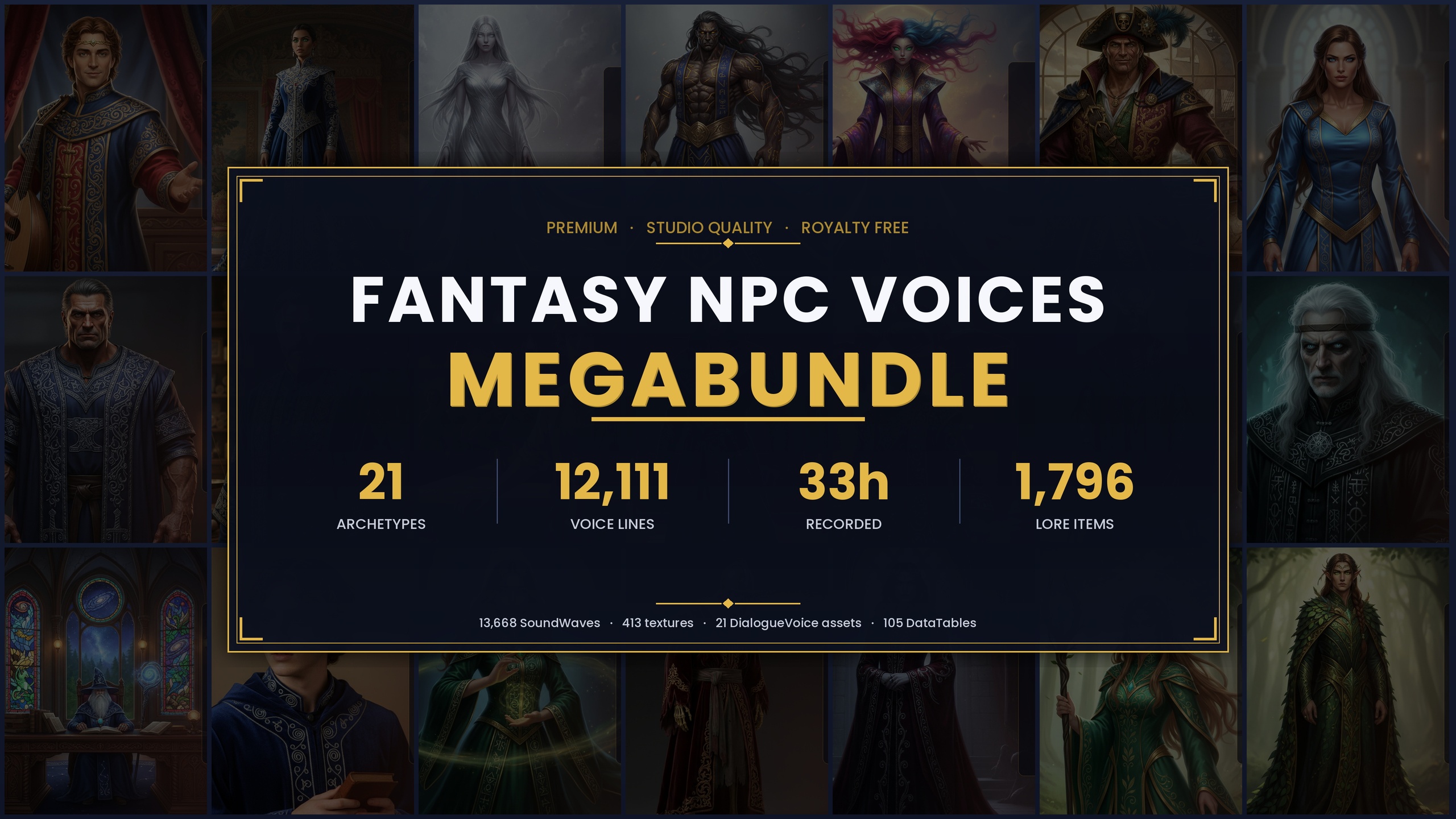
If you are looking at ue5 large audio pack import memory performance, the file size is usually what set off the alarm. The Fantasy NPC Voices Complete Pack ships as a roughly 30.7 GB zip that expands to about 30.8 GB on disk, holding 27,880 .uasset files plus four .ini files and a single .uproject. That weight is not bloat. It is the cost of 21 fully-voiced NPC archetypes and 13,668 USoundWave assets consolidated into one UE5.3 project, with a matching audio cue for every SoundWave.
Of those 13,668 SoundWaves, 12,111 are dialogue lines, 793 are voice-FX lines and 764 are music and theme tracks. The audio masters were recorded at 44,100 Hz, mono, one-shot with no looping. That is CD-quality, single-channel source: detailed enough to sound professional, but every clip still has to live somewhere, and at this line count it adds up fast.
The mistake teams make is treating a 30 GB pack as a single monolith they must import whole. You almost never want all 21 characters in one project, and the pack is not built to force that on you. Each character folder under 'Content/FantasyNPCVoices_CompletePack/' is self-contained, which means the very first performance decision you make is about how much of it you bring across at all.
Migrate only the characters you actually need
The single most effective thing you can do for editor load times, disk footprint and cook duration is to import less. Because every character folder is self-contained and the bundle uses an asset-type-first layout (Audio, AudioCues, DataTables, DialogueVoices, Structs, Textures), you can lift one archetype out cleanly without dragging the other twenty along.
1. Open the Complete Pack project, or add it as a source you can migrate from.
2. In the Content Browser, navigate to the character folder you want under 'Content/FantasyNPCVoices_CompletePack/'.
3. Right-click the folder and choose 'Migrate'. Unreal traces every dependency for that character and shows you the asset list before it copies anything.
4. Point the migrate target at your own project's 'Content' directory and confirm.
You can repeat this for two characters, five, or eventually all 21 as your cast grows. Migrating one archetype at a time keeps your working project small early on, which is exactly when fast iteration matters most. The shared structs come across automatically because Unreal resolves them as dependencies, so a single migrated character still has everything it needs to run.
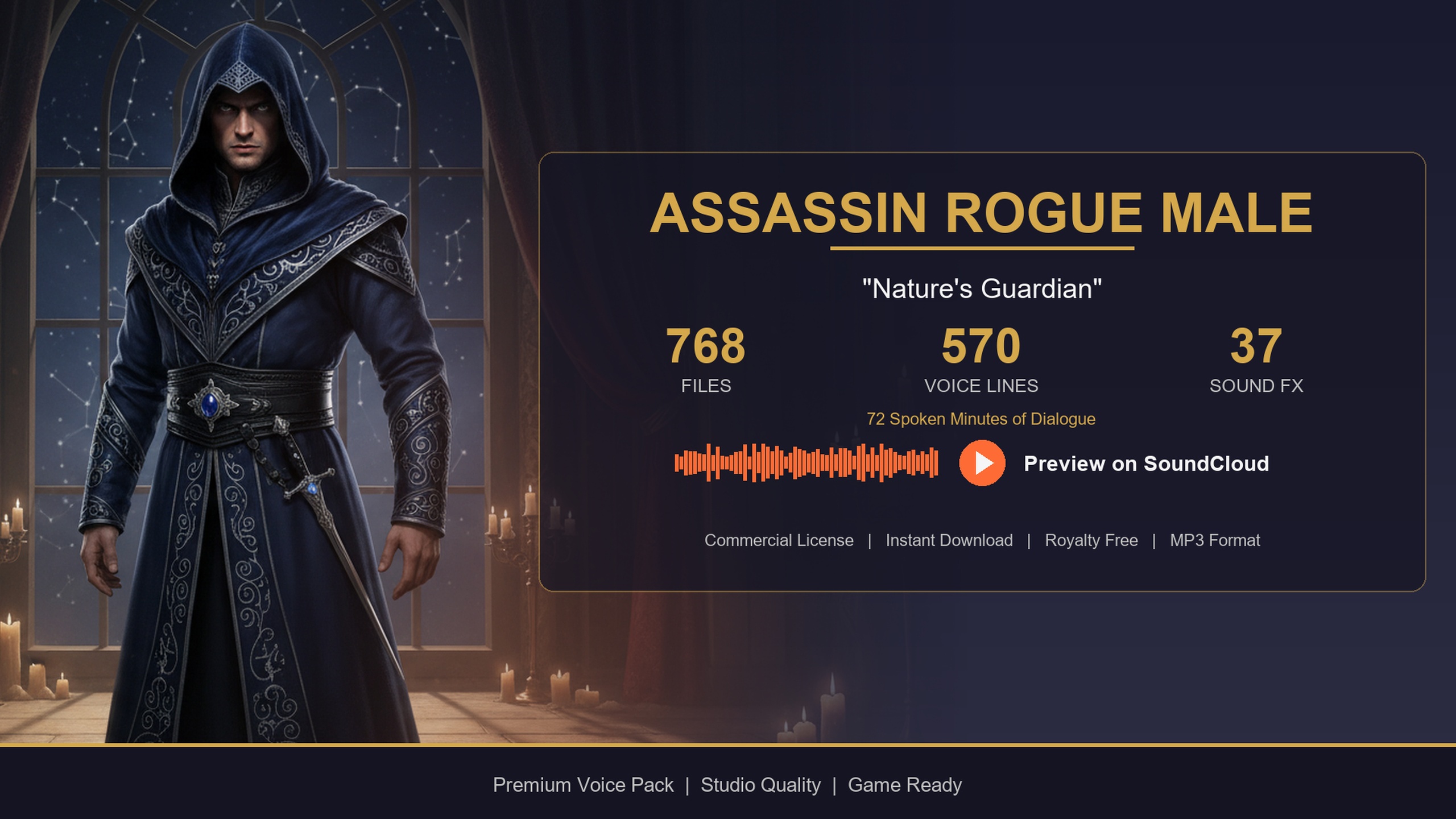
If you only need a handful of speakers, you do not have to buy the megabundle at all. Individual archetypes ship as standalone packs that migrate the same way, and one of them is free, so you can prove out your pipeline before committing storage to the full collection.
Soft references are why runtime memory stays low
A 30 GB pack on disk does not mean 30 GB in RAM, and the reason is the reference type. In the dialogue tables, the audio is not a hard pointer. The 'DT_Dialogue' row schema stores its audio in a 'VoiceAudio' field typed as 'TSoftObjectPtr<USoundWave>'. A soft object pointer is just a path until you ask for the asset, so loading a DataTable does not pull a single SoundWave into memory with it.
Nothing audible loads until first play. When you decide to speak a line, you call 'LoadSynchronous' on that line's 'VoiceAudio' soft pointer, which streams in only that one clip, then play it through 'Play Sound 2D' or 'Play Sound 3D'. With thousands of lines available but only the ones you actually trigger ever resident, your audio memory tracks what is playing, not what is installed. This is what lets a cast of 21 characters sit in a project without a runtime memory penalty proportional to the disk size.
The practical pattern is the same in Blueprint and C++. In Blueprint: reference the character's 'DT_Dialogue', get all row names, filter to rows whose 'ContextTags' contain the situation you want, pick a random match, then 'LoadSynchronous' the 'VoiceAudio' and play it. In C++: call 'GetAllRows' for the 'FDialogueRow' type, filter on 'Row->ContextTags.Contains(Context)', and play a random 'VoiceAudio.LoadSynchronous()'. If a line is long and you want to avoid a hitch on first play, load it asynchronously a beat ahead of when you need it rather than synchronously at the moment of playback.
How the DataTables behave under load
The data layer is small and cheap relative to the audio. The pack ships 105 DataTables, five per character: 'DT_Dialogue', 'DT_CharacterProfile', 'DT_Equipment', 'DT_Quests' and 'DT_WrittenContent'. All 21 characters share the same five row structs, and those structs are byte-identical across every pack, so one query helper works for any NPC you migrate.
DataTables load synchronously, and a single character's tables sit in the region of 50 to 100 rows each, so referencing one in a load or init step is cheap relative to the audio it points at and will not stall you. The cost only becomes noticeable if you re-query a table every frame in a hot loop. The fix is to cache: hold the DataTable reference and the row pointers you care about rather than re-fetching them, and pre-filter rows by category once at initialisation so combat or social lookups during play are just array reads.
Because the schemas are shared, that cache and that filter helper are written once and reused across your whole cast. Adding a new migrated character does not mean a new code path; it means pointing the same helper at a different 'DT_Dialogue'.
Let cook-time compression handle the shipped size
The shipped engine assets are PCM USoundWaves, derived from 128 kbps MP3 source masters. Uncompressed PCM is the largest the audio will ever be, and it is what you see in the editor. It is not what ships in your packaged game.
Unreal compresses audio per target platform at cook time, commonly to Ogg Vorbis on desktop, so the cooked build is substantially smaller than the editor footprint and is encoded in the format each platform prefers. You do not have to pre-convert anything by hand; the cook does it. What you can control is how much gets cooked at all, and that loops straight back to the first decision: a project carrying only the characters you migrated has far less to compress, so both cook time and packaged size scale with the cast you chose, not with the 30 GB you started from.
For platform targeting, stay inside what the pack supports. The listing covers Unreal Engine 5.3 to 5.7 on Windows and Mac; earlier engine versions are not supported because of the asset format. Within those bounds, the per-platform cook gives you appropriately compressed audio without manual reformatting.
Where the size lives, and where it doesn't
| Stage | What drives the cost | How to control it |
|---|---|---|
| On disk | All migrated .uasset files (PCM SoundWaves dominate) | Migrate only the characters you need |
| Editor / DataTable load | Synchronous DataTable load (50-100 rows per character; cheap vs. audio) | Cache the table and row pointers; pre-filter at init |
| Runtime memory | SoundWaves loaded on first play via TSoftObjectPtr | Only triggered lines load; async-load long lines ahead of time |
| Packaged build | Cook-time per-platform compression (often Ogg Vorbis) | Cook only the migrated cast; let the cook compress |
Disk footprint is not the same as editor memory, runtime memory or packaged size. Each is governed by a different mechanism.
FAQ
How do I import a large audio pack into UE5 without wrecking memory or build times?
Don't import the whole 30 GB bundle. Right-click and Migrate only the character folders you need from 'Content/FantasyNPCVoices_CompletePack/', since each folder is self-contained. The dialogue audio is referenced as 'TSoftObjectPtr<USoundWave>', so clips load only on first play, and Unreal compresses the audio per platform at cook time. Together these keep editor load, runtime memory and cook size proportional to the cast you actually use.
Does a 30 GB pack mean 30 GB of RAM at runtime?
No. The audio is held as soft object pointers in the DataTables, so loading a table pulls in no SoundWaves. A clip is streamed in only when you call 'LoadSynchronous' on its 'VoiceAudio' field to play it, so resident audio memory reflects what is currently playing, not what is installed on disk.
Can I avoid migrating all 21 characters?
Yes. Every character lives in its own self-contained folder, so you can Migrate one at a time and add more as your cast grows. Shared row structs come across automatically as dependencies. If you only need a few speakers you can also use the standalone single-character packs, including a free assassin pack, which migrate the same way.
Will the shipped game be as large as the editor pack?
No. The editor holds uncompressed PCM SoundWaves, but Unreal compresses audio per target platform at cook time, commonly to Ogg Vorbis on desktop, so the packaged build is meaningfully smaller. Cooking only the characters you migrated keeps both cook time and packaged size down.
Are the DataTables slow to load given the line count?
No. The DataTables are small relative to the audio they point at: a single character's tables run roughly 50 to 100 rows each and load synchronously, so referencing one at init is cheap. The cost only appears if you re-query every frame, which you fix by caching the DataTable reference and row pointers and pre-filtering by category once at initialisation.
Fantasy NPC Voices
The complete fantasy voice megabundle: roughly 33 hours of dialogue across 13,668 voiced WAVs at 44.1 kHz — paladins, vampires, witches, wizards, bards, goblins, necromancers and more. One library to voice an entire RPG cast.
Related on Fab
Related reading