
article · 2026-02-10
Nanite Foliage in UE5: Using Nanite Flower Meshes Without Tanking Performance
How Nanite changes the rules for dense flower fields, and the workflow that keeps a stylised garden running smoothly.
What Nanite foliage actually does
If you have ever painted a few hundred high-poly flowers across a glade and watched your frame budget evaporate, you already know the problem this article is about. Nanite foliage performance in Unreal Engine 5 is one of those topics where the marketing and the reality have drifted apart, so it is worth being precise about what the system gives you and what it does not.
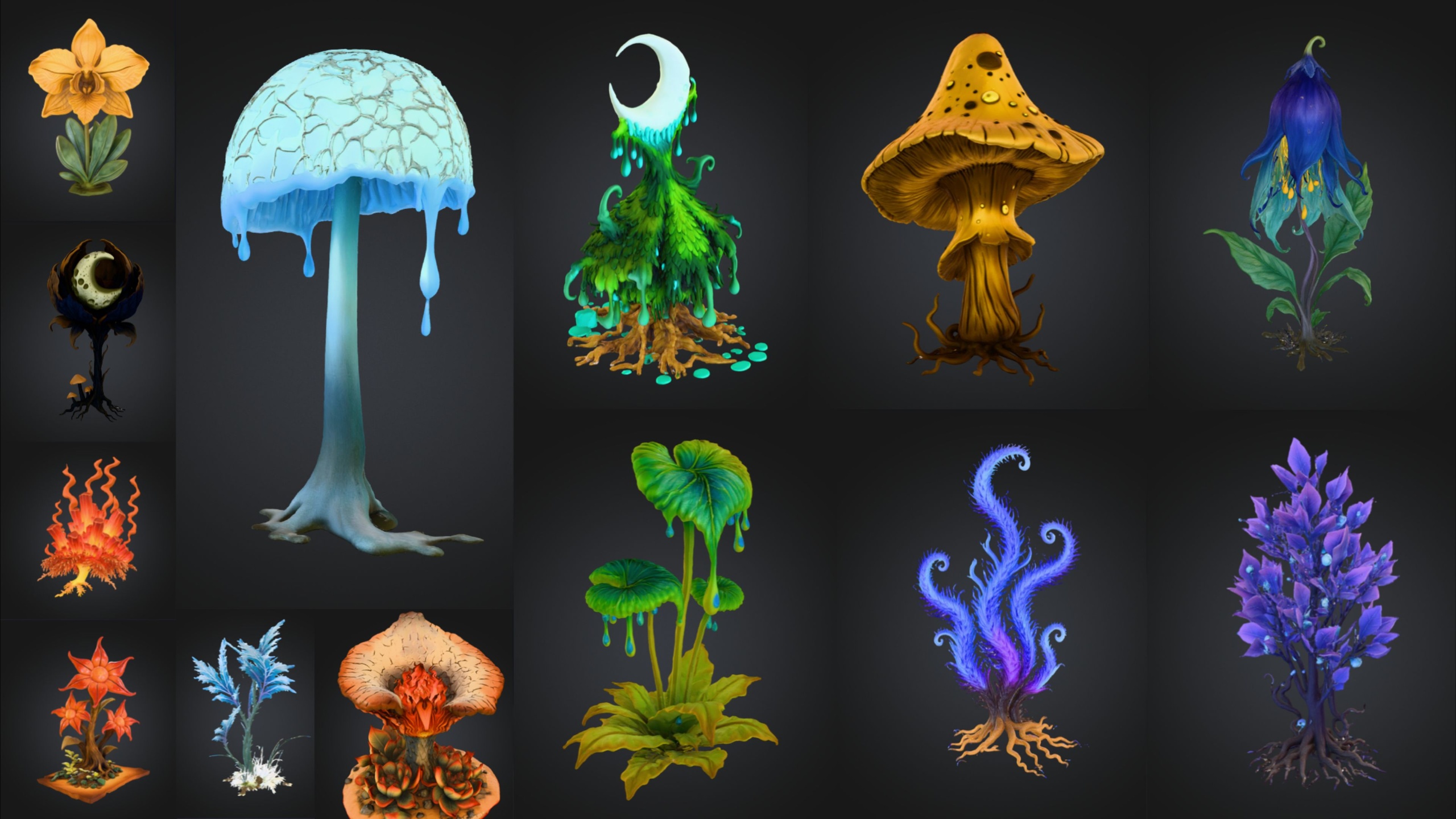
Nanite is UE5's virtualised geometry system. Instead of authoring and shipping a stack of discrete LODs for each mesh, you enable Nanite and the engine streams and renders triangles at a density appropriate to how many screen pixels the object covers. A flower filling half the frame draws a lot of detail; the same flower as a speck on the horizon draws almost none, and the transition is continuous rather than a visible LOD pop. The Fantasy Flower Pack ships its 51 plants as Nanite-ready static meshes precisely so you can drop high-detail blooms into a scene without hand-building LOD chains for every one of them.
The catch is that Nanite is geometry only. It does not virtualise materials, it does not magic away overdraw from large translucent cards, and it does not replace the per-instance bookkeeping that dense scatter creates. Understanding that boundary is the whole game when you are trying to keep a flower-heavy scene fast.
When Nanite helps, and when traditional foliage still wins
Nanite earns its keep when your foliage is genuinely dense geometry: solid, modelled petals and stems with real silhouettes, repeated thousands of times. That is exactly the shape of a hand-modelled flower mesh. Each plant in the Fantasy Flower Pack is its own static mesh with its own material and 2K PBR texture set, so when you scatter them across a garden floor, Nanite is doing what it is best at, collapsing an enormous triangle count down to whatever the current view actually needs.
Where the old hand-LOD-and-billboard approach can still beat Nanite is the classic grass-card field: huge numbers of flat, alpha-tested quads. Masked translucency forces the renderer to evaluate the material across overdrawing layers, and that cost lands whether the geometry is virtualised or not. If your ground cover is mostly thin cards rather than modelled volume, profile before you assume Nanite is the answer. For sculpted blooms with actual three-dimensional form, though, Nanite is the path of least resistance.
One honest caveat: these flowers are static meshes, not a wind-animated foliage system. There is no shipped Pivot Painter or vertex-wind setup in the pack, so they will not sway on their own. If you want motion, that is a material or World Position Offset job you add yourself, and WPO interacts with Nanite culling in ways you should test, not assume.
Instancing dense flower fields
Drawing a thousand individual actors will hurt no matter how clever the geometry system is, because the cost moves from triangles to draw calls and CPU-side instance management. The fix is instancing: tell the engine that you are placing many copies of the same mesh so it can batch them. With 51 distinct meshes to draw from, you have enough variety to build a convincing field while still keeping each species batched.
1. Decide your placement tool first. For a painted, art-directed look, use the Foliage tool: open the 'Foliage' mode, click 'Add Foliage Type', and assign one of the SM_FantasyFlower_ meshes. Painted foliage is rendered as instanced static meshes automatically, which is what you want.
2. For procedural coverage, feed the same meshes into a PCG graph instead and let it scatter them across a surface. PCG output renders through instancing as well, and it makes re-rolling the layout trivial. Treat both Foliage and PCG as workflow choices on your side, the meshes are not pre-configured as foliage types out of the box, so you assign them yourself.
3. Mix species deliberately. Rather than one mesh repeated, blend several of the 51 plants, blossoms, lotuses, crystalline plants, mushrooms, nightshade and ember blooms, at different densities. Visual variety breaks up obvious tiling, and because each species is its own instanced batch, you control the cost of each one independently.
4. Cull aggressively at distance. Set sensible culling distances on each foliage type so flowers stop drawing once they are too small to read. Nanite will already thin their triangles, but removing the instance entirely beyond a threshold saves the per-instance overhead Nanite does not address.
Every flower in the pack ships with automatic collision. That is convenient for hero placement, but collision is rarely wanted on ten thousand background blooms, so disable collision on your scatter instances and keep it only where the player can actually interact.
Profiling your scene
Never tune foliage by feel, measure it. UE5 gives you the tools to see exactly where a dense field is spending its time, and a few minutes with them will save you from chasing the wrong bottleneck.
1. Start with 'stat unit' in the console to see whether you are bound by the game thread, the draw thread or the GPU. Dense instanced foliage that is too slow usually shows up as a draw-thread or GPU cost, and the two demand different fixes.
2. Open the Nanite visualisation modes from the viewport view-mode menu to inspect triangle and cluster density across your flowers. If a single bloom is still drawing far more triangles than its screen size justifies, your Nanite fallback or screen-size settings need attention.
3. Use 'stat RHI' and the GPU profiler ('ProfileGPU', or Ctrl+Shift+comma) to confirm where the milliseconds go. Compare the cost with the foliage hidden versus shown so you know how much of your frame the field is really claiming.
4. Iterate on culling distance and species mix, then re-measure. Treat each change as an experiment with a before and after number, not a guess. Real measured deltas are the only honest evidence that your optimisation worked.
Work this loop and a garden of 51 distinct Nanite flowers becomes a set-dressing layer you can afford rather than a frame-rate liability. The geometry system does the heavy lifting on detail; your instancing and culling discipline does the rest.
Nanite vs traditional foliage for flower scatter
| Factor | Nanite static-mesh flowers | Traditional LOD + billboard cards |
|---|---|---|
| Best for | Modelled, volumetric blooms with real silhouettes | Flat alpha-card grass and filler |
| LOD authoring | None needed, geometry is virtualised | Manual LOD chain plus billboard |
| Main cost risk | Per-instance overhead at huge counts | Masked-translucency overdraw |
| Detail at close range | High, continuous, no LOD pop | Limited by authored top LOD |
| Setup effort | Drop in, enable instancing, cull | Build LODs and tune transitions |
A rough decision guide, not a benchmark. Always profile your own scene.
FAQ
Does Nanite foliage actually improve performance in Unreal Engine 5?
For dense, modelled foliage it usually helps, because Nanite renders only the triangles your current view needs and removes the work of authoring LOD chains. It does not reduce per-instance overhead or material and overdraw cost, so you still need to instance your scatter and cull it at distance. For flat alpha-card grass the win is smaller, profile before deciding.
Are the Fantasy Flower Pack meshes Nanite-ready?
Yes. All 51 plants ship as Nanite-ready static meshes built for Unreal Engine 5.6, each with its own material, a 2K PBR texture set and automatic collision, so they drop into a level without manual LOD setup.
How do I scatter the flowers across a large area efficiently?
Use instancing. Add the meshes as Foliage types and paint them, or feed them into a PCG graph for procedural scatter, both render as instanced static meshes. Mix several of the 51 species, set culling distances, and disable collision on background instances so it only stays where players interact.
Do the flowers sway or animate in the wind?
No. They are static meshes with no shipped wind or Pivot Painter setup, so they will not move on their own. If you want motion you add it yourself with a material or World Position Offset, and you should test how that interacts with Nanite culling.
What engine version do I need?
The pack is built and shipped as an Unreal Engine 5.6 project for Windows. Open the included project directly, or migrate the content folder into your own UE5 project.
Fantasy Flower Pack
Fifty hand-modelled fantasy, sci-fi and gothic flowers — 51 unique meshes with automatic collision, 201 textures at 2048² and Nanite-ready geometry. Dress gardens, alien worlds and stylised scenes.
Related on Fab



Related reading