article · 2026-02-27
Choosing NPC Voice Archetypes for a Believable RPG Town
How to cast common-folk, heroic and divine voices that feel like they belong to the same world — and unify them under one data layer.
The problem with casting a town from one voice
A believable RPG town is a chorus, not a soloist. The smith at the forge, the bard in the tavern and the god whose shrine looms over the square cannot all sound the same, or the world flattens the moment a player walks two streets. Yet the temptation for most teams is to lean on a single voice source and stretch it across every role, which is exactly when the cast starts to feel synthetic.
The fix is to think in archetypes. When you are searching for rpg npc voice archetypes for a fantasy town cast, what you actually need is a small, deliberate spread of voice styles that map cleanly onto the social tiers of a believable settlement: the common folk who run the shops, the heroic and noble characters who give quests, and the divine or otherworldly presences that sit above mortal life. Get those three tiers right and a town reads as lived-in before a single line of branching dialogue is written.
This guide walks through how to choose voices for each tier, how to match a voice style to an NPC's role, and — crucially — how to keep a mixed cast technically coherent by building every archetype on the same dialogue data layer. The Blacksmith Dialogue Pack is the worked example throughout, because the common-folk smith is the backbone every town is built around.
Common-folk vs heroic vs divine voices
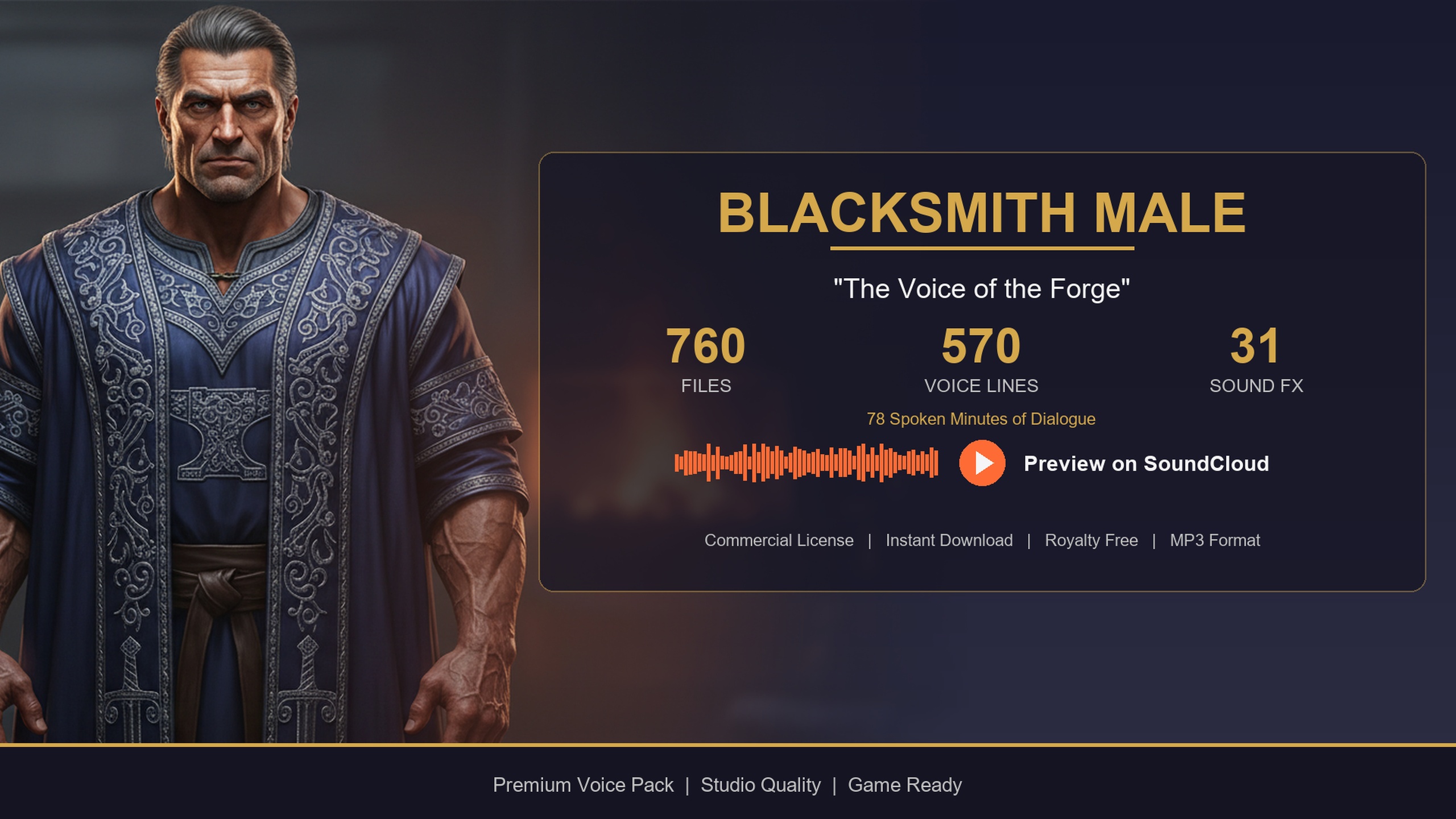
Start with the common folk, because they are the voices a player hears most. These are the shopkeepers, smiths and townsfolk who deliver greetings, commerce flavour and incidental banter all day long. The voice here should be grounded and unglamorous — a worker's voice, not a performer's. The Blacksmith Dialogue Pack delivers exactly this register: a gravel-throated, forge-warm baritone built for a shopkeeper or smith, with context-aware lines spanning greetings, shop and commerce flavour, social, combat and emotion. It is one of the common-folk tier archetypes, and it is the natural anchor for a town cast.
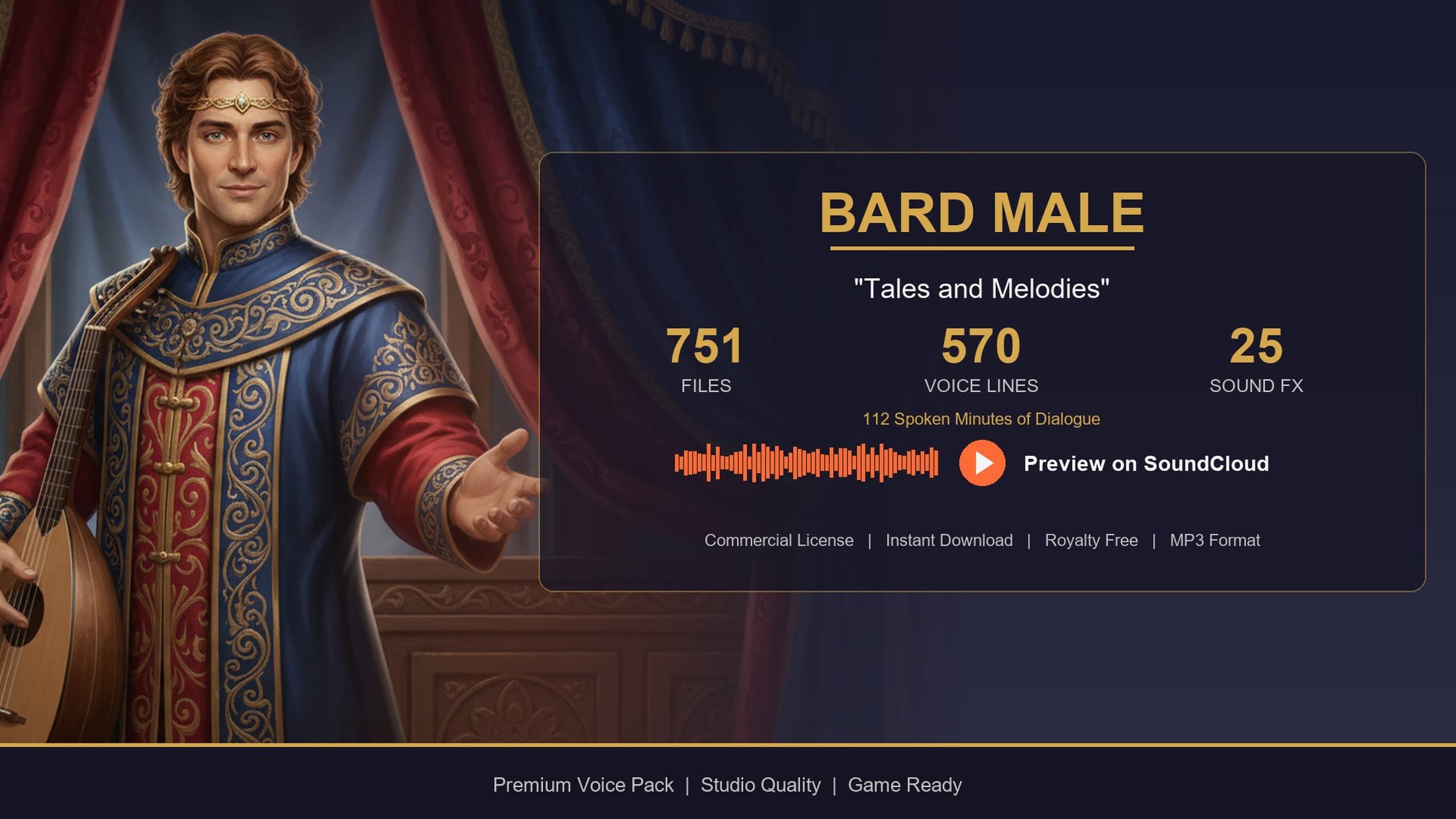
The heroic and noble tier sits a step above. These are your quest-givers and travelling characters, and their voices want charisma and projection rather than weariness. The Bard Dialogue Pack is the clean example here — a charismatic, theatrical male-bard performance with dramatic inflection, written to skew narrative for quest-giving, tavern tales and travelling-minstrel banter. Bards are story-heavy by nature, so this is the voice you reach for when a character needs to hold a player's attention through a long piece of exposition.
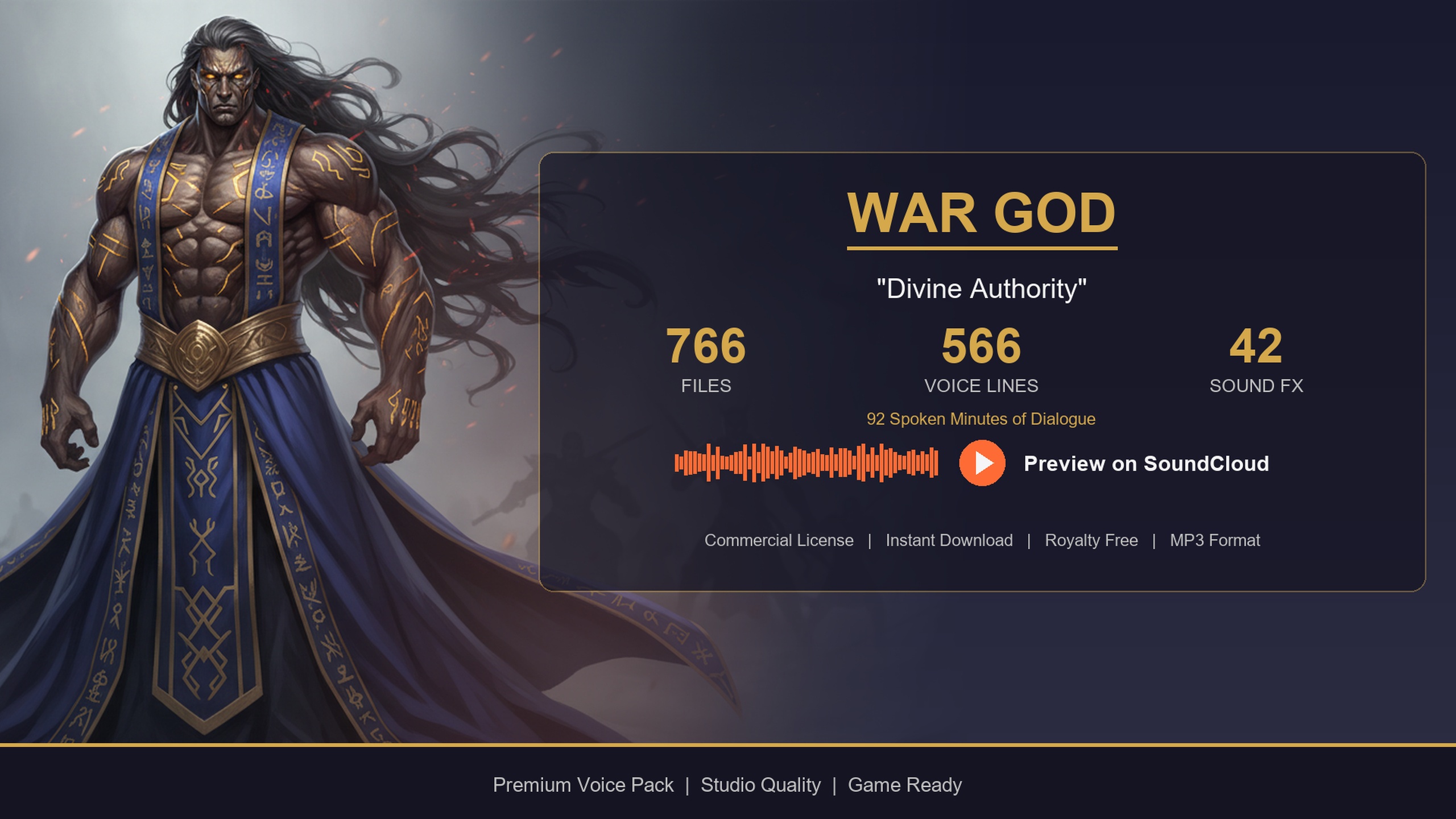
The divine tier is deliberately rare and deliberately different. A god or oracle should not sound like anyone the player can buy a sword from. The Deity Dialogue Pack supplies a thunderous, commanding war-god performance — booming proclamations and cinematic divine narration suited to gods, oracles and otherworldly beings. Used sparingly, at a shrine or a boss reveal, that contrast is precisely what makes the common folk feel mortal and the world feel layered.
The wider collection these packs belong to spans heroic and noble, arcane and mystical, divine, dark and villainous, and common-folk roles, so the three tiers above are a starting frame rather than the full palette. But for a town specifically, common-folk anchor plus heroic quest-givers plus a single divine presence is a casting spread that punches well above its line count.
Matching voice style to NPC role
Once you have your tiers, match the voice to what the NPC actually does on screen. A blacksmith's job is repetition and reliability: store-enter greetings, store-exit farewells, and flavour lines whenever the player upgrades or repairs gear at the forge. The Blacksmith pack's lines are tagged by category and subcategory, so you can pull greetings for a shop-open event and farewells for a shop-close event without hand-authoring anything. The forge-warm baritone is doing the heavy lifting of making a transactional NPC feel like a person.
A bard's job is the opposite — fewer, longer, more memorable moments. Because the performance is theatrical and the content skews narrative, lean on the longer line tiers for quest-giving and the story category for narrative beats, and let the bard carry cutscene-style delivery or a campaign intro. You do not want a bard barking the same one-liner every time the player passes; you want a handful of richer set-pieces.
A deity's job is rarer still and almost always non-diegetic. Trigger booming proclamations at shrines, rituals or boss arenas, and use the longer line tiers for prophecy and pronouncement. For a true voice-of-god effect, play the line in 2D with no spatial attenuation so it addresses the player from everywhere at once; reserve in-world 3D playback for when the voice genuinely emanates from an altar in the scene.
The practical rule across all three: common-folk voices are high-frequency and short, heroic voices are mid-frequency and narrative, and divine voices are low-frequency and cinematic. Cast to that frequency curve and a town's audio never feels either repetitive or overwrought.
How the same data layer unifies a mixed cast
The reason you can mix these three very different voices without the project turning into three different integration jobs is that they all sit on an identical dialogue schema. Every archetype in the collection uses the same DT_Dialogue DataTable and the same shared row structs, so the smith, the bard and the deity are queried by exactly one code path.
Concretely, the Blacksmith pack ships five DataTables per the collection layout — DT_Dialogue, DT_CharacterProfile, DT_Equipment, DT_Quests and DT_WrittenContent — and the Bard and Deity packs ship the same five. The DT_Dialogue rows carry the same fields throughout, including ContextTags for filtering and a VoiceAudio reference held as a TSoftObjectPtr to a USoundWave, which means nothing loads into memory until a line is actually played.
That uniformity is what lets you write the integration once. Here is the pattern that works for any archetype in the set:
1. Cache the character's DT_Dialogue reference at init rather than looking it up per line, and pre-filter rows by category so hot paths stay cheap.
2. When an event fires — a shop overlap, a quest hand-off, a shrine activation — filter the cached rows by the relevant ContextTags, for example social/greeting for a smith's store-enter bark.
3. Pick a random row from the filtered set so repeated visits do not replay the same clip.
4. Call LoadSynchronous on the row's VoiceAudio to resolve the soft pointer, then Play Sound 2D for non-diegetic delivery or Play Sound 3D for an in-world source.
5. Optionally display the row's ResponseText alongside the audio for subtitles or a dialogue box.
Each pack also includes a DialogueVoice (DV_) asset, so if you prefer Unreal's native dialogue system you can assign that asset as the speaker instead of driving playback by hand. Either way, swapping the smith for the bard or adding the deity changes which DataTable you point at — not the code that reads it.
Scaling from one archetype to the full bundle
Most teams should start narrow. Buy the single archetype your town cannot do without — for most fantasy settlements that is the Blacksmith, the common-folk anchor — migrate its self-contained content folder into your project, and wire up the query pattern above. Because each pack is drop-in, you prove out your dialogue integration against one character before committing to a cast.
From there you add tiers as the design needs them: a Bard pack for your first proper quest-giver, a Deity pack the moment a shrine or a divine boss enters the design. Every addition reuses the integration you already wrote, because the schema is shared, so the marginal cost of each new voice is download-and-migrate rather than re-engineer.
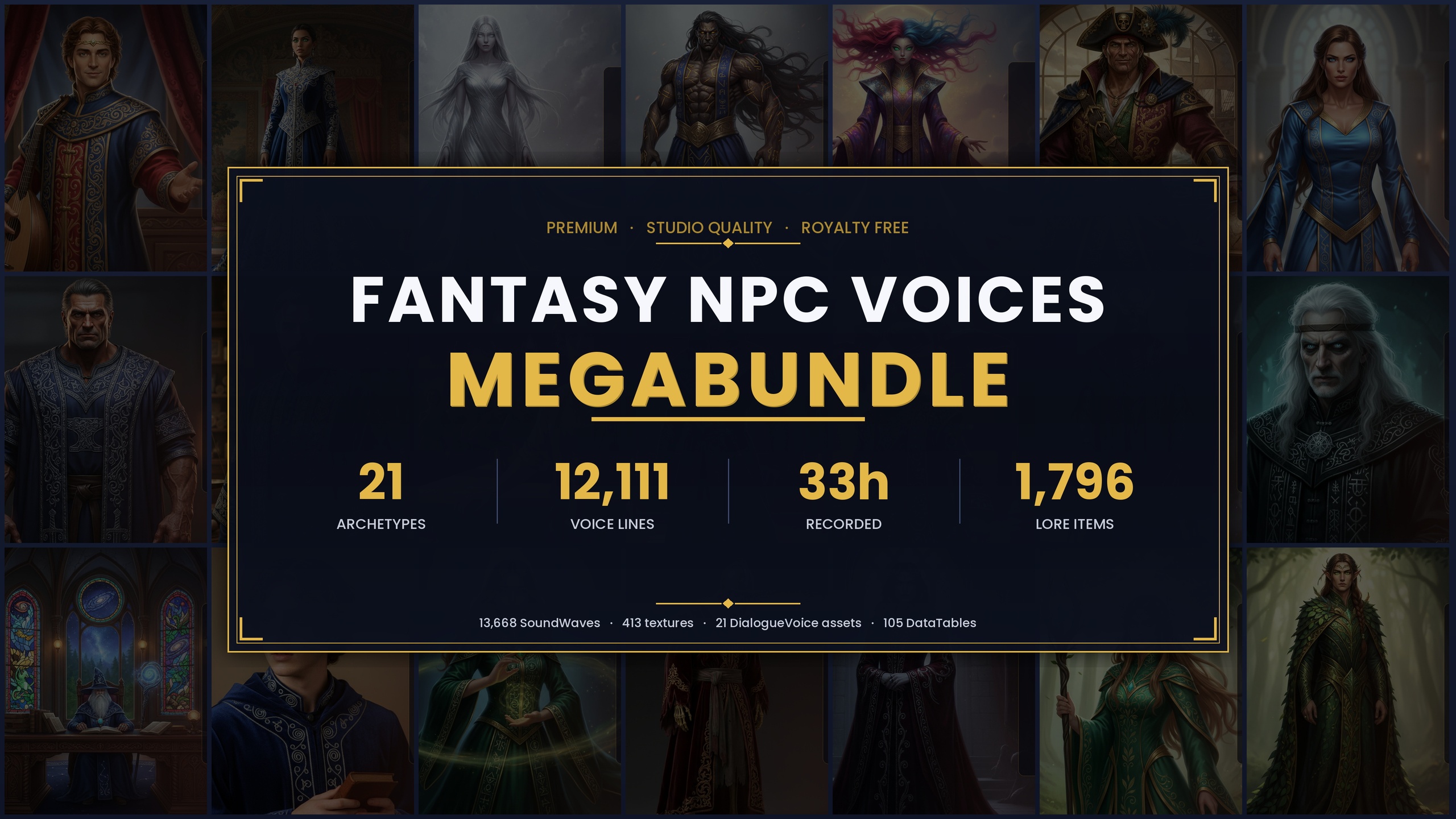
When the cast outgrows piecemeal buying, the Fantasy NPC Voices complete megabundle consolidates 21 distinct archetypes into a single UE5.3 project, spanning heroic and noble, arcane and mystical, divine, dark and villainous, and common-folk roles. All 21 characters share the same five row structs — byte-identical across every pack — so the one query helper you wrote for the blacksmith reads any character in the bundle without modification. It is the option for voicing an entire RPG cast from day one; the individual packs are the option for building that cast one believable voice at a time.
Whichever route you take, the casting principle is the same: pick voices by tier, match them to role, and let the shared data layer make a mixed town behave like one coherent project. Start with the smith, get your forge greetings firing on shop overlap, and you have the spine of a believable town in an afternoon.
Casting a fantasy town by voice tier
| Pack | Tier | Voice style | Voice lines | Audio | Price |
|---|---|---|---|---|---|
| Blacksmith Dialogue Pack | Common-folk | Forge-warm baritone (smith/shopkeeper) | 570 | ~78 min | $14.99 |
| Bard Dialogue Pack | Heroic / noble | Charismatic, theatrical bard | 570 | ~112 min | $3.99 |
| Deity Dialogue Pack | Divine | Thunderous war-god | 566 | ~92 min | $9.99 |
| Fantasy NPC Voices (Complete) | All tiers (21 archetypes) | Full collection in one project | 12,111 dialogue lines | ~33 hours voiced | $99.99 |
Figures are the User Guide voice-line and audio-runtime counts for each pack; prices are the listed Fab prices.
FAQ
What RPG NPC voice archetypes do I need for a believable fantasy town cast?
At minimum, three tiers: a common-folk anchor for shopkeepers and smiths, a heroic or noble voice for quest-givers, and a sparingly used divine voice for gods or oracles. The Blacksmith, Bard and Deity packs map directly onto those tiers, and the wider collection also covers arcane and dark or villainous roles if your town needs them.
Will mixing voices from different packs create extra integration work?
No. Every archetype in the collection shares the same DT_Dialogue schema and the same row structs, so you write one query helper and reuse it for every NPC. Adding a new voice changes which DataTable you point at, not the code that reads it.
Which pack should I buy first for a town?
Start with the common-folk anchor — usually the Blacksmith Dialogue Pack — because shopkeepers and smiths carry the most frequent lines a player hears. Prove out your dialogue integration against that one self-contained content folder, then add heroic and divine tiers as the design calls for them.
What engine versions and platforms are supported?
The packs list Unreal Engine 5.3 and up (5.3 to 5.7) and support Windows and Mac. Audio ships as one-shot USoundWave assets referenced through soft object pointers, so lines only load when first played.
How do I trigger a blacksmith's greeting and farewell lines?
Filter DT_Dialogue by the relevant ContextTags — for example a social greeting subcategory for store-enter and a farewell for store-exit — pick a random matching row, LoadSynchronous the VoiceAudio, and Play Sound 2D or 3D. Tie the greeting to a shop-open or overlap event and the farewell to shop-close.
Blacksmith Dialogue Pack
Forge banter, shop greetings and crafting flavour — 78 minutes of characterful blacksmith dialogue for fantasy and medieval games. Ready-to-use cues for any UE5 project.
Related on Fab
Related reading