
tutorial · 2026-04-15
How to Make an Occult Ritual Room Scene in Unreal Engine 5
Build a believable altar chamber in UE5 using canopic ritual jars, candlelight and a layered soundscape.
Start with the altar, not the room
If you want to know how to make an occult ritual room scene in Unreal Engine, the mistake to avoid is building the walls first. A ritual chamber reads as occult because of what sits at its centre and how the eye is led there, not because of the masonry around the edge. So begin with the focal point, dress outward from it, and let the architecture follow the composition rather than dictate it.
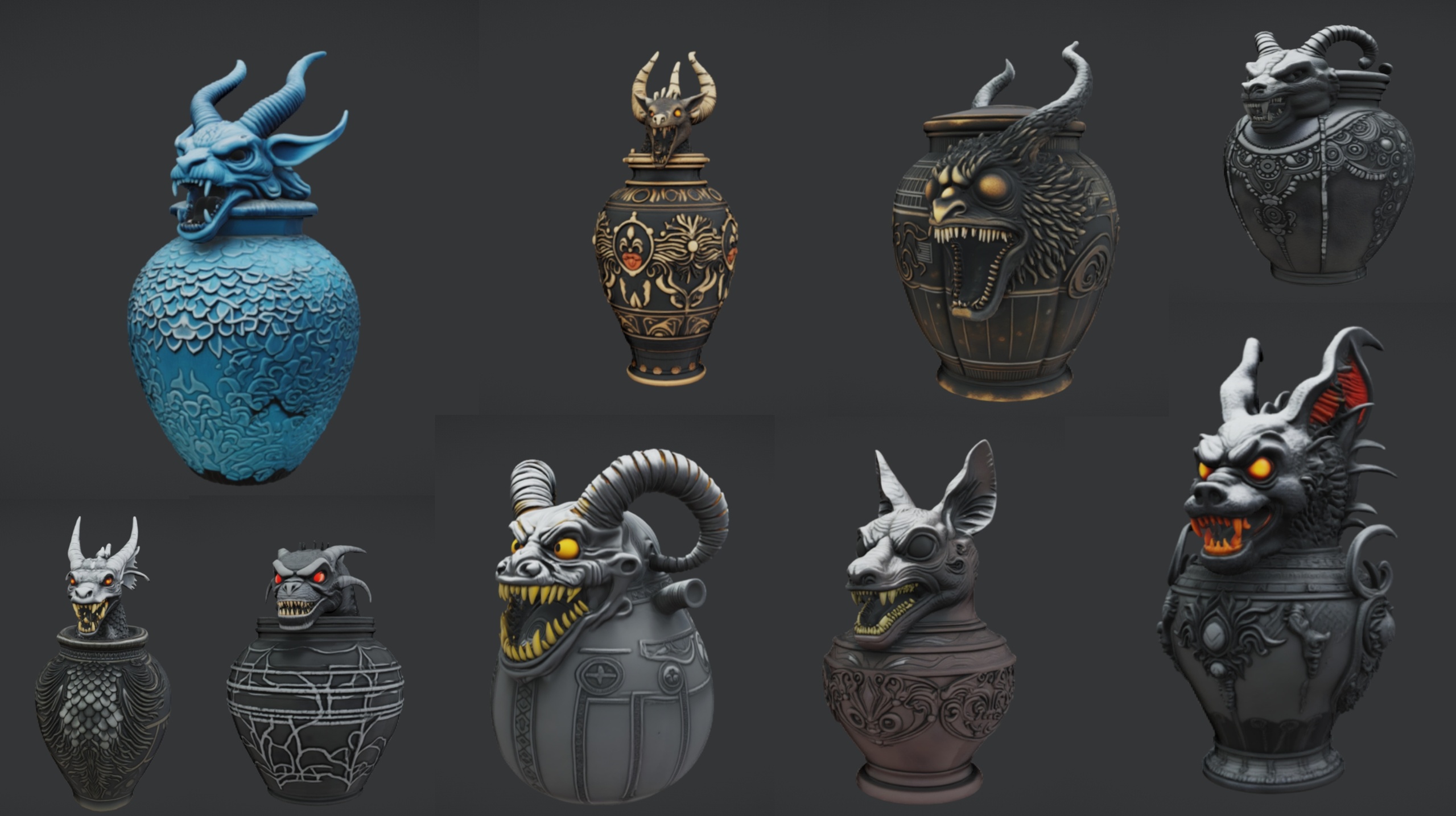
The Ritual Jars pack is built for exactly this approach. It ships nine ornate canopic-style jars (SM_RitualJar_1 through SM_RitualJar_9) plus a single large table mesh, SM_LargeTable, that is intended to serve as your altar. That table is the anchor of the whole scene. Drop SM_LargeTable into an empty level first, set it at the room's centre of gravity, and treat everything else you place as a relationship to it.
Every mesh in the pack is a Nanite static mesh with automatic collision and 2K PBR textures already assigned, so there is no LOD authoring or material wiring to do before you can compose. That matters early on, because it means you can iterate on layout at full visual fidelity instead of greyboxing — what you frame in the viewport is close to what you will light and ship.
Compose the camera before you fill the table
An occult scene lives or dies on framing, so decide where the player or camera will stand before you commit to an arrangement. Place a Cine Camera Actor at roughly eye height a few metres back from SM_LargeTable, pilot it, and use that view as your working composition the entire time you dress the altar.
Aim for a clear focal hierarchy. The altar should sit on or near a horizontal third, with a strong sense of depth front-to-back: something low and close to the camera, the jars as the mid-ground mass, and a darker void behind. Because the jars carry an Egyptian, gothic and abyssal/occult aesthetic, they do the thematic heavy lifting on their own once they are framed deliberately rather than scattered.
Leave deliberate negative space. A ritual room feels charged because it is sparse and intentional, not cluttered. Resist the urge to cover the table — empty surface around the jars is what signals ceremony.
Arrange the jars for ritual symmetry
Occult staging reads as deliberate when it is symmetrical or rhythmically repeated, because real ritual is about order imposed on chaos. With nine jars to work with you have enough to build a strong axis and still vary the silhouette.
1. Pilot your camera and select SM_LargeTable so you have a stable reference for the altar surface.
2. Place one jar dead centre and slightly back as the keystone of the arrangement — pick the most visually distinct of SM_RitualJar_1 to _9 for this role so the eye lands on it.
3. Mirror jars outward in matched pairs to the left and right of the keystone, holding the same spacing on each side. Use the 'Details' panel to type exact location values rather than dragging by eye, so the symmetry is clean.
4. Stagger a second row slightly behind and between the front jars to add depth without breaking the axis. Rotate individual jars a few degrees on yaw so identical meshes do not read as copy-paste.
5. If you want a less formal, more disturbed look, break the symmetry on purpose with a single toppled jar — but make it obviously intentional, off the main axis, so it reads as narrative rather than carelessness.
Because each jar already has automatic collision, you can let physics or manual nudging settle them naturally against the table surface without writing any setup. Treat the jars as static decorative meshes — whether any have openable lids was not part of the pack's design, so build around them as sealed vessels.
Light it with candles, not the sun
Nothing kills an occult mood faster than flat, even lighting. The room should be lit almost entirely from within — candle flames, a brazier, the faint glow of whatever the ritual is summoning — with deep shadow doing most of the work.
Kill or heavily dim any directional and sky light, then place Point Lights at the positions where candle flames would sit, low on or around the altar. Give them a warm colour temperature, a low intensity, and a tight attenuation radius so the light pools on the jars and falls off into blackness. A subtle, animated flicker — driving the light's intensity from a small sine-plus-noise value in the level Blueprint or a flame Blueprint — sells the candlelight far more than a static glow.
Lean on the 2K PBR materials here. The jars' normal and roughness maps are what make warm raking light catch their carved detail; a single grazing key light across the front row will reveal far more surface character than overhead fill. Add a faint volumetric fog so the candlelight has something to bloom into, and let the back of the room dissolve into dark.
Add rune props and a thematic backdrop
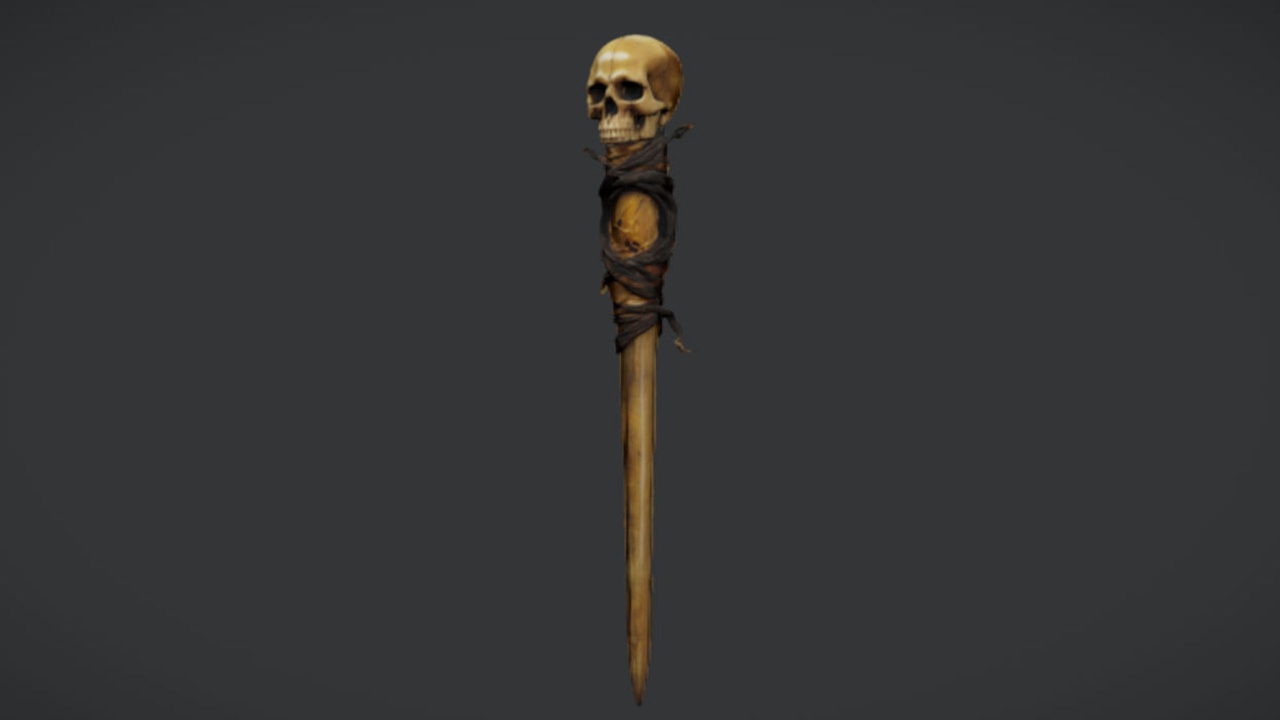
Jars and candles establish the altar; supporting props turn it into a story. The single most effective addition is a caster's implement laid across or leaning on the altar. The Necromancer's Staff is a free UE5 static mesh with 2K PBR textures that drops straight in as set dressing — rest it against the table edge or lay it across the front of the arrangement as the ritual's centrepiece tool. It ships as a plain static mesh with no VFX or attachment Blueprint, so for set dressing you simply place it; to put it in a character's hand you would set up a socket and attach it yourself.
For the backdrop, a looming face overhead transforms the whole register of the scene. The Grinning Moon Face Bundle gives you thirteen surreal moon-face meshes — all-seeing, screaming, haunted, arcane and more — each a Nanite static mesh with 2K textures. Place one large and distant behind the altar as a false moon that appears to watch the ritual; it is a fixed static mesh, so if you want it to glow you raise the emissive on its material yourself rather than expecting a built-in shader.
If you need to fill out the surrounding chamber quickly, the Dark Fantasy Props Bundle is a content project of 100+ gothic static meshes — cauldrons, tomes, lanterns, obelisks, altars and scrolls — that lets you dress the room around your central altar in a single pass. Like the jars, its meshes are Nanite and ship with their materials assigned. Note that the jars target UE 5.7 while the moon faces and the dark-fantasy bundle are authored for UE 5.6, so migrate content into a single project version and accept an engine-upgrade prompt where needed.
Layer the atmospheric audio
A ritual room you can hear is far more convincing than one you only see, and audio is the cheapest atmosphere you will ever add. Build it in layers so the space feels alive without any one sound drawing attention to itself.
Start with a continuous, looping room tone — a low drone or sub-bass hum — on an Ambient Sound actor with attenuation disabled so it fills the whole space evenly. This is the bed everything else sits on. Over it, place small attenuated Ambient Sound actors at each candle so a soft crackle and flicker emanate from the flames themselves, fading as the player moves away. For motion, add occasional one-shot stingers — a distant whisper, a single struck tone, a breath of wind — triggered on a randomised timer so the room never feels mechanically looped.
Mix for restraint. Keep the drone quiet enough that it registers as unease rather than sound, and let the silences between stingers do the unsettling work. An occult room should feel like it is holding its breath.
Props for an occult ritual room
| Pack | Role in the scene | Assets | Engine | Price (USD) |
|---|---|---|---|---|
| Ritual Jars | Central altar and canopic jars | 9 jars + table, 11 materials | UE 5.7 | 7.99 |
| The Necromancer's Staff | Caster implement on the altar | 1 static mesh | UE5 | Free |
| Grinning Moon Face Bundle | Looming backdrop / false moon | 13 face meshes | UE 5.6 | 5.99 |
| Dark Fantasy Props Bundle | Surrounding chamber dressing | 100+ static meshes | UE 5.6 | 34.99 |
Roles and verified specs for the packs referenced in this build. Engine versions are the authored versions per each pack's listing.
FAQ
How do I make an occult ritual room scene in Unreal Engine 5?
Start from the centre: place an altar table, arrange canopic-style ritual jars on it with deliberate symmetry, light the room almost entirely with warm flickering candlelight against deep shadow, add rune and caster props such as a staff, and layer a quiet looping room tone with attenuated candle crackle. The Ritual Jars pack supplies the altar table and nine jars as ready-to-place Nanite meshes.
How many ritual jars are in the pack and what does it include?
The Ritual Jars pack includes nine ornate canopic-style jar meshes (SM_RitualJar_1 to _9), a large table mesh (SM_LargeTable) to use as the altar, and a grass material for the demo ground — ten static meshes and eleven materials in total. All are Nanite with automatic collision and 2K PBR textures, delivered in a UE5 demo project.
Which Unreal Engine version do these packs target?
Ritual Jars is authored for Unreal Engine 5.7. The Grinning Moon Face Bundle and the Dark Fantasy Props Bundle are authored for UE 5.6, and The Necromancer's Staff is a generic UE5 mesh. Combine them in a single project version and accept the engine-upgrade prompt where required; older-engine compatibility for the 5.7 jars is not guaranteed without testing.
Do the jars have openable lids or animation?
Treat the jars as static decorative meshes. Whether any have openable lids was not part of the pack's verified design, and they ship as static meshes rather than animated or skeletal assets. Build your scene around them as sealed ceremonial vessels.
How should I light an occult altar scene?
Dim or remove directional and sky lighting and light from within using warm, low-intensity Point Lights placed where candle flames sit, with tight attenuation so the light pools on the jars and falls into darkness. Add a flicker by driving each light's intensity from a small sine-and-noise value, and use a faint volumetric fog so the candlelight has something to bloom into.
Ritual Jars
Nine ornate canopic ritual jars — Nanite meshes with automatic collision and 2K textures. Egyptian, gothic and abyssal props for tombs, altars and occult scenes.
Related on Fab


Related reading