article · 2026-06-04
Ancient Civilizations in UE5: Egyptian, Mayan & Occult World-Building
Build believable tombs, temples and ritual chambers in Unreal Engine 5 by pairing authentic ancient-script VFX with funerary props.
Selling an ancient world through detail
An ancient temple or tomb sells the moment the writing on the wall is the writing those people actually used. If you are doing Egyptian, Mayan or ancient world building in Unreal Engine, the fastest way to break the illusion is to scatter a single stock glyph loop across every surface, or to paste decorative shapes that read as 'fantasy runes' rather than a real script. Players who have seen a museum, a documentary or a single photo of a pyramid wall feel the difference even when they cannot name it.
The honest approach is to compose inscriptions from real characters and then light them like a discovery. This guide pairs two things from the MythicLemon catalogue: the 'Niagara Ancient Scripts Pack' for authentic, independently spawnable glyph VFX, and a small set of funerary props, the paid 'Ritual Jars' and the free 'The Azure Gargoyle Urn', to give the camera something to find. Everything below is grounded in what those packs actually ship, so you can plan a level rather than discover gaps mid-build.
The thread running through all of it is composition. Because each glyph is its own asset rather than a baked plate, you can write actual words on a sarcophagus, ignite them one at a time as a torch passes, and recolour an entire script from a single control.
Authentic scripts and inscriptions
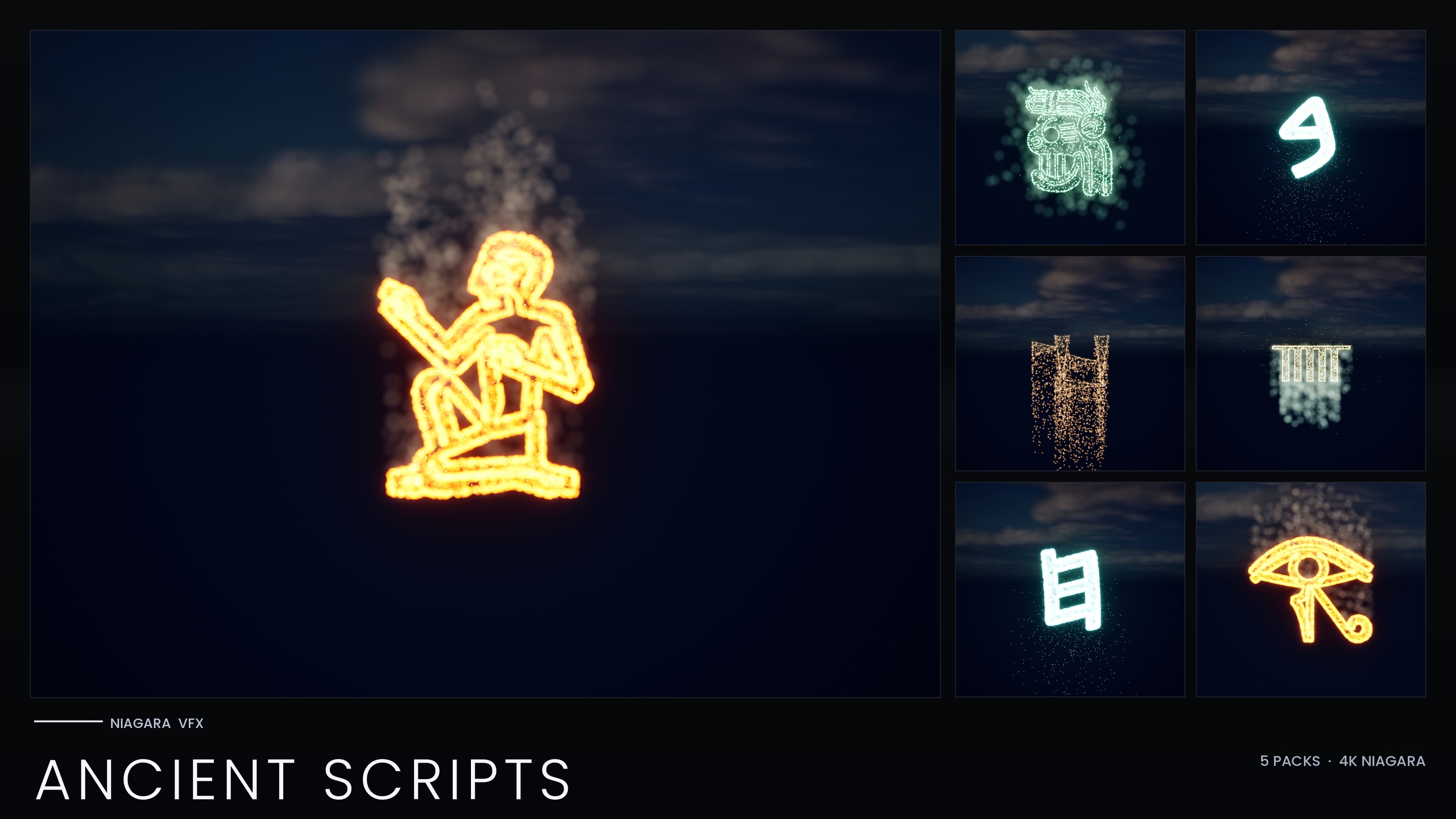
The 'Niagara Ancient Scripts Pack' is built around five real writing systems rather than invented symbols: Egyptian Hieroglyphics, Cuneiform (Mesopotamian wedge-writing), Mayan (Mesoamerican logo-syllabic glyphs), Ogham (early Irish stroke-marks) and Phoenician (the proto-alphabet). It ships 114 Niagara Systems and 114 matching static meshes, sourced from five fonts, so every glyph exists both as a spawnable effect and as a carve-able mesh. That dual delivery is the whole point: you place the static mesh to cut an inscription into a wall, then spawn the matching Niagara System on top of it when you want it to glow and breathe.
Each script shares one Niagara backbone and reads its look from a Niagara Parameter Collection, so a single edit recolours and re-times the entire script. That is how you turn a tomb's warm amber burn into a curse-blue glow without editing every glyph in the script one at a time. The pack is CPU-simulated and uses engine-default materials with zero custom textures, which keeps the footprint low and the setup near-instant, but it does mean the glow relies on HDR colour driving bloom, so leave bloom enabled in your scene.
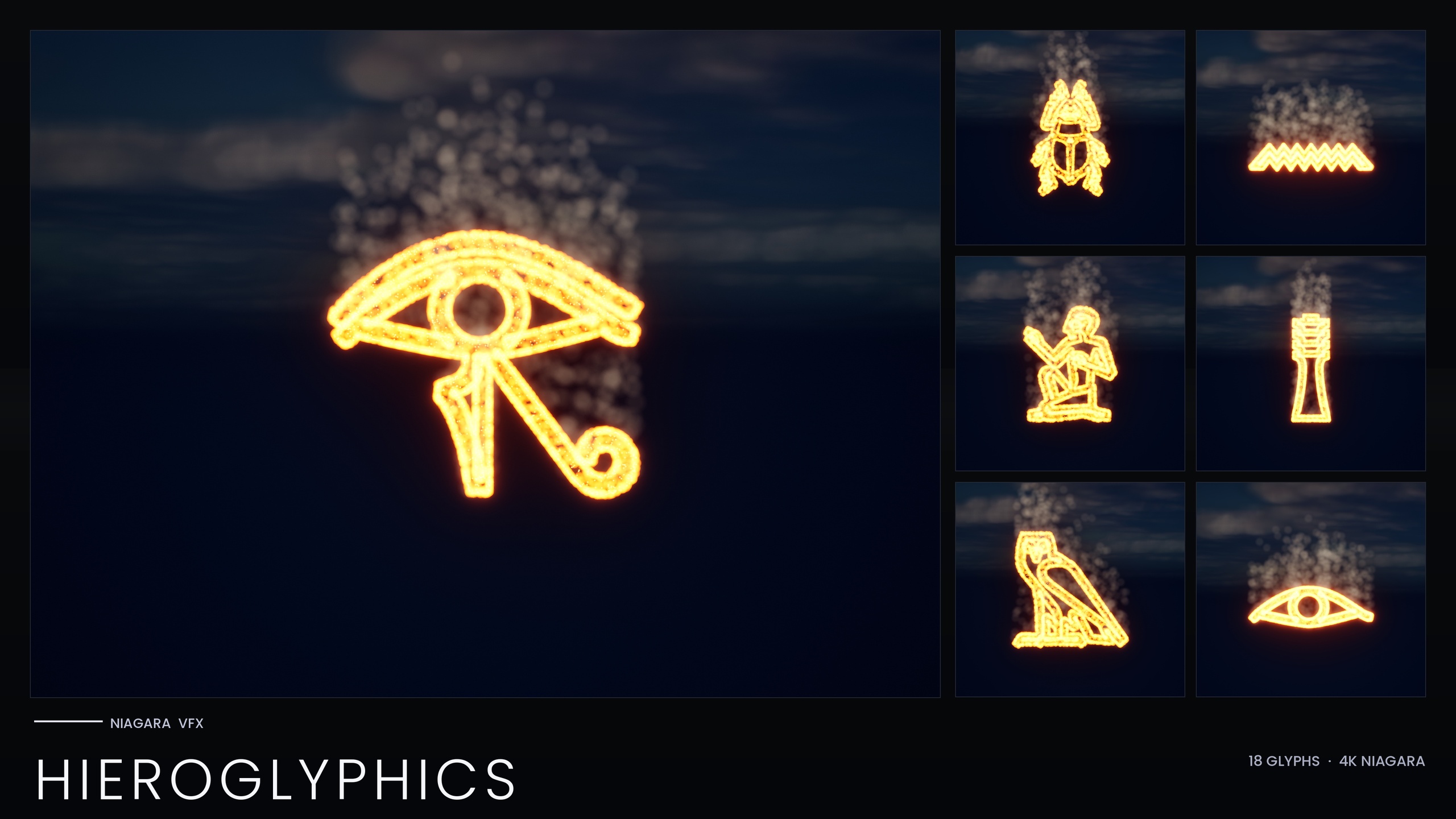
If you only need Egypt, the standalone 'Niagara Hieroglyphics Pack' is the smallest entry point: 18 Egyptian hieroglyph systems and 18 meshes, each built from three emitters, a hot HDR ember core, a red-orange glow halo and a slow ambient smoke column, all driven by a single Parameter Collection (NPC_HieroglyphicsStyle) with eight parameters for colour, size and spawn rates. The smoke emitter wafts a thin dust column upward, which reads beautifully in a still tomb. Note that the Parameter Collection must exist at import for the linked parameters to resolve.
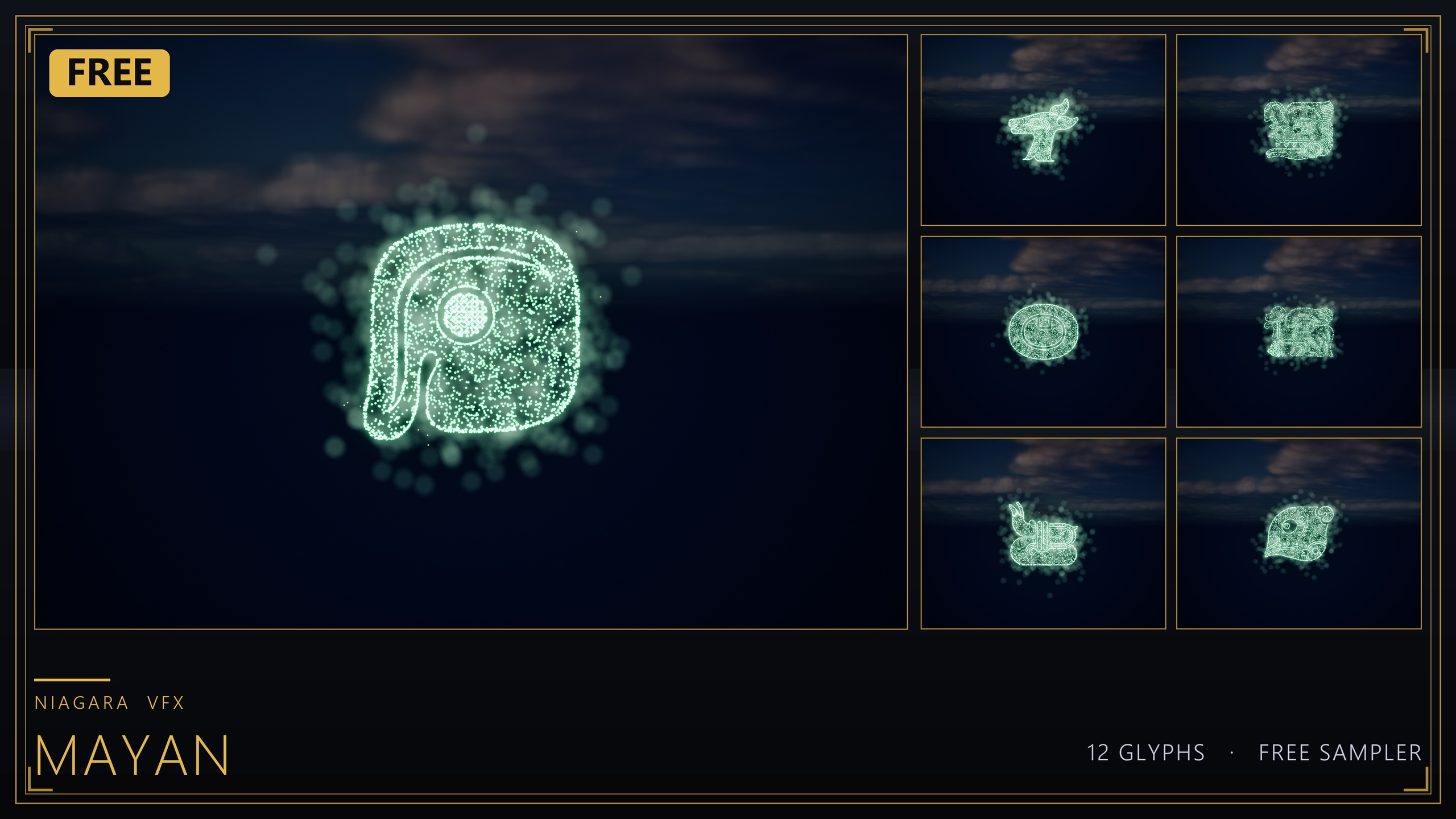
For Mesoamerica there is a free on-ramp. The 'Niagara Mayan Glyphs' sampler is twelve Maya glyphs as spawnable CPU systems with matching meshes and a ready demo map (L_Demo_Mayan), cleared for commercial use under the standard Fab licence. It is a hand-picked subset of the full 26-glyph Mayan set, so treat it as a sampler rather than a complete script: it is the cheapest way to prototype a jungle-temple reveal before committing to the full Ancient Scripts bundle.
Temple and tomb props
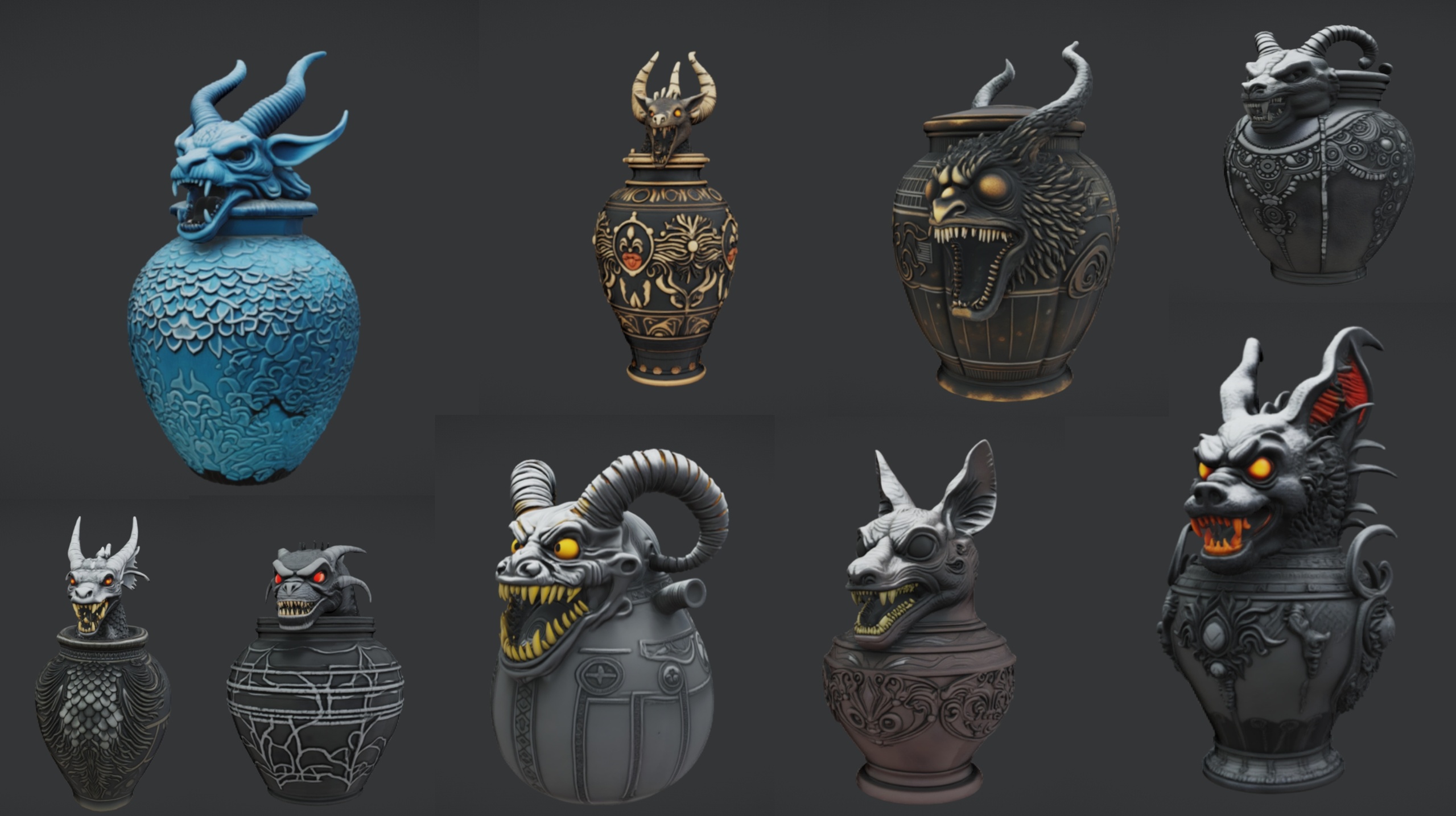
Glyphs need somewhere to live, and the camera needs a focal object. 'Ritual Jars' is a set of nine ornate canopic-style jars (SM_RitualJar_1 to 9) with an Egyptian, gothic and abyssal aesthetic, plus a large table prop (SM_LargeTable) for a ten-mesh total and a grass material for the demo ground. The jars are Nanite static meshes with automatic collision and 2K PBR textures, authored in Unreal Engine 5.7. The intended move is to arrange jars on the table to build an altar, then frame your inscriptions behind them.
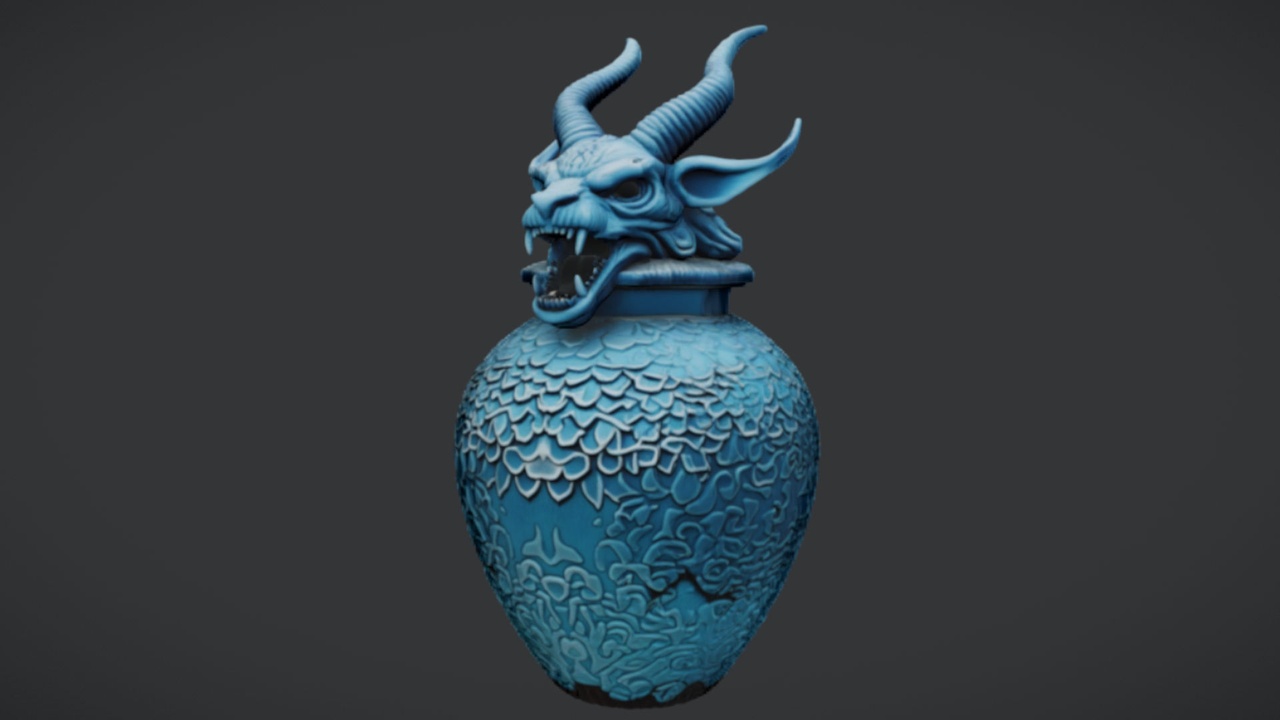
For a single hero accent, 'The Azure Gargoyle Urn' is a free funerary vessel: one ornate, azure-toned gothic urn as a drop-in UE5 static mesh with 2K PBR textures. It is a single mesh rather than a pack, so use it as the one object a player walks up to, a urn on a plinth at the end of a passage, with carved glyphs igniting on the wall beside it.
A note on engine versions, because it matters for migration. The script packs are authored in UE5.4 with their product listings citing UE 5.4 to 5.7, while 'Ritual Jars' is authored specifically in UE 5.7. If you are assembling everything in one project, target 5.7 to avoid a version-upgrade prompt on the jars, and migrate the script content in. Triangle counts and whether the jar lids open were not verified, so treat the jars as solid decorative meshes and do not promise interactivity you have not built.
Torch-lit reveals and discovery moments
The signature ancient-world beat is the inscription that comes alive as light reaches it. Because each glyph is an independent spawnable system, you can sequence a reveal rather than fade in a whole wall at once.
1. Place the static meshes first. Carve your inscription into the wall using the SM_Glyph_ meshes (or the Mayan meshes in Meshes/Mayan), arranged into a real word or cartouche, and give them an emissive material so they read even when unlit.
2. Author the reveal trigger. Attach the matching NS_ Niagara System to each glyph location, kept dormant, and drive activation from a trigger volume tied to the player's torch or a timeline so glyphs ignite in reading order rather than all at once.
3. Tune the mood from one asset. Open the script's Niagara Parameter Collection and set the ember, glow and smoke colours, sizes and spawn rates; the entire script retimes together. Pin an individual glyph with a per-glyph override only where you want a single character to behave differently, such as the keystone of a puzzle.
4. Keep bloom honest. The glow comes from HDR colour, so keep bloom enabled but keep HDR values modest, especially on the free Mayan sampler, so the colour tints the bloom rather than blowing the glyph out to white.
5. Reward the walk-up. End the passage on a prop, an altar of 'Ritual Jars' or the single 'Azure Gargoyle Urn', with the brightest, slowest glyph above it, so the player's eye lands on a real object the moment the inscription finishes lighting.
Putting a level together
A coherent ancient level is fewer assets used deliberately, not more assets scattered widely. A workable recipe: open a UE 5.7 project so the jars import cleanly, migrate in the script content, and build one strong inscription per room from the static-mesh glyphs. Use one script per culture for honesty, hieroglyphics in the Egyptian wing, Mayan in the Mesoamerican chamber, and only mix scripts deliberately when you are staging a trade-route or comparative-archaeology scene.
Manage your particle load the way the packs themselves do. The Ancient Scripts bundle splits its demo content across five maps, one per script, specifically to keep per-map GPU and RAM load manageable during preview; follow that instinct in production by keeping live Niagara glyphs to the inscription the player is actually near, and leaving distant walls as lit static meshes only.
Then dress the focal points. Arrange canopic jars on the table to form an altar, set the free urn as a lone accent at a passage end, and let the carved wall behind them carry the lore. Because the glyphs are real scripts and the props share an Egyptian-gothic-abyssal aesthetic, the room reads as one place rather than a kit of parts. Start free if you are still prototyping with the 'Niagara Mayan Glyphs' sampler and 'The Azure Gargoyle Urn', then step into the full 'Niagara Ancient Scripts Pack' for all five cultures and add 'Ritual Jars' for the altar.
Ancient world-building packs at a glance
| Pack | Type | Contents | Price | Engine |
|---|---|---|---|---|
| Niagara Ancient Scripts Pack | VFX (Niagara) | 114 systems + 114 meshes across 5 scripts | Paid | UE 5.4-5.7 |
| Niagara Hieroglyphics Pack | VFX (Niagara) | 18 Egyptian hieroglyph systems + 18 meshes | Paid | UE 5.4-5.7 |
| Niagara Mayan Glyphs | VFX (Niagara) | 12 Maya glyph systems + 12 meshes (free sampler) | Free | UE 5.4-5.7 |
| Ritual Jars | Props (3D) | 9 canopic jars + table, Nanite, 2K PBR | 7.99 USD | UE 5.7 |
| The Azure Gargoyle Urn | Prop (3D) | Single gargoyle urn, 2K PBR | Free | UE5 |
Counts and engine versions are from each product's listing. Script packs are CPU Niagara with engine-default materials; prop packs are static meshes with 2K PBR textures.
FAQ
What is the best way to do Egyptian and Mayan ancient world building in Unreal Engine?
Compose inscriptions from real scripts rather than reusing one stock glyph. The Niagara Ancient Scripts Pack ships every Egyptian, Mayan, Cuneiform, Ogham and Phoenician glyph as both a spawnable Niagara System and a carve-able static mesh, so you place the mesh to carve a wall and spawn the matching effect to make it glow. Pair that with funerary props like Ritual Jars and the Azure Gargoyle Urn to give the camera a focal object.
Are the scripts authentic or invented fantasy symbols?
Authentic. The pack is built from five real source fonts covering Egyptian Hieroglyphics, Cuneiform, Mayan, Ogham and Phoenician, so you can spell real words and cartouches rather than scatter decorative runes.
Can I recolour a whole inscription at once, for example from amber to a curse-blue glow?
Yes. Each script shares one Niagara backbone and reads its style from a Niagara Parameter Collection, so editing that single asset recolours and re-times the entire script. You can still pin one glyph with a per-glyph override where a single character needs to behave differently. The glow is driven by HDR colour, so keep bloom enabled.
Is there a free way to try this before buying?
Yes. The Niagara Mayan Glyphs sampler (12 of the 26 Mayan glyphs) and The Azure Gargoyle Urn are both free under the standard Fab licence, so you can build the full carve-then-ignite reveal loop at no cost before stepping up to the full Ancient Scripts Pack and Ritual Jars.
Which engine version should I target if I use the scripts and the jars together?
Target UE 5.7. The script packs list UE 5.4 to 5.7, while Ritual Jars is authored specifically in UE 5.7, so opening the jars in an older engine can trigger a version-upgrade prompt. Working in 5.7 and migrating the script content in avoids that.
Niagara Ancient Scripts Pack
114 Niagara glyph systems across five ancient scripts — Cuneiform, Hieroglyphics, Mayan, Ogham and Phoenician — for rituals, spells and mystical UI. CPU-simulated with a Parameter Collection and demo map.
Related on Fab
Related reading